📊 Full opportunity report: Backyard Homes In Focus: Proptech, Permits, And Property on IdeaNavigator AI — validation score, market gap, and execution plan.

Get business pricing on tech for your team
- Business-only prices and quantity discounts
- Tax-exempt purchasing
- Multiple users, one account, clear invoices
TL;DR
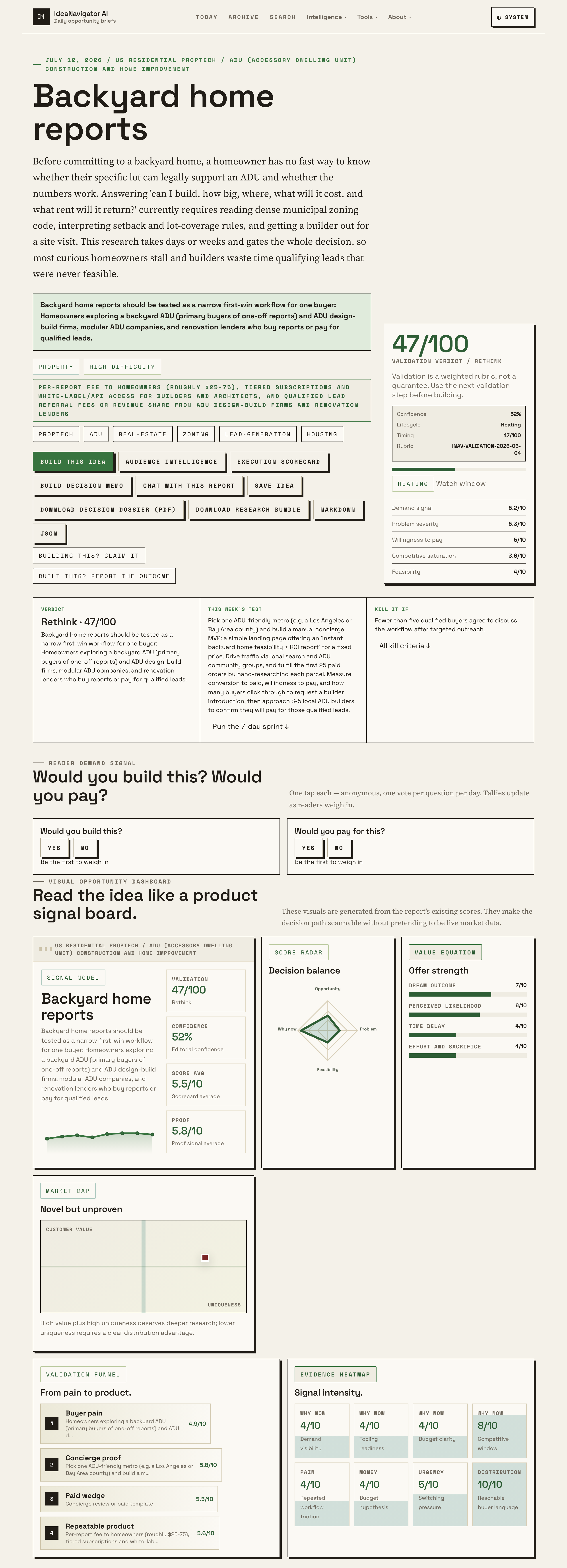
A market analysis by IdeaNavigator AI identifies instant backyard home (ADU) feasibility reports as a practical early product for residential proptech, targeting homeowners who want to know if their lot can legally support an ADU and whether the numbers work. The analysis cites surging ADU permitting in California and mature parcel data as reasons the timing is now favorable.
A new analysis from IdeaNavigator AI argues that instant backyard home feasibility reports — per-address PDF documents that tell homeowners whether their lot can legally support an accessory dwelling unit (ADU) and roughly what it would cost and earn — represent one of the most practical entry points in residential proptech today. The analysis frames the product as a “narrow first-win workflow” aimed at homeowners stalled at the earliest, most information-heavy stage of the ADU decision, and at the builders and lenders who need those homeowners as qualified leads.
The core problem the analysis identifies is pre-purchase uncertainty. Before committing to a backyard home, a homeowner has no fast way to answer the questions that gate the entire decision: can I build, how big, where on the lot, what will it cost, and what rent will it return? Answering them today requires reading dense municipal zoning code, interpreting setback and lot-coverage rules, and scheduling a builder site visit — a research process that takes days or weeks. According to the analysis, most curious homeowners stall at this stage, and builders waste time qualifying leads that were never feasible to begin with.
The proposed product is a web app where a homeowner enters a property address and pays roughly $25 to $75 for a homeowner-ready PDF report. The system would ingest county parcel data — lot boundaries, lot size, existing footprint — and evaluate the lot against state ADU law plus a manually curated rule set for one launch market, such as a few California counties. Each report would cover allowed ADU types, maximum size, setback and lot-coverage constraints, a buildable-area estimate, a realistic build-cost band, and projected rental income drawn from local rent comps.
Revenue would come from three streams, according to the analysis: per-report fees from homeowners, tiered subscriptions and white-label or API access for builders and architects, and qualified lead referral fees or revenue share from ADU design-build firms and renovation lenders. A “connect me with a vetted ADU builder” button would capture the lead-generation revenue.
Why ADU Reports Fit the Moment
The analysis rests on a genuine market shift. California legalized ADUs statewide in 2016 and has loosened rules nearly every year since, and other states and cities are following. Permitting has surged: Los Angeles County alone permitted over 45,000 ADUs in 2023, and ADUs now represent roughly one in five new housing units produced in California, according to the analysis. A persistent US housing shortage estimated in the millions of units continues to push policymakers toward legalizing denser infill construction on single-family lots.
For readers, the significance is twofold. First, homeowners curious about a backyard home currently face a research burden that the analysis says stalls most projects before they start — a paid report that compresses weeks of zoning research into minutes would change the economics of simply finding out. Second, the analysis argues that two enabling conditions have only recently matured: widespread access to parcel and zoning data, and large language model–based parsing of zoning code, which together make instant per-address feasibility reports newly practical rather than a manual consulting engagement.
Top picks for "backyard focu proptech"
As an affiliate, we earn on qualifying purchases.
The Regulatory Wave Behind Backyard Homes
Accessory dwelling units — small secondary homes on the same lot as a primary residence, variously called granny flats, in-law units, or backyard homes — sat in a legal gray zone in much of the United States for decades. California’s 2016 statewide ADU legislation changed that by overriding many local restrictions, and subsequent legislative sessions have progressively loosened rules on size, parking, and owner-occupancy requirements. As the analysis notes, the pattern has spread: other states and cities have adopted similar legalization frameworks, expanding the addressable market beyond California.
The analysis positions its proposed product at the intersection of that regulatory wave and the proptech industry’s broader move toward data-driven feasibility tools. It deliberately recommends starting narrow: one metro, hand-curated zoning rules, and a manually fulfilled first batch of orders — a validation approach associated with early-stage product development, in which the workflow is proven before automation is built.
Unproven Demand and Pricing Questions
The analysis is a product hypothesis, not a launch announcement. No company building this exact product is named, and it is not clear whether any existing proptech firm already offers comparable per-address ADU feasibility reports at the proposed $25–75 price point. The willingness of homeowners to pay that fee, and the conversion rate from report buyers to builder introductions, are both unmeasured assumptions in the analysis.
Several operational questions also remain open. Zoning rules vary not just by state but by county and city, so hand-curating even one launch market carries accuracy risk — a report that misstates a setback or lot-coverage constraint could mislead a homeowner into a false go or no-go decision. The analysis does not address how reports would handle edge cases such as irregular lots, hillside ordinances, or utility connection constraints, nor how build-cost bands would stay current amid construction-cost volatility. Whether ADU builders will actually pay for qualified leads, and at what rate, is likewise presented as something to confirm rather than a known fact.
The Recommended Validation Path
The analysis lays out a specific validation sequence. First, pick one ADU-friendly metro — the analysis suggests a Los Angeles or Bay Area county — and build a manual “concierge” version: a simple landing page offering an instant backyard home feasibility and ROI report at a fixed price. Second, drive traffic through local search and ADU community groups. Third, fulfill the first 25 paid orders by hand-researching each parcel, measuring conversion to payment, willingness to pay, and how many buyers click through to request a builder introduction. Only after that data exists, the analysis recommends approaching three to five local ADU builders to confirm they will pay for those qualified leads.
If the validation succeeds, the analysis’s implied next milestones are automating the parcel-data and rule-matching pipeline, expanding from the launch county to additional jurisdictions, and layering in the subscription, API, and lead-generation revenue streams. Whether any builder or entrepreneur acts on the recommendation — and what the first 25 hand-researched orders reveal about real demand — remains to be seen.
Source: IdeaNavigator AI
Key Questions
What is a backyard home feasibility report?
According to the IdeaNavigator AI analysis, it is a per-address document that tells a homeowner whether their lot can legally support an ADU, the maximum allowed size, setback and lot-coverage constraints, a buildable-area estimate, a build-cost band, and projected rental income from local rent comps.
How much would a report cost?
The analysis proposes a per-report fee of roughly $25 to $75 for homeowners, with additional revenue from builder subscriptions, white-label or API access, and qualified lead referral fees.
Why is California the suggested launch market?
California legalized ADUs statewide in 2016 and has loosened rules nearly every year since. The analysis cites Los Angeles County permitting over 45,000 ADUs in 2023 and ADUs representing roughly one in five new housing units produced in California.
Does this product exist yet?
The analysis is a product recommendation, not a launch announcement. It proposes a validation plan — fulfilling the first 25 paid orders by hand in one metro — before any automated product is built. No company building the exact product is named.
Who would buy these reports besides homeowners?
The analysis identifies ADU design-build firms, modular ADU companies, and renovation lenders as secondary buyers, either purchasing reports directly, paying for tiered subscriptions or white-label access, or compensating for qualified leads generated when report buyers request builder introductions.
Source: IdeaNavigator AI
Fall Picks
fall essentials
As an affiliate, we earn on qualifying purchases.