TL;DR
In a Nov. 25, 2026 article, Thorsten Meyer describes replacing several software subscriptions with custom tools built using Claude Code and Codex. He says the tools can work together through written guides and software interfaces, while acknowledging that maintenance, security, review and reliance on two AI companies are costs of the approach.
Thorsten Meyer says he has replaced rented tools for web analytics, project tracking, PDFs and video recording with software he built using Claude Code and OpenAI Codex. In an article published Nov. 25, he describes linking the tools so software agents can pass work between them, a model he says cuts his software bills while shifting responsibility for upkeep and security onto him.

Get business pricing on tech for your team
- Business-only prices and quantity discounts
- Tax-exempt purchasing
- Multiple users, one account, clear invoices
Meyer says he pays for several subscriptions to Claude and Codex, whose AI coding agents he uses to build tools for his business. He describes giving an agent a task in plain language, then having it inspect a project, write code, run tests and report back. He says he sets the goals and reviews the results. His account reflects his own practice; it does not provide an independent comparison of the tools’ cost or performance.
The article describes a workflow for producing a video and accompanying article. A project tracker holds the job and its rules; tools provide their own guides, transcribe reference videos, create a PDF, supply 3D models, publish the finished video and check readership analytics. Meyer says the steps moved through seven tools without a person clicking between them, while people set the goal and check the result.
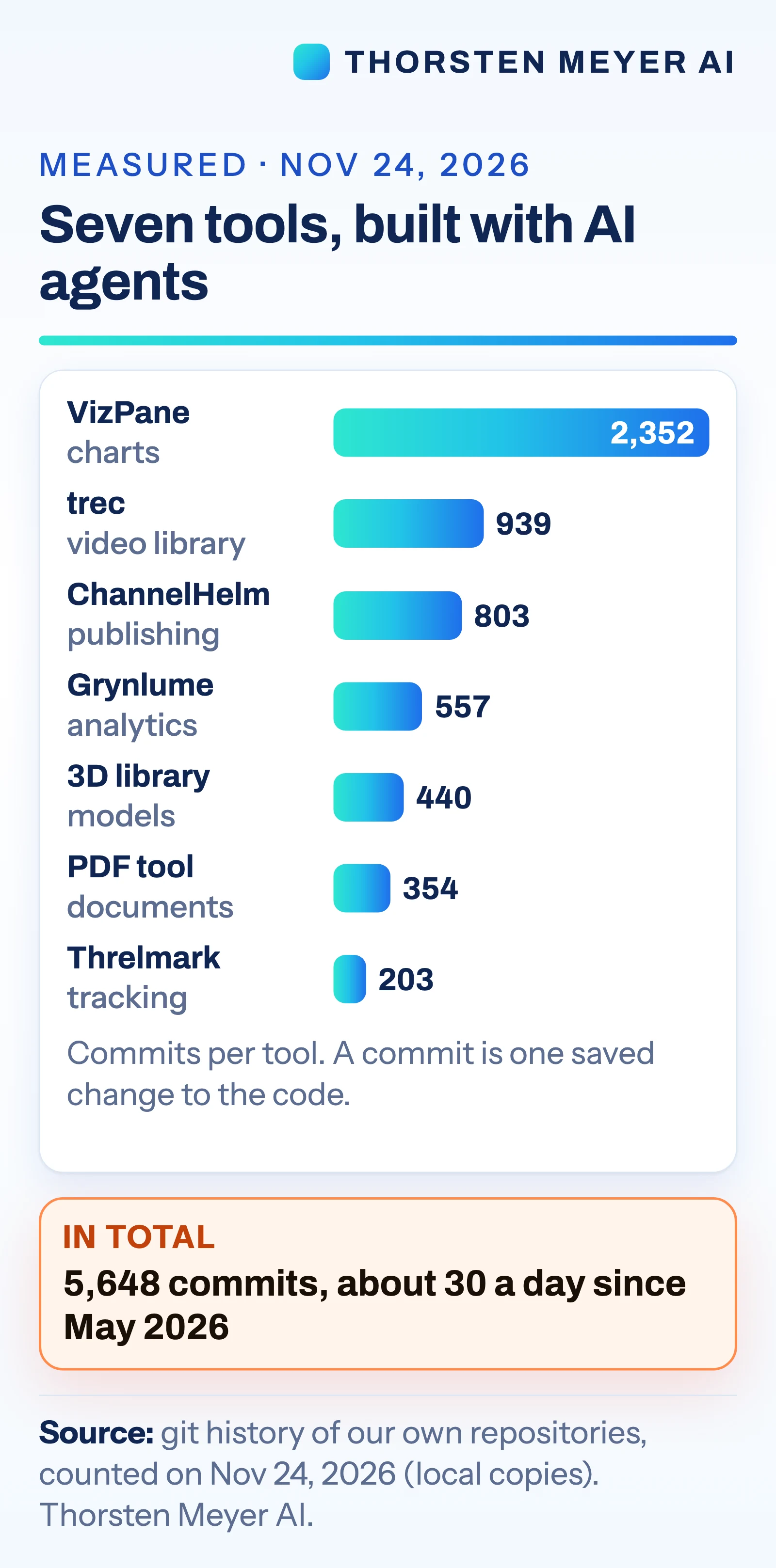
As a measure of the codebase, Meyer reports that seven tools in his repositories had 5,648 commits and 2,128 test files as of Nov. 24, 2026. Those are figures from his own repositories. The article does not give a comparison baseline or explain how much of the code or testing was generated by agents.
Custom Tools Shift Work to Owners
Meyer’s account illustrates one way small businesses and solo workers might tailor software to their own workflows as AI coding agents become available. A business can build a narrow tool for its own needs rather than adapt its processes to a general-purpose service. The account does not establish that this is cheaper or more dependable for businesses generally.
The tradeoff is a shift in responsibility. Meyer says maintenance, security and review are now his job, and that he relies heavily on Anthropic and OpenAI. For software vendors, he argues that reliability, support, security and compatibility with agents may matter more as some customers build simpler tools themselves. That is his assessment, not a measured forecast.
Products Worth Considering

Apple Watch Series 12 GPS 42mm Smartwatch

Apple MacBook Air 13-inch with M5 chip, 16GB Memory, 1TB SSD, Starlight

Amazon Kindle Scribe Colorsoft 64GB with Premium Pen
As an affiliate, we earn on qualifying purchases.
From Software Rentals to Agents
Meyer frames the change against the common subscription model known as software as a service, in which users access applications running on a provider’s cloud infrastructure. He cites the U.S. National Institute of Standards and Technology’s definition in Special Publication 800-145: users generally do not manage the underlying servers, storage or individual application capabilities, though some settings may be available.
In Meyer’s description, AI coding agents change who can create a specialized application. Rather than relying only on tools designed around human users clicking through screens, he builds applications that agents can also use. He says agents need a readable guide explaining a tool and a standard interface through which to interact with it. He cites Jeremy Howard’s proposal for a guide file, but the supplied article text does not include the full explanation or identify the interfaces used by each tool.
““The scarce part is no longer the code. It is knowing exactly what you need, and checking that you got it.””
— Thorsten Meyer
Costs and Reliability Remain Unmeasured
The article does not quantify the total cost of building and maintaining the tools, compare it with the subscriptions they replaced, or report time saved. It also does not provide an independent security review, reliability data or details of how the reported test files were counted. Meyer acknowledges maintenance, security and review as responsibilities, but gives no estimate of the work they require. The extent to which this approach works for other businesses remains unclear.
Meyer’s Fleet in Daily Use
Meyer presents the article as a written companion to a video explaining his workflow, and describes using the fleet to produce and publish that material. The article does not announce a product launch, release schedule or outside evaluation. The next evidence of how the approach performs would come from further details on operating costs, upkeep, security and whether the connected workflow remains dependable as his tools change.
Key Questions
Which software services does Meyer say he replaced?
He says his web analytics, project tracking, PDF and video recording tools now run on tools he owns. He does not list the former providers or give a subscription-by-subscription cost comparison.
Which AI coding agents does he use?
Meyer says he uses Claude Code from Anthropic and Codex from OpenAI, paying for several subscriptions. He does not state the total subscription cost.
How do the tools work together?
Meyer says each tool has a readable guide and a standard interface that lets agents find out what it does and use it. He describes a job moving through seven tools, from project tracking to analytics, without a person clicking between steps.
What costs or risks does Meyer identify?
He says maintenance, security and reviewing agent-built work are his responsibility. He also says he is heavily dependent on Anthropic and OpenAI. He does not quantify those costs or report an independent security assessment.
Source: Thorsten Meyer AI