TL;DR
A November 23 explainer from Thorsten Meyer AI describes how diffusion models create images by learning to remove noise in stages, guided by a text prompt. It also outlines limits in image generation and summarizes a 2025 UK court ruling on Stable Diffusion, while noting that other legal questions remain open.
Thorsten Meyer AI published an explainer on November 23 describing how diffusion models turn random noise into images by removing it over a series of steps, with a text prompt steering the process. The report also explains why these systems can struggle with details such as lettering and object placement, and summarizes a 2025 UK court finding about Stable Diffusion.

Get business pricing on tech for your team
- Business-only prices and quantity discounts
- Tax-exempt purchasing
- Multiple users, one account, clear invoices
The explainer says a diffusion model learns from training images that have been progressively mixed with noise. A neural network is trained to estimate the noise added at each stage. When generating an image, the model starts with noise and repeatedly removes an estimated portion, producing broad forms before finer details. The article draws on the 2020 research paper “Denoising Diffusion Probabilistic Models,” by Jonathan Ho, Ajay Jain and Pieter Abbeel.
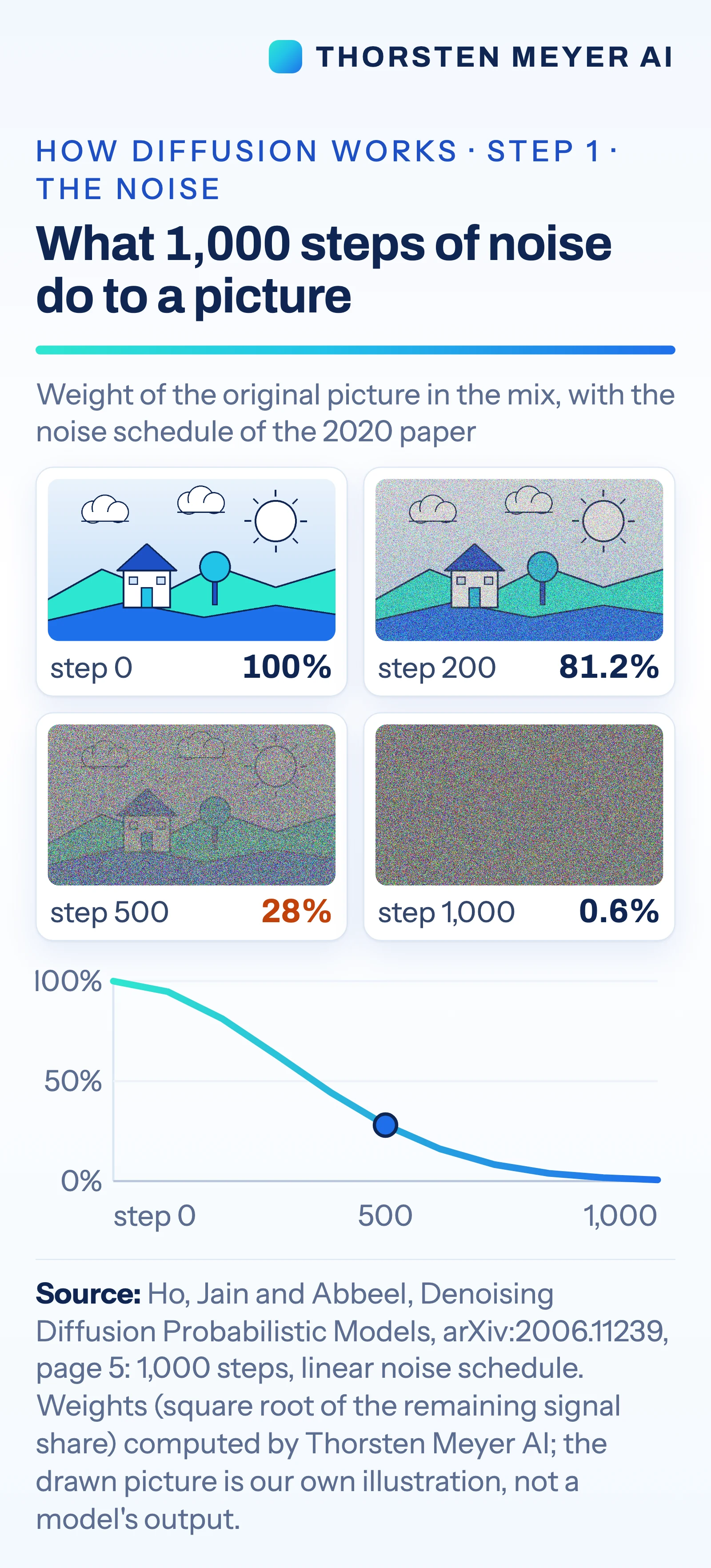
In that paper, the researchers used 1,000 noise steps in their experiments. The explainer contrasts that training setup with a 50-step default in a widely used open-source pipeline, citing Hugging Face diffusers documentation. These figures describe particular methods and defaults; they are not a universal step count for every image model or generation.
The report also describes latent diffusion, in which image processing takes place in a compressed representation. It says a 512 × 512 image in Stable Diffusion v1 becomes a representation with 48 times fewer numbers. A text encoder converts a prompt into numbers, while a guidance method steers generation toward the prompt. The article says stronger guidance can bring the result closer to the text while costing some image quality.
Why Noise Shapes the Final Image
The stepwise process helps explain both how a prompt can influence an image and why some instructions are difficult for a model to follow. The prompt guides the model through successive estimates; it does not give the system a direct, explicit plan for counting objects or placing one object precisely on another. The explainer connects that design to familiar errors such as garbled lettering, incorrect object relationships and inconsistent counts.
The report also raises a question beyond image quality: whether generated outputs may reproduce parts of training images. It says researchers have extracted near-copies of training images from models. That finding describes a documented technical concern, but it does not by itself establish that any particular output was copied or that a specific use violates copyright law.
For readers, the distinction matters because image generation is often presented as a direct translation of words into pictures. The explainer instead describes a sequence of learned estimates, shaped by both the prompt and the model’s training. That account can help readers understand why results vary and why a plausible image is not proof that the system followed every instruction accurately.
Products Worth Considering

Samsung 49-Inch Odyssey G93SC QD-OLED Curved Gaming Monitor

Kindle Paperwhite Signature Edition Bundle, 32GB, Jade, with Plant-Based Leather Cover and Wireless Charging Dock

Samsung Odyssey G3 G30D 27-Inch FHD Gaming Monitor
As an affiliate, we earn on qualifying purchases.
From Early Diffusion to Image Tools
The explainer traces the idea to a 2015 paper by Jascha Sohl-Dickstein and colleagues. Their approach described gradually destroying structure in data and then learning a reverse process to restore it. The analogy in the article is ink dispersing through water: a recognizable pattern fades as it spreads, and the model learns how to reverse the gradual change.
The 2020 paper by Ho, Jain and Abbeel helped make this approach practical for image generation. It describes a forward process that adds noise over many steps and a learned reverse process that removes it. In the explainer’s account of that paper’s schedule, the original image contributes a diminishing share of the signal: 81.2% after 200 steps, 28% after 500, and 0.6% after 1,000. The article says these weights were calculated for its illustration; they are not measurements of a newly tested image model.
The report focuses on image diffusion and borrows only two concepts from language-model systems: a text encoder and attention. It presents the article as part of an explainer series about how AI works, rather than as a report of a new model launch or research finding.
““Systematically and slowly destroy structure in a data distribution through an iterative forward diffusion process.””
— Jascha Sohl-Dickstein and colleagues, quoted from their 2015 paper
Limits and Copyright Questions Remain
The explainer does not identify a new experiment or quantify how often models produce errors in lettering, counting or object placement. It describes these as known limitations, but their frequency can vary by model, prompt and image. The article also does not specify the conditions under which its cited 50-step default applies beyond naming the diffusers documentation.
On copyright, the source says a UK court found in 2025 that Stable Diffusion itself is not an “infringing copy.” It does not provide the case name or detailed reasoning in the supplied material. The article says other questions remain open. The ruling, as summarized there, should not be read as resolving every legal dispute involving training data, generated images or their use.
The supplied source cuts off during its discussion of training, so it does not provide the full account of later steps or additional evidence that may appear in the complete article. No new court ruling, model release or independently verified technical test is reported here.
What Readers Can Check Next
The next step for readers seeking the technical basis is to consult Ho, Jain and Abbeel’s 2020 paper, identified in the explainer as arXiv:2006.11239, alongside the cited Hugging Face diffusers documentation. Those sources can clarify which training setup and generation defaults the article is describing. The article also points readers to a separate explainer on neural networks and another on large language models for background on the systems it references.
On legal questions, the source does not give a date for another hearing or decision. It says some questions remain open, but supplies no specific upcoming milestone. Further legal developments and technical studies of image reproduction would be needed to clarify how broadly the concerns apply.
Key Questions
Does an image model retrieve a matching photograph?
The explainer describes diffusion generation as starting from noise and progressively removing it under the influence of a prompt. It does not describe the process as searching for a matching photograph.
How many steps does image generation take?
It depends on the method and settings. The source says the 2020 paper used 1,000 steps in its experiments and cites a 50-step default in a widely used open-source pipeline. Those numbers do not apply to every model.
Why can models get words or object positions wrong?
The article says lettering, counting and placing objects are difficult for these systems. In its account, a model uses repeated estimates guided by prompt information, which can leave details or relationships inaccurate.
Did a UK court settle copyright questions about Stable Diffusion?
The supplied source says a UK court found in 2025 that Stable Diffusion itself is not an “infringing copy.” It also says other questions remain open, so the ruling does not settle every copyright issue described in the article.
Source: Thorsten Meyer AI