
📊 Full opportunity report: How AI Is Changing Note-Taking: 11 Apps To Use In 2026 on ThorstenMeyerAI.com — validation score, market gap, and execution plan.

Get business pricing on tech for your team
- Business-only prices and quantity discounts
- Tax-exempt purchasing
- Multiple users, one account, clear invoices
TL;DR
AI is significantly changing note-taking in 2026 by offering advanced transcription, handwriting recognition, and smart organization. This article reviews 11 leading apps and devices shaping the future of note management.
AI-powered note-taking applications are transforming how users capture, organize, and access information in 2026. Leading tools like iFLYTEK AINOTE Air 2 and Plaud Note AI now combine voice recognition, handwriting, and smart summarization, offering users more efficient workflows. For a comprehensive overview, see the original analysis. This development is reshaping productivity for students, professionals, and researchers.
The iFLYTEK AINOTE Air 2 remains a top choice for its versatile AI paper tablet with excellent transcription and e-ink handwriting support. Plaud Note AI is favored for quick voice transcription, especially in meetings and lectures. Many apps now support multi-language transcription, speaker differentiation, and integration with cloud services, enhancing overall usability. However, device compatibility and learning curves remain considerations for users adopting these tools. Experts note that AI note apps are increasingly blending voice, handwriting, and text input, making note-taking more adaptive and accessible than ever before. Learn more about these trends in this guide.
The 11 picks
- 1
 iFLYTEK AINOTE 2 Paper Tablet, 10.65" Electronic Notebook with Pen, Powered b…View on Amazon →
 - 2
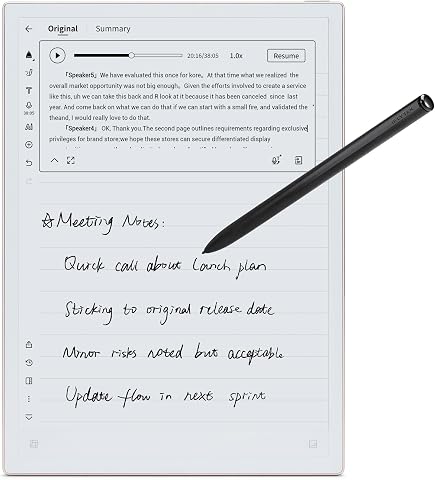 iFLYTEK AINOTE 2 AI Digital Notebook, 10.65" E-Ink Tablet with AI Assistant a…View on Amazon →
 - 3
 iFLYTEK AINOTE Air 2 Bundle with Black Folio Case, 8.2-inch AI Paper Tablet f…View on Amazon →
 - 4
 AINOTE Air 2 8.2" AI E Ink Tablet with Stylus and Adjustable LightView on Amazon →
 - 5
 Plaud Note Pro AI Voice Recorder Transcribe & Summarize for Meetings Calls, U…View on Amazon →
 - 6
 Plaud Note AI Voice Recorder Transcribe & Summarize, Black, Non-Pro VersionView on Amazon →
 - 7
 Pocket AI Voice Recorder with Auto Transcription and AI Note TakerView on Amazon →
 - 8
 Comulytic Note Pro AI Voice Recorder, Meeting Recorder & Note TakerView on Amazon →
 - 9
 Comulytic Note Pro AI Voice Recorder, AI Taking Device and Meeting Recorder w…View on Amazon →
 - 10
 AI Voice Recorder with Transcription & Summarization, 64GB, 100H Battery, App…View on Amazon →
 - 11
 128GB AI Voice Recorder with Transcription and Noise CancellationView on Amazon →
Impact of AI on Productivity and Workflow Efficiency
The integration of AI into note-taking tools in 2026 offers substantial productivity gains, enabling faster transcription, better organization, and seamless access across devices. These advancements benefit students, professionals, and researchers by reducing manual effort and improving information retention. As AI continues to evolve, these tools may further automate note summarization and keyword extraction, streamlining workflows even more. The shift toward AI-enhanced note management could redefine productivity standards in academic and corporate environments.
Rapid Evolution of AI-Enabled Note Apps in Recent Years
Over the past few years, AI-powered note apps have evolved from basic transcription tools to sophisticated platforms combining handwriting recognition, voice commands, and smart organization features. In 2024, apps like Otter.ai and Evernote integrated AI to improve search and summarization. The 2026 landscape now includes dedicated hardware like e-ink tablets and voice recorders optimized for AI features, reflecting a broader trend toward specialized, AI-enhanced productivity devices. This growth is driven by advances in natural language processing and machine learning, which continue to improve transcription accuracy and contextual understanding.
“Devices like the AINOTE Air 2 are setting new standards for handwriting recognition and transcription accuracy in 2026.”
— Jane Liu, tech industry expert
Remaining Challenges and Limitations of AI Note Apps
While AI note apps have advanced significantly, some issues remain. Transcription accuracy can still be affected by background noise or overlapping speech, especially in noisy environments. Compatibility across diverse devices and ecosystems can pose hurdles, and learning curves for advanced features may deter casual users. Additionally, concerns about data privacy and reliance on cloud services are ongoing debates. It is not yet clear how these challenges will be fully addressed as technology continues to evolve.
Future Developments and Expected Innovations in 2027
In the coming year, expect further improvements in AI transcription accuracy, especially in multi-speaker environments. New hardware optimized for AI note-taking, such as next-generation e-ink tablets and voice recorders, are likely to enter the market. Developers are also working on more seamless ecosystem integrations, enabling real-time collaboration and offline functionality. Enhanced privacy features and AI-driven automation, like automatic summarization and keyword tagging, are anticipated to become standard components of note apps in 2027.
Key Questions
Which AI note-taking app offers the best transcription accuracy in 2026?
According to industry reviews, iFLYTEK AINOTE Air 2 and Plaud Note AI are among the most accurate, particularly in multi-language and multi-speaker scenarios.
Can these apps handle handwritten notes effectively?
Yes, especially on devices like e-ink tablets such as the AINOTE Air 2, which are optimized for stylus input and handwriting recognition. Compatibility with other devices varies depending on the app.
Are AI note apps suitable for professional use in meetings?
Many apps support real-time voice transcription and speaker differentiation, making them suitable for meetings. However, background noise and overlapping speech can impact accuracy, so choosing the right app and device is important.
What should I consider when choosing an AI note app?
Key factors include transcription accuracy, input methods (voice, handwriting, text), device compatibility, ecosystem integration, ease of use, and privacy features. Evaluating these based on your workflow helps select the best fit.
Source: ThorstenMeyerAI.com
Columbus Day / Indigenous Peoples' Day Picks
long weekend sales
As an affiliate, we earn on qualifying purchases.