

TL;DR
Palo Alto Networks agreed on November 18, 2026, to acquire Applied Compute in an all-stock transaction valued at $4.5 billion, subject to adjustments. The deal would add tools for training and running open-weight AI models to Palo Alto’s security business, but it has not closed and the companies have not disclosed all financial or product details.
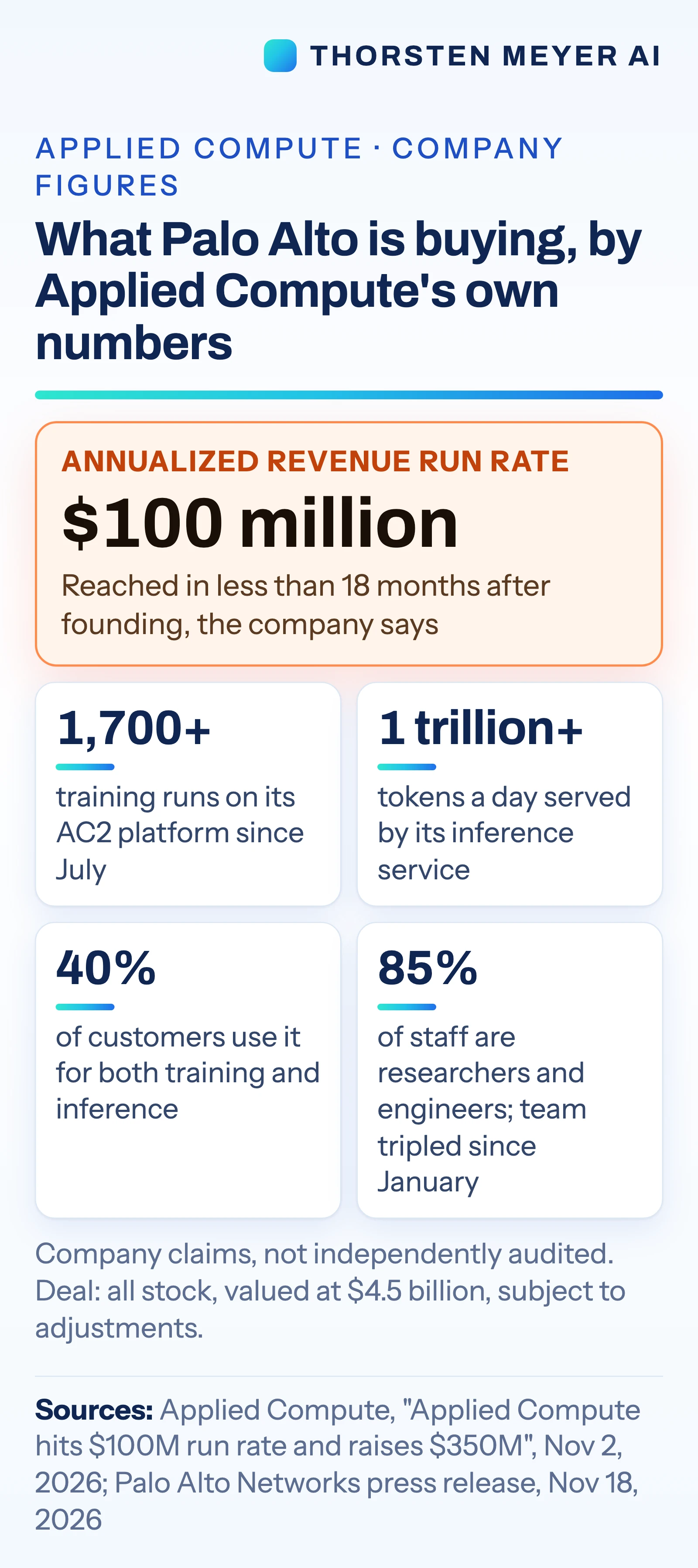
Palo Alto Networks said November 18 that it has agreed to acquire Applied Compute in an all-stock transaction valued at $4.5 billion, subject to adjustments. The cybersecurity company says the deal will add a platform for adapting and running open-weight AI models, extending its business closer to the systems enterprises use to build and operate AI.

Get business pricing on tech for your team
- Business-only prices and quantity discounts
- Tax-exempt purchasing
- Multiple users, one account, clear invoices
The agreement is definitive, but the acquisition is not yet complete. Palo Alto’s announcement says the transaction remains subject to customary closing conditions, including regulatory clearance. The company expects it to close in its fiscal third quarter of 2027, which it says runs from February through April 2027.
The payment will be made in Palo Alto shares rather than cash. The stated valuation is $4.5 billion, subject to adjustments; the announcement does not describe those adjustments. Palo Alto says Applied Compute’s team will join the company, and Applied Compute chief executive Yash Patil is to become a Co-Chief AI Officer after closing. The release does not identify who else would share that title.
Applied Compute provides technology for post-training and inference of open-weight models. Post-training adapts a model after its initial development, while inference is the process of using a model to produce outputs. Palo Alto says Applied Compute will continue serving AI-native companies, digital businesses and large enterprises, while Palo Alto plans to bring the platform to its global customer base. The announcement does not detail how the products will be integrated.
Palo Alto Moves Closer to AI Models
The agreement would take Palo Alto beyond monitoring and securing AI use toward offering infrastructure for training and operating models. That could give customers a way to buy AI platform and security services from one provider. Palo Alto’s press release argues that enterprises will increasingly use open-source and open-weight models and that large providers are not delivering those models securely. Those are the company’s strategic claims, not independently established market findings in the material available.
For business customers, the deal raises practical questions about vendor choice and control. Combining AI infrastructure with security services could simplify procurement, but it could also increase dependence on a single supplier. Organizations already using Applied Compute or Palo Alto may want to review contract provisions covering data handling, changes in ownership and exit rights. The announcement does not say whether existing service terms will change.
The transaction also signals how Palo Alto sees its future growth. On an earnings call reported by CNBC, chief executive Nikesh Arora said that, if the strategy works, the opportunity could dwarf the company’s cybersecurity business. That is an executive’s projection about potential, not a forecast supported in the announcement by revenue estimates or customer commitments.
Products Worth Considering

Apple AirPods Pro (2nd Generation) Wireless Earbuds with USB-C MagSafe Charging Case

Samsung 27-Inch Odyssey G5 QHD Gaming Monitor (G50F)

Bose QuietComfort Ultra Earbuds (2nd Gen), Wireless Noise-Cancelling Earbuds, White Smoke
As an affiliate, we earn on qualifying purchases.
Three AI Deals in 2026
The Applied Compute agreement follows two other AI-related moves by Palo Alto in 2026. The company said its acquisition of Portkey, an AI gateway for monitoring and governing traffic, closed on May 29. On September 1 it announced the acquisition of Console, an AI agent platform intended to help security teams automate alerts and fixes.
Together, the three deals point toward a broader set of AI products: tools that govern AI traffic, platforms that run agents, and technology for training and serving models. The sequence is relevant to the Applied Compute announcement because it shows Palo Alto pursuing multiple layers of the enterprise AI stack. It does not, by itself, establish how much revenue those products will produce or how quickly customers will adopt them.
Palo Alto announced the Applied Compute agreement on the same day as its quarterly results and said it would provide further transaction details on its earnings call. Its announcement describes the company as serving more than 70,000 customers; that is a company-provided figure. Applied Compute describes its own offering as an “AI superCloud for open models.”
““If it works, I think this will dwarf the ability that we have in cybersecurity.””
— Nikesh Arora, Palo Alto Networks chief executive, as quoted by CNBC
Price Adjustments and Integration Details
The companies have not explained what adjustments could affect the $4.5 billion valuation, or provided a fuller breakdown of the transaction terms in the supplied materials. Regulatory clearance remains outstanding, and the announcement does not identify which reviews are required or whether any conditions could change the expected timetable.
It is also unclear how Palo Alto will combine Applied Compute’s platform with its existing products, what customers will pay, or whether the acquisition will change data handling, service commitments or product availability. The announcement says Applied Compute will continue serving existing customer categories, but it gives no specific transition plan. No revenue forecast, adoption target or financial contribution from the acquisition is provided here.
Arora’s comments describe the possible scale of the opportunity, but the companies have not supplied evidence in the announcement showing that AI will become larger than Palo Alto’s cybersecurity business. The eventual results will depend on customer demand, execution and the deal’s completion.
Regulatory Review and Closing
Palo Alto expects the acquisition to close in its fiscal third quarter of 2027, covering February through April 2027, if regulatory clearance and other customary closing conditions are met. Until then, Applied Compute remains a separate company and the announced transaction remains pending.
Further company disclosures may clarify the valuation adjustments, regulatory process, product integration and customer arrangements. Customers and employees will also be watching for information about leadership, service terms and how the platform will fit into Palo Alto’s product lineup. The announcement does not give dates for those updates.
Key Questions
What did Palo Alto Networks agree to buy?
It agreed to acquire Applied Compute, whose platform supports post-training and inference of open-weight AI models.
How much is the acquisition worth?
Palo Alto valued the all-stock transaction at $4.5 billion, subject to adjustments. The announcement does not explain the adjustments.
Has the acquisition closed?
No. It remains subject to customary closing conditions, including regulatory clearance.
When does Palo Alto expect to complete the deal?
The company expects closing in its fiscal third quarter of 2027, which runs from February through April 2027.
What will happen to Applied Compute’s customers?
Palo Alto says Applied Compute will continue serving AI-native companies, digital businesses and large enterprises. The announcement does not provide detailed plans for contracts, data handling or product integration.
Source: Thorsten Meyer AI