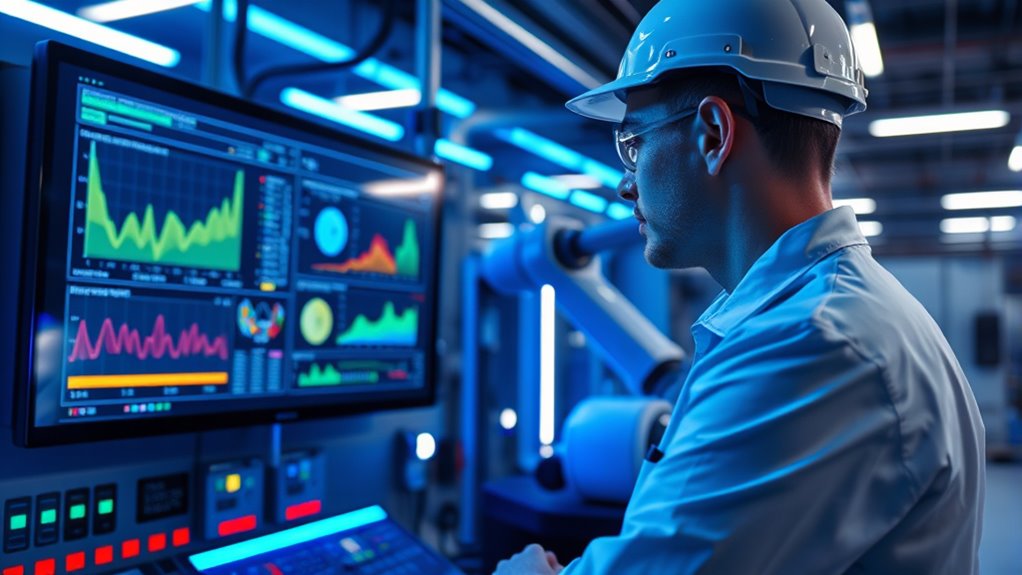

Predictive maintenance automation uses sensors, data analytics, and machine learning to monitor equipment health continuously. It predicts issues before failures happen, helping you prevent costly downtime and extend machinery life. By automating data collection and analysis, you can spot early warning signs and optimize maintenance schedules effectively. If you want to discover how these technologies work together to keep your operations running smoothly, there’s more to explore ahead.
Key Takeaways
- Utilizes sensor integration for continuous real-time monitoring of equipment conditions.
- Employs machine learning to analyze data and predict potential equipment failures proactively.
- Automates maintenance scheduling and alert systems, reducing manual intervention and human error.
- Enhances equipment lifespan and reduces downtime through early detection of issues.
- Centralizes data analysis for optimized decision-making and ongoing system improvement.

Predictive maintenance automation is transforming how industries manage equipment health by using advanced data analytics and machine learning. Instead of relying on routine inspections or waiting for equipment to fail, you now have the ability to anticipate issues before they happen. This shift is made possible through sensor integration, which involves attaching sensors to machinery to continuously monitor various parameters such as temperature, vibration, pressure, and sound. These sensors gather real-time data, providing a constant stream of information about your equipment’s condition. When combined with data analytics, this information becomes incredibly powerful. Data analytics allows you to process large volumes of sensor data efficiently, identifying patterns and anomalies that might indicate an upcoming failure. By analyzing trends over time, you can spot subtle changes that wouldn’t be obvious through manual inspections, enabling you to make more informed maintenance decisions.
Sensor integration is the backbone of predictive maintenance. It’s what allows your systems to collect precise, continuous data without interrupting operations. These sensors are designed to be durable and highly accurate, ensuring you get reliable insights into your equipment’s health. Once installed, they feed data into a centralized system where advanced algorithms analyze the information in real-time. This integration simplifies the maintenance process because it automates data collection, reducing human error and freeing up your team to focus on more strategic tasks. With sensors working around the clock, you gain immediate visibility into equipment performance and can detect early signs of wear or malfunction. This proactive approach helps you avoid costly breakdowns and unplanned downtime. Proper sensor placement is crucial to ensure accurate data collection and system effectiveness.
Data analytics takes the raw sensor data and transforms it into actionable insights. Using machine learning models, your system learns from historical data to understand what normal operation looks like and what deviations signify trouble. When the analytics detect irregularities, you’re alerted immediately, giving you enough time to schedule maintenance or repairs during planned downtime. This not only enhances equipment longevity but also optimizes resource allocation, saving you money in the long run. The combination of sensor integration and data analytics creates a feedback loop where continuous monitoring leads to smarter maintenance strategies. Over time, your predictive models improve, becoming more accurate and tailored to your specific machinery.
Frequently Asked Questions
What Industries Benefit Most From Predictive Maintenance Automation?
You’ll find manufacturing, transportation, and energy industries benefit most from predictive maintenance automation. Industry-specific applications help reduce downtime and maintenance costs by leveraging predictive analytics techniques. You can monitor equipment health in real-time, predict failures, and schedule repairs proactively. This approach maximizes efficiency, minimizes disruptions, and extends asset lifespan, making it a game-changer for these sectors. Embracing predictive maintenance automation helps you stay ahead in a competitive landscape.
How Does Predictive Maintenance Reduce Operational Costs?
Imagine you’re living in the Jetsons era—predictive maintenance helps you stay ahead. It reduces operational costs by preventing unexpected breakdowns, saving you money on repairs and downtime. With early detection, you extend equipment longevity and avoid costly replacements. This proactive approach guarantees your machinery runs smoothly, optimizing efficiency and cutting expenses. Ultimately, predictive maintenance keeps your operations lean and competitive, making every dollar work harder for you.
What Are the Initial Setup Requirements for Automation Systems?
To set up automation systems, you need to guarantee proper sensor calibration so data is accurate. Integrate your sensors with existing data systems for seamless information flow. You’ll also require reliable hardware, such as IoT devices, and software for data analysis. Plan for network connectivity and security measures. Training staff on system operation is essential. These steps create a solid foundation for effective predictive maintenance automation.
Can Predictive Maintenance Integrate With Existing Infrastructure?
Yes, predictive maintenance can integrate with your existing infrastructure, but you may face some integration challenges. You’ll need to guarantee data compatibility between current systems and new predictive tools. Sometimes, updating or modifying your infrastructure is necessary to enable seamless data exchange. By addressing these challenges early, you’ll facilitate smooth integration, allowing your maintenance processes to become more proactive and efficient without disrupting your operations.
What Are the Common Challenges Faced During Implementation?
During implementation, you often face challenges like ensuring data security and providing employee training. Protecting sensitive data from breaches requires robust security measures. Meanwhile, staff need proper training to understand new systems and workflows, which can slow down adoption. Balancing technology integration with these human and security factors is vital. If you address these issues early, you’ll smooth the shift and maximize the benefits of predictive maintenance automation.
Conclusion
You embrace predictive maintenance automation, saving time and money while preventing costly breakdowns. Yet, as machines become smarter, there’s a reminder that behind every innovation, human oversight remains crucial. The contrast between technological efficiency and the irreplaceable value of human intuition can evoke both excitement and concern. By combining automation with your expertise, you ensure reliability and innovation, forging a future where progress and human touch coexist—powerful, purposeful, and resilient.