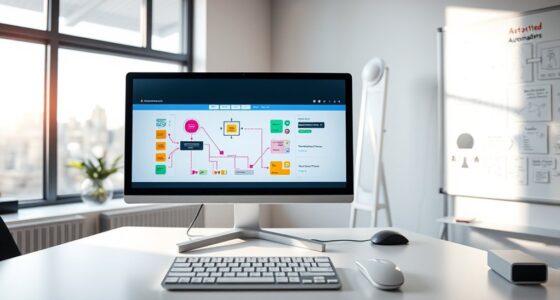
Process mining essentials involve analyzing event logs generated by your systems to discover and improve actual business workflows. You use specialized tools to visualize processes, identify bottlenecks, deviations, and redundancies. Accurate logs with detailed timestamps are vital for reliable insights. It’s a continuous effort that helps you monitor changes, optimize workflows, and make smarter decisions. Keep exploring to understand how process mining can transform your operations and uncover hidden opportunities.
Key Takeaways
- Process mining discovers, visualizes, and analyzes actual business workflows using event logs for accurate insights.
- High-quality, detailed event logs with timestamps and activity data are crucial for reliable process models.
- Automated process discovery tools generate visual models highlighting inefficiencies, deviations, and bottlenecks.
- Continuous monitoring enables ongoing process improvement and adaptation to organizational changes.
- Proper system configuration ensures comprehensive data capture, enhancing process discovery accuracy and insights.

Process mining is a powerful technique that helps you discover, analyze, and improve your business processes by extracting insights from event logs. These logs are records of activities generated by your systems, capturing every step, decision, and interaction involved in your workflows. By examining event logs, you can gain a clear picture of how your processes actually function, rather than relying on assumptions or outdated documentation. The core of process mining lies in process discovery, where algorithms sift through event logs to automatically construct visual process models. This step is vital because it reveals the true flow of work, including variations, bottlenecks, and deviations that you might not have been aware of.
When you start with process discovery, you upload your event logs into specialized tools that analyze timestamps, case IDs, and activity labels. These logs contain detailed data about each process instance, allowing the software to piece together the sequence of steps taken for every task. This automated approach saves you hours of manual process mapping and provides an accurate, data-driven view of your operations. As a result, you can identify inefficiencies, redundancies, and points where delays occur. For example, you might discover that certain steps are repeatedly skipped or that approvals take longer than expected, highlighting areas for improvement.
Understanding how to leverage event logs effectively is essential. You need to guarantee your systems are properly configured to capture thorough and clean data. This means setting up your IT infrastructure to log every relevant activity, from start to finish, with precise timestamps. The more detailed your event logs, the more accurate your process discovery will be. Once you have reliable logs, process mining tools can automatically generate models that illustrate the actual process flow, including all variations and exceptions. This visualization helps you see where your processes diverge from what’s documented or intended. Additionally, ensuring your logs include high-quality data is crucial for accurate analysis.
Process discovery using event logs is not a one-time activity; it’s an ongoing process. As your systems evolve, so do your processes. Regularly analyzing event logs allows you to monitor changes, measure the impact of improvements, and maintain a clear understanding of current operations. By continuously applying process mining, you can uncover hidden issues, optimize workflows, and guarantee your processes remain efficient and compliant. Ultimately, mastering process discovery through event logs empowers you to make smarter decisions, streamline workflows, and achieve better business outcomes.
Frequently Asked Questions
How Does Process Mining Differ From Traditional Process Analysis?
You see, process mining differs from traditional process analysis because it uses digital footprints from event logs to uncover real process flows. Instead of relying on interviews or assumptions, you analyze actual data through data visualization tools, revealing inefficiencies and bottlenecks. This approach offers a factual, detailed view of your processes, making improvements more targeted and effective compared to traditional methods that often depend on subjective insights.
What Are the Key Challenges in Implementing Process Mining?
You might face challenges like data privacy concerns, which require careful handling of sensitive information. Implementing process mining also demands significant organizational change, as teams need to adapt to new tools and workflows. Additionally, you could struggle with data quality issues and gaining stakeholder buy-in. Overcoming these hurdles involves clear communication, strong governance, and ensuring compliance with privacy regulations to successfully leverage process mining insights.
Which Industries Benefit Most From Process Mining Techniques?
Your industry benefits immensely from process mining techniques, especially in sectors like healthcare analytics and manufacturing optimization. You can uncover hidden inefficiencies and streamline operations, saving countless hours and resources. Healthcare providers improve patient outcomes, while manufacturers boost productivity. With process mining, you harness powerful insights that transform complex workflows into seamless, efficient processes—making your industry not just better, but revolutionary.
How Secure Is Sensitive Data Used in Process Mining?
Your sensitive data in process mining remains secure through data encryption and strict access controls. Encryption protects your information during storage and transmission, making it unreadable to unauthorized users. Access controls ensure only authorized personnel can view or modify data. By implementing these security measures, you reduce risks of data breaches, maintaining confidentiality and trust in your process mining activities. Always stay updated on security best practices to keep your data safe.
What Future Trends Are Expected in Process Mining Technology?
You’ll see future process mining tech heavily focus on AI integration and cloud deployment. AI will automate data analysis, identify patterns faster, and provide smarter insights, making your workflows more efficient. Cloud deployment guarantees you access real-time data securely from anywhere, boosting collaboration. Expect these advancements to make process mining more scalable, intuitive, and powerful, helping you optimize operations with minimal effort and maximum accuracy.
Conclusion
By mastering process mining, you open the unseen layers of your operations—like a detective revealing hidden clues. It’s your key to transforming data into clarity, efficiency, and innovation. Remember, every process holds secrets waiting to be uncovered; all it takes is your curiosity and the right tools. Embrace this journey, and you’ll find that the path to optimization isn’t just a possibility—it’s your destiny. Will you seize the opportunity to redefine your future?