
TL;DR

Get business pricing on tech for your team
- Business-only prices and quantity discounts
- Tax-exempt purchasing
- Multiple users, one account, clear invoices
IdeaClyst acts as a personal, local AI war room that pressure-tests ideas through structured debate, discovery, and a founder’s workspace. It helps founders make smarter, faster decisions without risking data leaks or cloud dependencies.
Imagine standing at a crossroads with three promising ideas. You feel the pull of excitement, but also the weight of uncertainty. Making the right choice can save months and hundreds of thousands of dollars. That’s where IdeaClyst steps in—a personal war room for your brain, built to help you test, discover, and decide with confidence.
This isn’t just about brainstorming. It’s about creating a structured environment where your best ideas are challenged, refined, and validated—without handing over your data or relying on unreliable gut feelings. If you’re tired of hoping your intuition is right, you’re about to see how a dedicated war room can turn hope into strategy.
A war room for your next idea
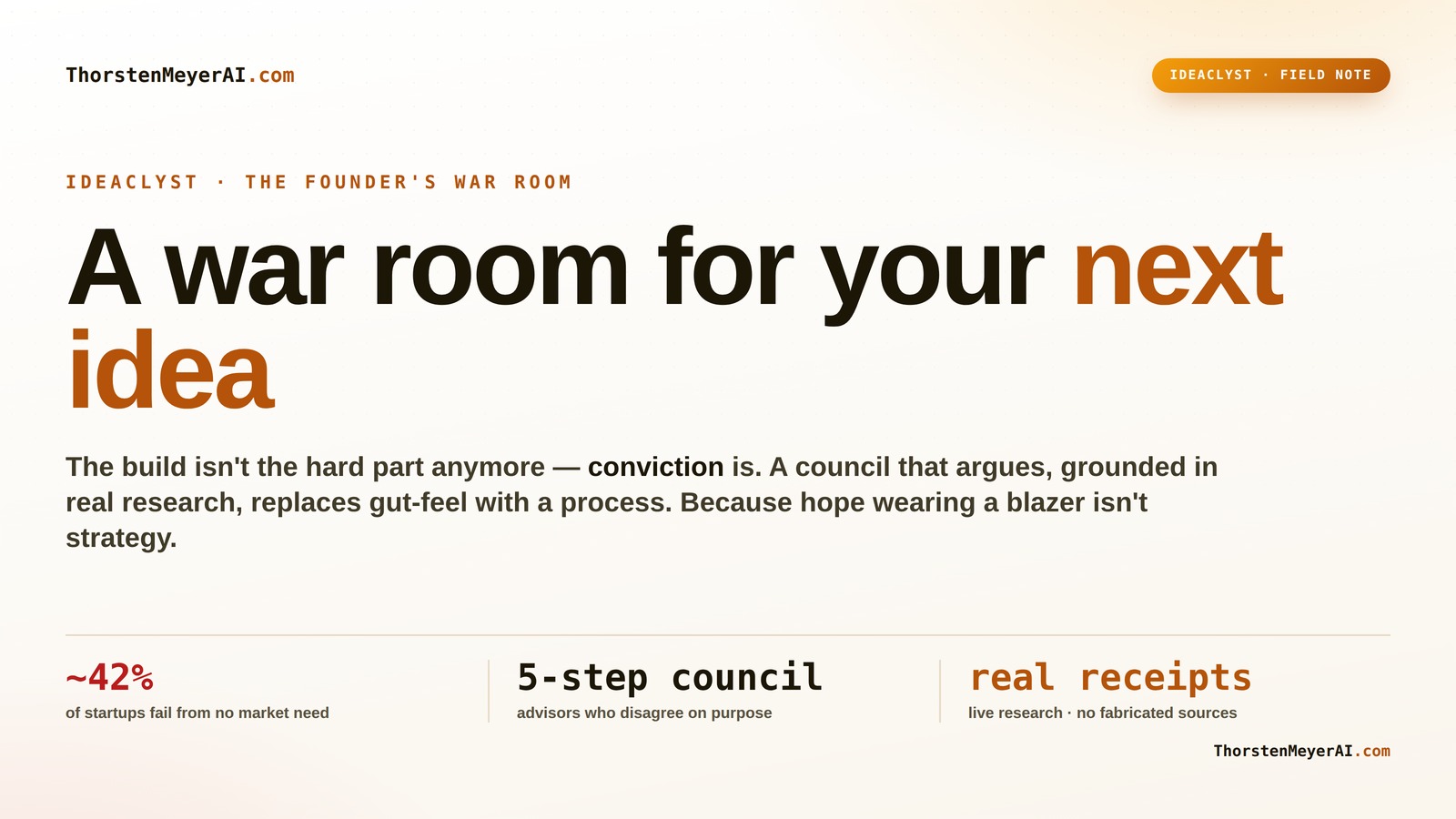
The build isn’t the hard part anymore — conviction is. Knowing which idea deserves the next six months, and being able to defend it. Most founders answer with gut feel and optimistic math. That’s hope wearing a blazer. IdeaClyst replaces it with a process.
The most expensive decision is what to build
The single most valuable thing a tool can do is talk you out of the wrong six months. The numbers make the case better than any pitch.
Three tools in one — on your own machine
Strip away the framing and IdeaClyst is three things at once, all running locally with nothing leaving your laptop.
An AI council
Pressure-tests an idea you bring it — advisors who argue on purpose.
A discovery engine
Finds ideas you didn’t know to look for by hunting real demand signals.
A founder’s workspace
Carries winners from “interesting” all the way to “ready to build.”
Advisors who disagree on purpose
Not one confident, agreeable answer — a structured five-step deliberation where models play different roles and turn on their own work. The disagreement is the feature.
The five-step deliberation
A council that leads with the bad news surfaces the objections you’d otherwise find the expensive way, on month five.
Product strategy
Who’s it for, what’s the wedge, why now, what’s the business model.
Technical architecture
What would it actually take to build — and where’s the risk.
Critique pass
The council turns on its own work. Where’s the hand-waving? What kills this?
Second, independent critique
A different voice, a different angle — so blind spots don’t survive.
Final synthesis
Everything into one coherent founder packet: strategy, architecture, validation, plan.
When IdeaClyst cites a source, it actually fetched it
The hard departure from “ask an AI what it thinks of my startup.” It runs in a strict, real-data-only mode — if it can’t gather genuine evidence, it says so plainly rather than inventing a plausible paragraph.
Confidence with receipts
No fabricated statistics, no imaginary competitors, no made-up citations. The packet survives a skeptical co-founder or a sharp investor because the reasoning has receipts.
Market research first
Scouts the landscape before the council reasons about anything.
Competitor read
Real positioning, pricing signals, feature claims — differentiation vs. reality.
Validation with links
Not “talk to customers” — concrete signals & sources you can click.
From the blank page to build-ready
Evaluation is half the problem; the blank page is the other half. And a plan is worthless if it dies in a tab you never reopen.
Bring a space, not an idea
“AI for accountants,” “tools for indie game studios” — plus your goal and real capacity. It hunts demand signals across HN, Reddit, Product Hunt, GitHub, pricing pages.
- An honest market read — leads with the bad news when a space is hard
- An opportunity map — high pain, thin competition
- Ranked candidates — wedge, who pays, effort, risk, confidence
- each with KILL CRITERIA — when to walk away
A home and a forward path
Every promising idea gets carried forward, with every artifact in plain files on your disk.
- Validation tooling — sprint board, interview list, evidence browser
- Founder profile — a personal-fit lens; same discovery, different advice
- Build workspaces — funnel, personas, landing draft, version history
- “Build this idea” → a PRD + task queue, ready for a coding agent
Key Takeaways
- IdeaClyst offers a structured, local-first AI war room that pressure-tests ideas through debate, research, and critique, reducing costly mistakes.
- Grounding AI insights in live web data ensures your validation stays relevant and accurate, avoiding the trap of outdated assumptions.
- The structured council’s disagreement uncovers hidden risks, making your decision-making more resilient and confident.
- A war room can be physical, digital, or portable—choose the setup that fits your team’s environment and workflow.
- Personalizing and maintaining your war room keeps motivation high and decision quality sharp over time.
As an affiliate, we earn on qualifying purchases.
Why Your Next Idea Needs a War Room — Not Just Gut Feelings
You’ve probably relied on gut feeling, quick chats, or a spreadsheet to pick your next move. But these methods are risky. Studies show that 42% of startup failures stem from building something nobody wants. That’s like investing months in a product that’s already dead on arrival.
A war room flips the script. It’s a dedicated space—physical or digital—where you gather facts, challenge assumptions, and build conviction. Imagine having a virtual roundtable of AI advisors dissecting your idea from every angle, so you don’t have to bet blind.
Research from industry experts highlights that structured decision environments cut failure rates and increase clarity. IdeaClyst’s core strength is turning fuzzy ideas into well-backed plans, saving you from costly missteps.
Why does this matter? Because in startup environments, uncertainty is a given, but poor decision-making amplifies risk. A war room provides a disciplined approach—forcing you to confront assumptions, gather evidence, and consider multiple perspectives. This tradeoff between effort and insight often results in better outcomes and fewer wasted resources, especially when the alternative is acting on biased intuition or incomplete data.
idea testing and validation tool for entrepreneurs
As an affiliate, we earn on qualifying purchases.
As an affiliate, we earn on qualifying purchases.
Inside IdeaClyst: Your Personal AI Debate Club
IdeaClyst is like having a team of advisors—each with their own perspective—debating your idea. It runs five structured steps: strategy, architecture, critique, independent critique, and synthesis. This process surfaces hidden risks and assumptions you might overlook.
For example, you can feed it a rough idea like, ‘A platform for remote team bonding,’ and it will challenge its market fit, technical feasibility, and growth potential. The AI models argue, question, and defend, revealing flaws or opportunities.
The output isn’t a vague opinion but a detailed founder packet—complete with research, critique points, and a clear plan—saved as a Markdown file on your machine. No cloud, no data leaks, just your ideas, owned and versioned.
Why does this matter? Because structured debate helps uncover biases and blind spots that might otherwise go unnoticed. Each step is designed to deepen your understanding, challenge assumptions, and push ideas toward robustness. Relying solely on your intuition or a single advisor risks confirmation bias—where you see only what confirms your beliefs. The AI council’s diverse perspectives act as a safeguard, ensuring your idea is tested from multiple angles, leading to more resilient and validated plans.
As an affiliate, we earn on qualifying purchases.
Grounded in Reality: How IdeaClyst Uses Live Web Research
Unlike typical AI tools that just regurgitate canned knowledge, IdeaClyst anchors its debate in real-time web data. It checks current market trends, competitors, and technical risks—making its insights fresh and relevant.
For instance, if you suggest a new SaaS tool, it’ll scan recent articles, reviews, and industry reports to verify if the market is truly growing or if competitors are consolidating. This live research helps you avoid building a product that’s already saturated or irrelevant.
Why does this matter? Because markets and technologies evolve rapidly. Relying on outdated or static data can lead to misguided decisions—investing time and resources into ideas that are no longer viable. By integrating live web research, IdeaClyst reduces this risk, providing you with current insights that reflect the real competitive landscape. This approach helps you identify emerging opportunities or threats early, giving you a strategic advantage. According to recent data, 86% of startups that incorporate real-time research validate their ideas faster and more accurately. This isn’t just a statistic; it’s a crucial factor in making informed, timely decisions that align with current market realities.
As an affiliate, we earn on qualifying purchases.
The Power of Disagreement: Why a Debating AI Council Outperforms Solo Advice
Having one AI tell you, ‘Your idea is great,’ isn’t validation—it’s echo chamber territory. IdeaClyst’s real magic is in its AI council, where models argue and challenge each other. This disagreement exposes weaknesses and blind spots.
Imagine one model emphasizing market risks, another questioning technical feasibility, and a third scrutinizing business model assumptions. Their debate uncovers issues you wouldn’t notice alone. It’s like a panel of experts, each playing devil’s advocate.
Why does this matter? Because decision-making is inherently complex. Relying on a single opinion or a yes-man approach often leads to confirmation bias—where you only hear what you want to hear. The structured disagreement forces you to confront uncomfortable truths, revealing flaws that could derail your project later on. This process enhances your ability to evaluate ideas critically, rather than accepting them at face value. It’s a systematic way to surface biases, challenge assumptions, and build more resilient plans. Founders who leverage this debate-driven approach tend to make decisions with higher confidence and lower risk, because they’ve actively tested their ideas against diverse perspectives rather than passive acceptance.
How to Use IdeaClyst in Your Daily Startup Routine
- Start with a clear, concise idea or problem statement. For example, ‘A lightweight project management tool for freelancers.’ Learn more about integrating AI into your startup routine.
- Feed it into IdeaClyst and let the AI council run its five-step process.
- Review the founder packet—strategy, critiques, and validation tests. Use this to decide whether to pivot, refine, or build.
- Iterate by refining your idea based on feedback and running new councils as needed.
- Save your work locally, version control, and integrate findings into your pitch deck or product roadmap.
This process isn’t just about quick validation; it’s about embedding a disciplined approach to decision-making. Regularly practicing this cycle sharpens your ability to identify viable ideas, avoid costly pitfalls, and adapt swiftly. The structured debate and validation process helps you develop a more nuanced understanding of your ideas’ strengths and weaknesses. By consistently applying this method, you cultivate a mindset that values evidence and critical thinking over guesswork, leading to more confident and resilient decisions. Think of it as your personal strategic war room—always ready for the next challenge, right in your laptop or workspace.
Physical, Digital, or Portable? Choosing Your War Room Setup
IdeaClyst fits perfectly into a digital war room—your personal, local AI council accessible from your laptop. But you can also adapt the concept for physical spaces or portable kits.
If you prefer a physical setup, create a dedicated wall or whiteboard where ideas, critiques, and progress are visualized. Use colorful sticky notes, charts, and photos to inspire your team. This setup encourages real-time interaction and makes the validation process tangible, which can be especially effective for collaborative teams that thrive on visual cues and face-to-face discussions.
For remote teams, a digital war room on your laptop or a shared drive works best. Keep everything organized in folders—research, critiques, final plans—so you can revisit anytime. Portable options include notebooks or even a well-organized binder for on-the-go validation sessions. The main tradeoff is between immediacy and convenience versus physical presence and tactile engagement. Choose what aligns with your team’s workflow and your personal preference to maintain consistent, focused validation sessions.
Making Your War Room Personal and Motivating
Your war room should feel like your own battlefield—motivating, personal, and inspiring. Use team colors, mascots, or motivational quotes to boost morale. If it’s a physical space, add personal touches like photos or trophies. These elements personalize the environment, making it a space where you want to engage deeply with your ideas and challenges. When your environment reflects your identity or values, it fosters a stronger emotional connection, increasing your commitment to rigorous validation and continuous improvement.
For digital setups, customize your workspace with icons, color themes, and personal notes. Keep a section for ‘wins’—successful validations or milestones—to celebrate progress. This not only boosts morale but also creates a visual record of your journey, reinforcing your motivation through tangible evidence of growth. When you see your ideas evolve and your efforts recognized, it energizes you to face new challenges with confidence.
Remember, a war room isn’t just about data; it’s about mindset. When you see your ideas evolve, face challenges head-on, and celebrate small victories, you’ll build conviction faster and more naturally.
Avoiding Common Pitfalls: Keep Your War Room Sharp
A war room can become cluttered or complacent if you’re not careful. Overloading it with too many ideas or neglecting updates can dilute its effectiveness. Regular review and pruning are essential—outdated data and irrelevant ideas should be removed to keep the environment focused and actionable. This disciplined housekeeping ensures your war room remains a powerful tool rather than a cluttered archive.
Another common pitfall is complacency—believing that once an idea has been debated, the process is complete. In reality, ideas evolve, markets change, and new information emerges. Continuous iteration and fresh debates are necessary to keep your validation relevant. Additionally, avoid echo chambers by actively encouraging honest critique and diverse viewpoints. Structured debate facilitates this, but it requires discipline to resist confirmation bias—where you unconsciously seek only agreeable opinions. Setting regular review cycles and fostering a culture of constructive challenge help maintain a sharp, effective war room that adapts to your startup’s growth and changing landscape.
Ultimately, the goal is clarity and agility. Use your war room to quickly pivot, refine, or kill ideas based on real insights, not assumptions. This disciplined approach saves time, reduces waste, and increases your chances of success.
Frequently Asked Questions
What exactly is a war room for ideas?
A war room for ideas is a dedicated space—physical or digital—where you gather data, challenge assumptions, and refine your plans. It’s like a strategic headquarters for making smarter, faster decisions.
Can I use a simple notebook or digital tool instead of a full room?
Absolutely. A war room can be as simple as a dedicated wall, a notebook, or a digital folder. The key is consistent focus and organization—whatever helps you stay disciplined and clear.
How do I set up a war room without breaking the bank?
You can start with a blank wall, a whiteboard, or a shared folder on your computer. Use colorful sticky notes, printouts, or simple templates to visualize your ideas. The goal is visibility and structure, not expensive equipment.
What should I include in my war room to stay motivated?
Add personal touches like photos, quotes, or milestones. Regularly update it with wins and progress to keep morale high. A personal or team-driven environment fuels ongoing engagement and conviction.
Conclusion
A war room isn’t just a fancy concept—it’s a practical tool that turns guesswork into strategy. IdeaClyst elevates this idea with a local, structured AI debate environment that fits into your laptop or workspace.
Think of it as your personal battlefield, where every decision is backed by rigorous challenge and real-time data. When you master your war room, you master your startup’s future.
Halloween Picks
halloween
As an affiliate, we earn on qualifying purchases.