

TL;DR
Federal Reserve Governor Christopher Waller told CNBC on Nov. 18 that the Fed may need to raise rates by half a percentage point at its Dec. 8-9 meeting unless it clearly signals another increase in January. He cited inflation above the Fed’s 2% goal, while other officials have cautioned against dramatic action. The committee has not decided, and upcoming inflation and jobs data could shape the debate.
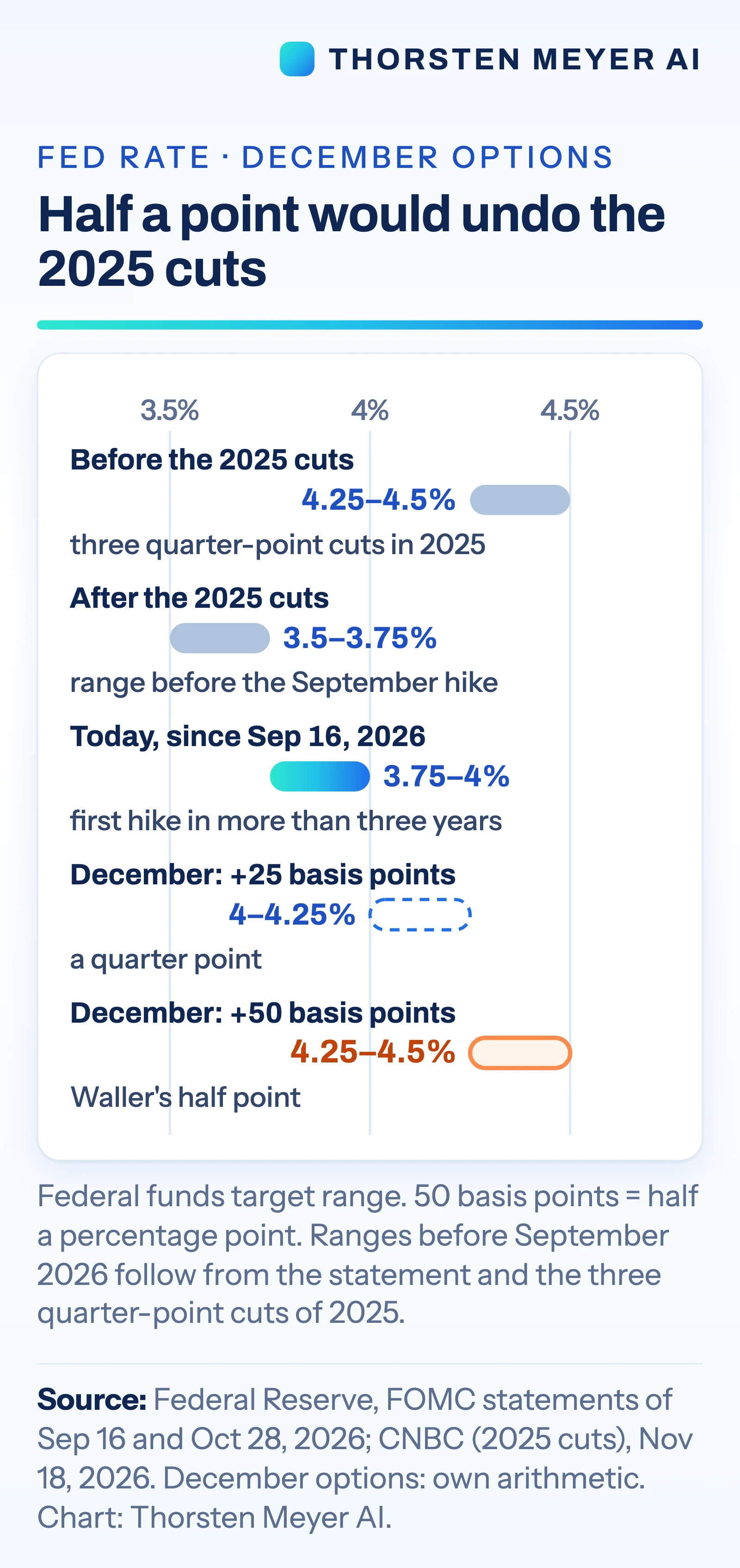
Federal Reserve Governor Christopher Waller said on Nov. 18 that the central bank may need to raise its benchmark interest rate by half a percentage point in December unless it clearly signals another increase in January. The proposal, made in a CNBC interview, reflects his concern that inflation is moving away from the Fed’s 2% target; it is Waller’s view, not a decision by the rate-setting committee.

Get business pricing on tech for your team
- Business-only prices and quantity discounts
- Tax-exempt purchasing
- Multiple users, one account, clear invoices
Waller told CNBC that the Federal Open Market Committee (FOMC), which sets the federal funds rate, could raise rates by a quarter point in December and signal a further move in January. If it does not give that signal clearly, he said, “you have to go 50 [basis points] in December.” A basis point is one-hundredth of a percentage point, so 50 basis points equals half a percentage point.
He pointed to inflation as the reason for acting. “I’m very, very concerned about inflation. It’s kind of headed in the wrong direction, and it’s spreading out,” he said, according to CNBC. The September personal consumption expenditures price index, the inflation measure the Fed targets, was 3.6% above its level a year earlier, compared with the Fed’s 2% goal.
Waller had set out a conditional case for a larger move in a Nov. 10 speech: he said a 50-basis-point increase “should be considered” if core consumer prices rose around 0.3% in October. CNBC reported that core CPI rose 0.3% that month. That data point is part of the debate, but it does not determine the committee’s decision.
Rate Debate Reaches Hiring and AI
A higher federal funds rate can raise borrowing costs across the economy as banks, bond markets and other lenders adjust their terms. That can make households more cautious about spending and lead businesses to delay investment or hiring. These are possible effects of tighter policy; Waller’s proposal does not establish what any particular employer or borrower will do.
The debate has particular relevance for firms financing AI infrastructure. Fed Vice Chair for Supervision Michelle Bowman said AI-related debt was “on track to exceed $800 billion this year” and that higher rates already “appear to be holding back investment” at newer and medium-sized AI companies. Those are Bowman’s assessments, not a measure of how a December increase would affect future investment.
Waller’s proposed timing also puts jobs in view. The source material describes a labor market with low hiring and low layoffs, where people who lose jobs can take longer to find another. If inflation remains high, policymakers face pressure to restrain demand; tighter credit could also weigh on firms’ capacity to expand and hire.
Products Worth Considering

Sony WH-1000XM4 Wireless Noise Cancelling Headphones (Silver)

Bose SoundLink Plus Portable Bluetooth Speaker, Black

Apple MacBook Air 13-inch Laptop with M5 Chip, 16GB Memory, 512GB SSD, Liquid Retina Display, and 12MP Center Stage Camera (Midnight)
As an affiliate, we earn on qualifying purchases.
Waller’s Case and Fed Divisions
Waller is one of the FOMC’s 12 voters, so his public position is influential but does not settle the outcome. The October meeting minutes said “a couple of participants” thought an increase larger than 25 basis points “could warrant consideration” if inflation data were unfavorable. That signals some openness to a larger move among participants, not a committee consensus.
New York Fed President John Williams has expressed a more cautious view. “I don’t think the situation calls for dramatic action,” he said. The disagreement reflects the policy trade-off: higher rates may help slow price increases, while also making financing more expensive for workers, households and companies.
Waller also referred to the Fed’s three quarter-point rate cuts in 2025, calling them “insurance cuts” and saying the central bank may need to reverse them and possibly raise rates further. He framed that as his own assessment. The Fed’s published disclaimer says his views are not necessarily those of his colleagues or the FOMC.
““If you’re not going to signal this very clearly to markets, you’re going in January, my view is then you have to go 50 [basis points] in December to put it in place and get it done.””
— Christopher Waller, in a Nov. 18 CNBC interview
The December Vote Is Open
The FOMC has made no decision on the December rate move. Waller’s comments are his own, and the source material does not establish how many other voters support a half-point increase or whether the committee will choose to signal a January move.
The effects of a possible increase on jobs and AI investment are also uncertain. Bowman said higher rates appear to be holding back investment at some AI firms, but the available material does not quantify how much a further increase would change borrowing, projects or hiring. A raw debt estimate does not show how much of that borrowing is exposed to rate changes.
Inflation and Jobs Data Come First
Before the Dec. 8-9 meeting, the next cited milestones are the release of October PCE inflation data on Nov. 25 and the November jobs report. Those figures may inform officials’ assessment of inflation and the labor market. The source material does not specify the jobs report’s release date.
The committee will then weigh incoming data and participants’ views at its meeting. Until it announces a decision, Waller’s half-point proposal remains one governor’s position rather than a forecast of the Fed’s action.
Key Questions
What rate increase did Waller propose?
He said the Fed may need to raise rates by 50 basis points, or half a percentage point, at its Dec. 8-9 meeting if it does not clearly signal another increase in January.
Has the Fed decided to raise rates in December?
No. Waller stated his own view in a CNBC interview. The FOMC has not announced a decision.
Why does Waller support a larger increase?
He said he is concerned that inflation is moving in the wrong direction. The source material reports that September PCE prices were 3.6% higher than a year earlier, above the Fed’s 2% goal.
What could higher rates mean for jobs and AI companies?
Higher borrowing costs could lead businesses to defer investment or hiring. Bowman said higher rates already appear to be holding back investment at newer and medium-sized AI firms, but the effects of any December move are not yet known.
Source: Thorsten Meyer AI