
📊 Full opportunity report: Retirement Care Planner on IdeaNavigator AI — validation score, market gap, and execution plan.

Get business pricing on tech for your team
- Business-only prices and quantity discounts
- Tax-exempt purchasing
- Multiple users, one account, clear invoices
TL;DR
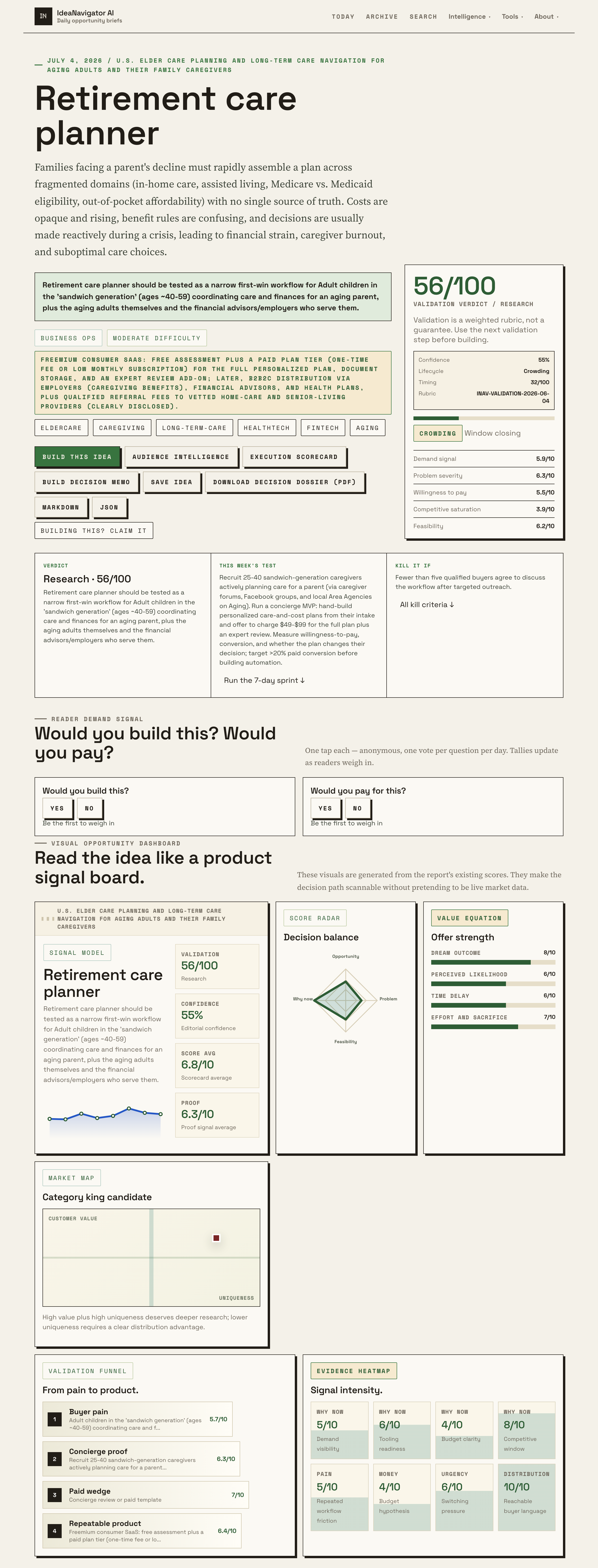
A prototype retirement care planning tool is in development to assist adult children managing aging parents’ care. It aims to provide personalized cost and care options, addressing a critical market need.
A new retirement care planning web app is in early testing, aimed at helping adult children in the ‘sandwich generation’ coordinate care and finances for aging parents. The tool offers personalized care and cost analyses, addressing a pressing market need as long-term care costs rise and families face complex decision-making.
The proposed platform targets families facing the challenge of managing care options such as in-home aides, assisted living, and nursing homes, while navigating Medicare and Medicaid eligibility and affordability concerns. It is designed as a guided, user-friendly interface that, after a brief intake, generates localized cost comparisons, eligibility explanations, affordability projections, and action checklists with vetted local providers.
This initiative is currently in a pilot phase, recruiting 25-40 caregivers actively planning for a parent. The initial offering includes a free assessment, with a paid tier providing comprehensive personalized plans, document storage, and expert reviews. The goal is to validate willingness-to-pay and measure if the tool influences decision-making before automating the process further.
Why a Retirement Care Planning Tool Matters Now
As the U.S. approaches a demographic peak with approximately 73 million Americans aged 65 and older by 2030, the need for effective long-term care planning intensifies. Costs for assisted living and nursing homes have surged, with median assisted living costs reaching $6,200 per month and nursing home semi-private rooms around $115,000 annually. Many middle-aged caregivers face mounting financial and emotional stress, often making reactive decisions in crises. A structured, personalized planning tool could reduce financial strain, improve care choices, and ease caregiver burnout, making it highly relevant for a broad segment of the population.
As an affiliate, we earn on qualifying purchases.
Growing Demand for Structured Long-Term Care Planning
The U.S. elder care market has seen significant cost increases in recent years, prompting families to seek better guidance. Currently, families rely on fragmented sources, often making decisions under stress with limited transparency about costs and benefits. The concept of a dedicated retirement care planner emerges amid this backdrop, aiming to streamline decision-making, provide clarity, and support proactive planning. The initiative builds on the trend of integrating digital solutions into health and financial planning, targeting a market eager for accessible, personalized guidance.
“Families are overwhelmed by the complexity and cost of long-term care options, and a guided digital tool could significantly improve decision-making.”
— an anonymous researcher
assisted living facility cost comparison
As an affiliate, we earn on qualifying purchases.
As an affiliate, we earn on qualifying purchases.
Uncertainties Surrounding Adoption and Effectiveness
It remains unclear how receptive middle-aged caregivers will be to using such a tool, and whether the prototype will effectively influence their decisions. The project is in early testing, and outcomes such as willingness-to-pay, actual decision impact, and scalability are still being evaluated. Further data is needed to confirm if the platform can meet the diverse needs of families across different states and income levels.
Medicare Medicaid eligibility guide
As an affiliate, we earn on qualifying purchases.
As an affiliate, we earn on qualifying purchases.
Next Steps in Validation and Development
The team plans to complete initial testing with recruited caregivers, analyze user feedback, and measure engagement and decision changes. If results are positive, they will proceed to automate the platform, expand the pilot to additional regions, and explore partnerships with employers, financial advisors, and health plans. The ultimate goal is to launch a broader market-ready version and gather data to refine features and pricing.
As an affiliate, we earn on qualifying purchases.
Key Questions
How will the retirement care planner determine personalized care options?
The platform will use a short intake about the parent’s health, location, and finances to generate localized cost comparisons, eligibility explanations, and priority action checklists based on public benchmark data.
Who will have access to this retirement care planning tool?
Initially, it will target middle-aged caregivers actively planning for an aging parent, with potential expansion to employers, financial advisors, and health plans in later stages.
What are the costs associated with using the platform?
The initial assessment will be free, with a paid tier costing $49-$99 for full personalized plans, document storage, and expert review. Future pricing models may vary based on market feedback.
When will the full version of the platform be available?
There is no fixed release date yet; development depends on initial testing outcomes. If pilot results are promising, broader rollout could occur within the next year.
What are the main challenges faced in developing this tool?
Key challenges include ensuring accurate, localized cost data, user engagement, and demonstrating that the platform effectively influences decision-making under stressful circumstances.
Source: IdeaNavigator AI
Halloween Picks
halloween
As an affiliate, we earn on qualifying purchases.