
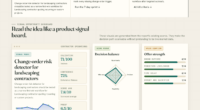
📊 Full opportunity report: The unbundling of the budget app. Why a conversational finance surface absorbs what the personal-finance apps charge for, and what survives the absorption. on ThorstenMeyerAI.com — validation score, market gap, and execution plan.

Get business pricing on tech for your team
- Business-only prices and quantity discounts
- Tax-exempt purchasing
- Multiple users, one account, clear invoices
TL;DR
OpenAI introduced a personal-finance feature within ChatGPT, absorbing the commodity layers of budget apps. This shift threatens traditional standalone apps, which now face a split between high-friction, trust-based functions and passive data insight.
OpenAI launched a personal-finance feature within ChatGPT on May 15, 2026, integrating account aggregation, spending insights, and financial questions into the chatbot. This move significantly alters the landscape for standalone budget apps, which now face a new competitive environment where commodity functions are absorbed into a broader conversational surface.
The new ChatGPT feature connects users’ bank accounts through Plaid, covering over 12,000 institutions, and provides a dashboard of spending, subscriptions, and upcoming payments, answering financial questions grounded in actual user data. Over 200 million people already ask ChatGPT financial questions monthly, according to OpenAI.
This development follows the absorption of Hiro Finance’s team into OpenAI earlier in April 2026, signaling a strategic shift towards embedding personal-finance capabilities within a conversational AI platform. The core thesis is that a personal-finance app’s commodity functions—aggregation, categorization, insights—are now effectively integrated into the chatbot at near-zero marginal cost, threatening standalone apps that focus solely on these functions.
However, functions requiring friction, trust, or relationship—such as behavior change, household collaboration, and privacy—remain outside the scope of the chatbot’s current design. Experts say this split will reshape the category, with some apps surviving by focusing on high-friction or trust-dependent roles.
The unbundling
of the budget app.
Why a conversational finance
surface absorbs what the apps
charge for, and what
survives the absorption.
three survive the absorption
before the surface even launched
the pattern’s first demonstration
broad category, not the defensible one
- Aggregation · same Plaid integration, 12,000+ institutions
- Categorization · performed at the shared aggregator layer
- Net-worth & dashboard · generated as a side effect of connection
- Insight & explanation · the surface’s native strength, tuned to a finance benchmark
- Behavior change · requires friction the surface is built to remove
- Collaboration · multi-person workflow, not a single-user query
- Trust / privacy · the surface’s structurally weakest flank
- Action jobs · surface is read-only — for now
The category does not collapse into the chatbot. It splits into the part the surface absorbs and the part it cannot. The passive-dashboard middle hollows out. What survives is the behavior, the relationship, and the privacy promise a general-purpose surface can least credibly make.Thorsten Meyer · The Unbundling of the Budget App · Agentic Commerce 02
Implications for Personal-Finance App Ecosystem
This shift signifies a fundamental change in how consumers will interact with financial management tools. The integration of core functions into a conversational AI reduces the need for standalone apps that primarily offer aggregation and insight, potentially leading to a decline in their relevance. Meanwhile, apps that emphasize behavioral change, household collaboration, or privacy—areas where friction and trust are essential—may retain their importance. For consumers, this means a move toward more integrated, conversational interfaces for routine financial data, but a continued need for specialized apps for sensitive or high-trust functions.
As an affiliate, we earn on qualifying purchases.
Evolution of the Personal-Finance Category Post-Mint
The collapse of Mint in early 2024, after Intuit shut it down and redirected users to Credit Karma, created a vacuum in the personal-finance space. This vacuum was filled by a range of apps focusing on different segments: YNAB for behavioral change, Monarch for household management, and Rocket Money for mass-market budgeting. The subsequent growth of Monarch Money, which raised $75 million in May 2025, indicated a healthy category.
However, the launch of ChatGPT’s finance surface marks a new phase. By integrating account aggregation and insights directly into a chatbot, OpenAI is effectively unbundling the core functions of traditional budget apps, challenging their core value proposition and business models. This development is part of a broader trend where AI-driven surfaces begin to replace standalone apps for commodity functions.
“The core thesis is that a personal-finance app’s commodity functions—aggregation, categorization, insights—are now effectively integrated into the chatbot at near-zero marginal cost, threatening standalone apps that focus solely on these functions.”
— Thorsten Meyer
As an affiliate, we earn on qualifying purchases.
Unclear Impact on Existing Personal-Finance Apps
It remains unclear how quickly standalone apps will adapt or whether they will find new roles that AI cannot easily replace, such as managing trust, privacy, or behavior change. The long-term viability of apps focusing solely on aggregation and insight is uncertain, as the conversational surface offers similar functionality at a lower cost.
As an affiliate, we earn on qualifying purchases.
Future Developments in AI-Integrated Financial Management
Expect further integration of AI-driven financial features into larger platforms, with some standalone apps pivoting toward high-friction, trust-dependent services. Monitoring how traditional apps respond—whether through differentiation or specialization—will be key. Additionally, regulatory and privacy considerations may influence the future landscape, especially for trust-based functions.
As an affiliate, we earn on qualifying purchases.
Key Questions
Will standalone budget apps become obsolete?
Not necessarily. Apps focusing on high-friction, trust-dependent functions like behavior change and household collaboration are likely to persist, but their role may shift as commodity functions are absorbed into AI surfaces.
How does ChatGPT’s new feature affect user privacy?
While the feature offers passive data aggregation and insights, privacy remains a concern. The extent of data handling and trust depends on how OpenAI and partner institutions manage privacy promises and regulations.
Can traditional apps compete with AI surfaces on engagement?
Traditional apps may need to focus on high-trust, high-friction services or integrate AI features themselves to stay relevant. Pure aggregation and insight apps face increasing pressure from conversational interfaces.
What does this mean for the future of personal finance management?
The category is splitting into two: passive, data-driven insights integrated into AI surfaces, and specialized apps that handle sensitive, trust-dependent tasks. The overall market will likely become more segmented and specialized.
Source: ThorstenMeyerAI.com
Halloween Picks
halloween
As an affiliate, we earn on qualifying purchases.