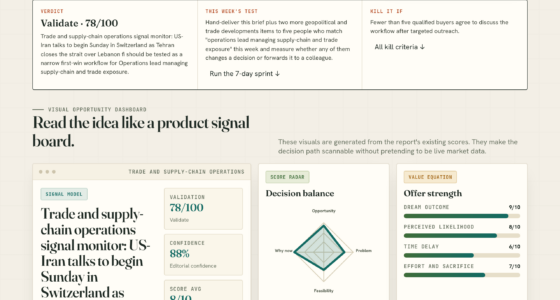

📊 Full opportunity report: District 1’S Primary Results As A Signal For Trade And Supply Chain Shifts on IdeaNavigator AI — validation score, market gap, and execution plan.

Get business pricing on tech for your team
- Business-only prices and quantity discounts
- Tax-exempt purchasing
- Multiple users, one account, clear invoices
TL;DR
The primary results in Congressional District 1 have emerged as a potential early indicator of broader trade and supply chain changes. This signals the importance of real-time, role-filtered monitoring for operations leaders managing geopolitical risks.
Primary election results in Congressional District 1 have been identified as a potential early signal for upcoming shifts in trade and supply chain operations. This development is significant for operations leaders managing supply-chain and geopolitical exposure, as it may forecast broader economic or policy changes affecting their roles. The results are being closely monitored as a role-specific indicator that could influence strategic decisions in real time.
Recent election outcomes in District 1, a key congressional battleground, have been highlighted by analysts as a possible early warning sign for shifts in trade policies and supply chain stability. According to sources familiar with geopolitical monitoring efforts, these election results could reflect underlying political currents that might influence trade agreements, tariffs, or regulatory environments in the near term.
Trade and supply-chain operations often rely on timely signals to anticipate market changes, but current monitoring tools struggle to filter signals relevant to specific operational roles. The emergence of District 1’s results as a potential indicator underscores the need for role-filtered, real-time analysis tools that can convert political developments into actionable insights. Google Trends data recently scored this signal at 88/100, indicating a high relevance score for supply-chain decision-makers.
Industry experts note that election results in key districts often serve as barometers for broader policy shifts, but the challenge remains in translating these signals into operational decisions. The focus now is on developing a dedicated monitor that tracks such developments, filters for relevance, and provides concise briefs to operations leads managing supply-chain exposure.
Implications of District 1 Results for Trade and Supply Chains
This development matters because it suggests that political shifts, as reflected in local election outcomes, could soon influence international trade policies, tariffs, or regulatory frameworks. For operations leaders, early detection of such signals could mean the difference between proactive adjustments and reactive crises. As geopolitical and trade developments accelerate, role-specific monitoring becomes essential to maintaining supply chain resilience and making informed strategic decisions.
Furthermore, this signals a move toward more granular, real-time intelligence tools tailored to specific operational roles, reducing information overload and enabling faster response times. The potential for District 1’s results to forecast broader policy shifts underscores the importance of integrating political signals into supply chain risk management frameworks.
real-time geopolitical risk monitoring tools
As an affiliate, we earn on qualifying purchases.
As an affiliate, we earn on qualifying purchases.
Background on Political Indicators and Supply Chain Monitoring
Traditionally, supply chain and trade operations have relied on macroeconomic data, official policy announcements, and periodic geopolitical analyses. However, recent trends show that political developments at local and regional levels can serve as early indicators of larger shifts. Election results, especially in strategically significant districts like District 1, are increasingly viewed as proxies for upcoming policy changes that could impact trade agreements, tariffs, or regulatory standards.
In recent years, the rapid pace of geopolitical change has challenged traditional monitoring methods. The rise of digital tools, such as Google Trends, has enabled real-time tracking of public interest and political activity, with some signals scoring high relevance for trade and supply chain operations. This particular election outcome is being scrutinized as part of a broader effort to develop role-specific, fast-response intelligence systems that can turn political signals into operational insights.
Prior to this, most supply chain risk assessments focused on macro-level indicators, but the increasing volatility of geopolitical landscapes has underscored the need for more granular, timely signals. The District 1 results are now part of this evolving landscape, illustrating how local political shifts can serve as early warning signs for broader economic impacts.
supply chain risk management software
As an affiliate, we earn on qualifying purchases.
As an affiliate, we earn on qualifying purchases.
Unclear How District 1 Results Will Influence Broader Policies
While the election results in District 1 are being analyzed as a potential early indicator, it is not yet clear how directly these results will translate into actual policy shifts or trade disruptions. The connection remains speculative at this stage, and further developments or official policy announcements are needed to confirm the impact.
Experts caution that local election outcomes are only one of many signals, and predicting their influence on national or international trade policies involves considerable uncertainty. The timeline for any tangible policy changes remains uncertain, and the extent to which these will affect supply chains is still to be seen.
As an affiliate, we earn on qualifying purchases.
Next Steps for Monitoring and Decision-Making
The focus will be on tracking subsequent political developments, official policy announcements, and market reactions to the District 1 results. Developers of role-specific monitoring tools are expected to refine algorithms that filter relevant signals from broader geopolitical noise. Operations teams will likely incorporate these early signals into risk assessments and contingency planning.
Additionally, further analysis will be conducted to establish whether similar local election outcomes in other districts or regions serve as reliable predictors for trade and policy shifts. The ongoing collection and validation of such signals aim to improve the predictive accuracy of supply chain risk management frameworks.
Expectations are that, over the coming weeks, more data will clarify the direct impact of District 1’s results, and decision-makers will adjust their strategies accordingly based on the evolving geopolitical landscape.
role-specific supply chain monitoring devices
As an affiliate, we earn on qualifying purchases.
As an affiliate, we earn on qualifying purchases.
Key Questions
How reliable are local election results as indicators for trade policy changes?
While local election results can reflect broader political currents, their reliability as predictors of trade policy shifts depends on the context and subsequent official actions. They are considered early signals rather than definitive indicators.
What tools are being developed to filter relevant political signals for supply chain managers?
Developers are working on role-specific monitors that track feeds like Google Trends, filter for relevance to supply chain and trade exposure, and generate concise briefs for decision-makers.
Will the results in District 1 definitely lead to policy changes?
It is not yet certain whether the election outcomes will lead to concrete policy changes. Further developments and official policy announcements are needed to confirm any direct impact.
How soon can supply chain teams expect to see actionable insights from these signals?
Real-time or near-real-time monitoring tools aim to deliver insights within hours or days of relevant political developments, but validation and refinement are ongoing.
Could similar signals be observed in other districts or regions?
Yes, analysts are exploring whether election results in other key districts can serve as reliable early indicators, but this requires further validation.
Source: IdeaNavigator AI
Halloween Picks
halloween
As an affiliate, we earn on qualifying purchases.