
📊 Full opportunity report: The 9 Most Advanced AI-Enabled Mobile Workstations Of 2026 on ThorstenMeyerAI.com — validation score, market gap, and execution plan.

Get business pricing on tech for your team
- Business-only prices and quantity discounts
- Tax-exempt purchasing
- Multiple users, one account, clear invoices
TL;DR
In 2026, nine AI-enabled mobile workstations stand out for their advanced hardware, supporting demanding professional workloads. This report details their features, significance, and what remains uncertain.
Nine of the most advanced AI-enabled mobile workstations have been introduced or are available in 2026, showcasing significant hardware advancements designed for professional AI, data science, and creative workloads. For a detailed overview, see the original analysis. These models are notable for integrating cutting-edge GPU, CPU, and AI-acceleration technologies, reflecting a shift toward portable yet highly capable systems. This development matters because it enables professionals to perform complex AI tasks on the go, expanding the reach of high-performance computing beyond traditional desktops.
The lineup includes models from Dell, Lenovo, and other leading manufacturers, featuring configurations such as Dell’s Precision 7680 with RTX 2000 Ada GPUs, 64GB RAM, and 2TB SSD, and Lenovo’s ThinkPad P14s Gen 6 optimized for portability and CPU-heavy tasks. These systems leverage AI-specific hardware accelerators, high-end graphics, and large memory capacities to handle demanding workloads like 3D rendering, simulation, and AI model training. Learn more about top mobile workstations in the best options for 2026. Notably, the Precision 7680 with RTX 2000 Ada is considered the top overall choice for its balanced performance across CPU, GPU, and storage, suitable for large datasets and multitasking.
Manufacturers emphasize customization options, with some models offering OLED and 4K displays for visual professionals, though these features may impact battery life and glare. The focus remains on delivering sustained performance, thermal management, and support for professional software applications. The market for AI-enabled mobile workstations is growing rapidly, driven by increasing demand for portable high-performance hardware in fields such as engineering, data science, and digital content creation. This trend is analyzed in the original report.
The 9 picks
- 1
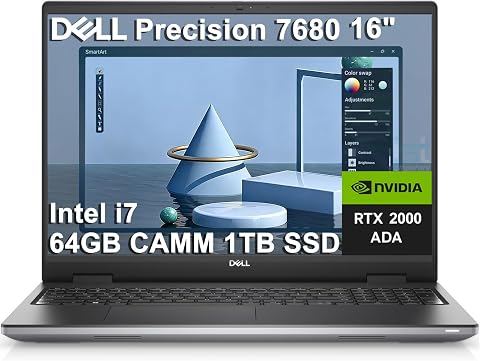 Dell Precision 7680 Mobile Workstation Laptop with NVIDIA RTX 2000 Ada, 16" F…View on Amazon →
 - 2
 Dell Pro 16 Plus PB16255 Business Notebook 16" FHD+ AMD Ryzen 7 Pro 250, 16GB…View on Amazon →
 - 3
 Dell Precision 7680 Mobile Workstation Laptop (NVIDIA RTX 2000 Ada 8GB, 16" F…View on Amazon →
 - 4
 Dell Precision 7680 Mobile Workstation LaptopView on Amazon →
 - 5
 HP ZBook X G1i Mobile Workstation AI Laptop 16" FHD+ Intel 16-Core, NVIDIA RT…View on Amazon →
 - 6
 Lenovo ThinkPad P16s Gen 4 Laptop with AMD Ryzen 7 PRO 350, 16” OLED Touchscr…View on Amazon →
 - 7
 Lenovo ThinkPad P14s Gen 6 Mobile Workstation with AMD Ryzen AI 7 PRO 350, 32…View on Amazon →
 - 8
 Dell Precision 3561 Mobile Workstation 15.6-inch FHD i5-11500H 16GB RAM 512GB…View on Amazon →
 - 9
 Dell Precision 7680 Mobile Workstation Laptop (16" OLED 4K UHD+ Touchscreen,…View on Amazon →
Impact of Portable AI-Workstations on Industry
The emergence of these AI-enabled mobile workstations in 2026 signifies a major shift in professional computing, enabling high-performance AI tasks to be performed remotely or in the field. This expansion supports industries like automotive design, aerospace, media production, and research, where mobility combined with power is critical. It also signals a competitive landscape where hardware providers are racing to integrate AI accelerators, high-end graphics, and large memory capacities into portable systems, potentially reducing reliance on traditional desktop setups.
Evolution of Mobile Workstations and AI Integration
Over the past few years, mobile workstations have progressively incorporated more powerful GPUs, faster CPUs, and larger RAM capacities, moving from basic portable systems to high-end tools capable of handling AI workloads. In 2025, the market saw the first wave of AI-specific hardware accelerators in laptops, setting the stage for 2026’s offerings. Major manufacturers like Dell and Lenovo have expanded their lines to include models explicitly optimized for AI, 3D rendering, and data science, reflecting industry-wide recognition of portable high-performance computing’s importance. The current lineup builds on these advancements, with models tailored for different professional needs, from graphics-intensive tasks to CPU-bound computations.
“Our Precision 7680 with RTX 2000 Ada GPUs exemplifies the balance between power and portability, supporting demanding professional applications on the go.”
— Dell spokesperson
Remaining Questions About AI-Workstation Capabilities
While these systems boast impressive hardware, it is still unclear how they perform under sustained AI workloads over extended periods, especially regarding thermal management and battery life. The long-term durability of AI accelerators in portable systems remains to be tested in real-world scenarios. Additionally, software optimization and driver support for AI-specific hardware in mobile environments are still evolving, which could impact actual performance and reliability. Market adoption rates and user feedback are also pending, leaving some uncertainty about how these systems will be received in diverse professional settings.
Future Developments and Market Adoption Trends
Next steps include real-world testing and reviews of these systems’ performance in demanding AI tasks, with industry experts closely monitoring thermal and power management. Manufacturers are expected to release firmware updates and software optimizations to enhance stability and efficiency. Market adoption will likely accelerate as AI workloads become more prevalent across industries, and software developers optimize applications for these new hardware capabilities. Further innovations may include even smaller form factors, more integrated AI accelerators, and enhanced battery technologies to support longer mobile use.
Key Questions
What makes these workstations suitable for AI workloads?
They incorporate AI-specific hardware accelerators, high-end GPUs, large RAM capacities, and fast SSDs, enabling efficient processing of AI models, data analysis, and complex simulations.
Are these systems portable enough for fieldwork?
Yes, many models are designed with portability in mind, balancing performance with weight and battery life, though some tradeoffs exist with display features and thermal management.
Will software support keep up with hardware advancements?
Software support is improving, with major AI and professional applications optimizing for new hardware accelerators, but some compatibility issues may still arise initially.
When will these AI-enabled workstations become widely available?
Most models are already available or will be released in the coming months, with broader adoption expected as industries recognize their benefits.
How do these workstations compare to traditional desktops?
They offer comparable AI processing power in a portable form factor, enabling more flexible workflows, though desktops may still outperform in sustained high-power tasks due to better cooling and power capacity.
Source: ThorstenMeyerAI.com
Halloween Picks
halloween
As an affiliate, we earn on qualifying purchases.