

The best AI automation software for small business should save you hours every week without demanding a technical background, and after comparing the leading options in this category, The No-Code AI Automation Handbook stands out as the best overall choice for most owners thanks to its practical, tool-agnostic approach to automating everyday busywork. Two other picks deserve early attention: AI + WhatsApp Small Business Automation for customer-facing teams that live in messaging apps, and The AI Automation Agency Standard for founders who want to turn automation skills into a service business. The main tradeoff you’ll face is between guides that teach you to automate your own operations (cheaper, faster payoff) and systems built for selling automation to clients (higher ceiling, steeper learning curve). There’s also a real split between tool-specific guides tied to platforms like Make.com and Zapier and broader playbooks that stay useful as software changes. Read on for the full breakdown of all twelve options, including who each one is for and who should skip it.

Get business pricing on tech for your team
- Business-only prices and quantity discounts
- Tax-exempt purchasing
- Multiple users, one account, clear invoices
Key Takeaways
- The lineup splits cleanly into two camps: owner-focused guides that automate your own operations (picks 3, 9, 10) and agency-focused systems for selling automation services (picks 1, 8) — mixing them up is the most common buying mistake.
- Tool-specific guides tied to Make.com, Zapier, and WhatsApp deliver faster results but age faster; the top-ranked picks stay platform-agnostic so the material survives software updates.
- Hour-saving claims ranged from 10 to 20+ hours per week, but only the top picks showed a realistic, step-by-step path to those numbers for a non-technical owner.
- The premium agency systems cost more and take longer to pay off, yet they were the only options with a credible recurring-revenue model attached.
- Channel-specific picks (like the WhatsApp guide) only belong in your cart if that channel is genuinely where your customers already are — otherwise you’re paying for a narrow playbook you won’t use.
| The AI Automation Agency Standard |  | Best for Building an Agency Business | Format: Professional guide / system (digital book) | Target audience: AI automation agency founders and consultants | Core focus: High-value client delivery and production-grade AI agents | VIEW LATEST PRICE | See Our Full Breakdown |
| AI Automation & No-Code Blueprint |  | Best for Workflow Builders | Format: Digital guide / blueprint | Platforms covered: Make.com and Zapier | Core focus: Connecting LLMs to no-code workflow platforms | VIEW LATEST PRICE | See Our Full Breakdown |
| The No-Code AI Automation Handbook |  | Best Overall for Small Business Owners | Format: Digital handbook | Target audience: Small business owners and non-technical operators | Core focus: Automating routine busywork across the business | VIEW LATEST PRICE | See Our Full Breakdown |
| AI + WhatsApp Small Business Automation |  | Best for Customer-Facing Teams | Format: Digital practical guide | Core focus: AI-driven sales, follow-ups, and customer service on WhatsApp | Target audience: Customer-facing small businesses using WhatsApp | VIEW LATEST PRICE | See Our Full Breakdown |
| Agentic AI for Small Business: No-Code Automation Playbook |  | Best for Forward-Looking Automators | Format: Digital playbook | Core focus: Agentic (decision-making) no-code automation | Target audience: Small business owners and early adopters | VIEW LATEST PRICE | See Our Full Breakdown |
| AI for Small Business: From Marketing and Sales to HR and Operations, How to Employ the Power of Artificial Intelligence for Small Business Success |  | Best for Whole-Business Strategy | Format: Book (digital/ paperback) | Topic Coverage: Marketing, sales, HR, operations | Audience Level: Small business owners and managers | VIEW LATEST PRICE | See Our Full Breakdown |
| AI Automation for Small Businesses: Build Semi-Passive Income Systems Without Hiring or Coding |  | Best for Solo Income Builders | Format: Book (digital) | Core Focus: Semi-passive income automation | Coding Required: No | VIEW LATEST PRICE | See Our Full Breakdown |
| The One-Person AI Automation Agency: A Practical 30-Day Blueprint to Build a Future-Ready Service Business, Win Small-Business Clients, and Create Recurring Revenue with Artificial Intelligence | 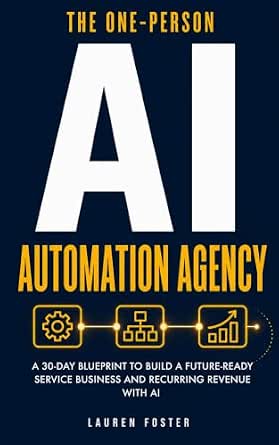 | Best for Starting an AI Service Business | Format: Book (digital) | Structure: 30-day actionable blueprint | Core Focus: AI automation agency business | VIEW LATEST PRICE | See Our Full Breakdown |
| AI-Powered Automation and Workflows for Small Business Owners (AI Productivity for Small Business Owners Book 5) |  | Best Series-Based Workflow Pick | Format: Book (digital) | Series: AI Productivity for Small Business Owners, Book 5 | Core Focus: AI-powered workflows and productivity | VIEW LATEST PRICE | See Our Full Breakdown |
| AI Automation for Small Businesses: The Practical 2026 Guide to Saving Time, Reducing Costs & Growing Your Business |  | Best Current-Year Starter Guide | Format: Book (digital) | Edition: Practical 2026 Guide | Core Focus: Time savings, cost reduction, business growth | VIEW LATEST PRICE | See Our Full Breakdown |
| Scaling a Business Using AI Automation |  | Best for Growth-Stage Founders | Format: Book (digital/print) | Primary Focus: Scaling businesses with AI automation | Core Topics: Intelligent systems, growth automation, operational complexity reduction | VIEW LATEST PRICE | See Our Full Breakdown |
| Upskill or Out: AI, Small Business, and the New American Dream |  | Best Big-Picture Read | Format: Book (digital/print) | Primary Focus: AI’s impact on small business and career adaptation | Core Topics: Upskilling, technological change, entrepreneurship and the American Dream | VIEW LATEST PRICE | See Our Full Breakdown |
| AI automation software for small business | Format | Core focus | Coding required | Audience Level |
|---|---|---|---|---|
| The AI Automation Agency Stand | Professional guide / system (digital book) | High-value client delivery and production-grade AI agents | No (professional systems focus) | — |
| AI Automation & No-Code Bluepr | Digital guide / blueprint | Connecting LLMs to no-code workflow platforms | No | — |
| The No-Code AI Automation Hand | Digital handbook | Automating routine busywork across the business | No | — |
| AI + WhatsApp Small Business A | Digital practical guide | AI-driven sales, follow-ups, and customer service on WhatsApp | No | — |
| Agentic AI for Small Business: | Digital playbook | Agentic (decision-making) no-code automation | No | — |
| AI for Small Business: From Ma | Book (digital/ paperback) | — | No | Small business owners and managers |
| AI Automation for Small Busine | Book (digital) | Semi-passive income automation | No | Beginner solopreneurs |
| The One-Person AI Automation A | Book (digital) | AI automation agency business | — | — |
| AI-Powered Automation and Work | Book (digital) | AI-powered workflows and productivity | No | Beginner to intermediate owners |
| AI Automation for Small Busine | Book (digital) | Time savings, cost reduction, business growth | No | Beginner small business owners |
| Scaling a Business Using AI Au | Book (digital/print) | — | — | Intermediate to advanced business owners |
| Upskill or Out: AI | Book (digital/print) | — | — | Beginner-friendly, big-picture oriented |
More Details on Our Top Picks
The AI Automation Agency Standard
The AI Automation Agency Standard stands out for readers whose endgame isn’t automating their own shop — it’s selling automation as a service. Where most titles in this roundup teach a small business owner to reclaim ten hours a week, this one frames AI automation as a product: production-grade agents, high-value clients, recurring retainers, and a business that runs without the founder glued to it. Compared with The No-Code AI Automation Handbook, which stops at internal efficiency, this goes straight to client delivery and ROI proof, which is what agency buyers actually pay for. The tradeoff is steep: it assumes you already understand AI tooling and skips the hand-holding, and there’s no visible pricing or ratings to gauge credibility. This pick makes sense for consultants ready to productize; solo shop owners should start elsewhere.
Pros:- Complete professional system covering client delivery, not just tools
- Strong focus on recurring revenue and founder independence
- Covers production-grade AI agents rather than toy demos
- Written for high-value B2B client work
Cons:- Assumes prior AI and business-development knowledge
- No pricing, specs, or customer ratings to verify quality
- Too agency-focused for readers automating their own business
Best for: Consultants and technical founders who want to package AI automation as a client service with recurring revenue
Not ideal for: Small business owners automating their own operations — the agency-client framing adds complexity they don’t need
- Format:Professional guide / system (digital book)
- Target audience:AI automation agency founders and consultants
- Core focus:High-value client delivery and production-grade AI agents
- Business model coverage:Recurring revenue and founder independence
- Coding required:No (professional systems focus)
- Skill level:Intermediate to advanced
Our verdict“Buy this only if your goal is running an automation agency for paying clients, not streamlining your own back office.”
AI Automation & No-Code Blueprint
This option earns its spot as the most tool-specific guide in the lineup. Rather than surveying AI broadly, it drills into connecting large language models with Make.com and Zapier — the two platforms most small businesses already touch. Compared with Agentic AI for Small Business, which stays conceptual about no-code automation, this blueprint names the actual plumbing, so readers finish with working integrations instead of vague inspiration. The promise of saving 20+ hours weekly is realistic only if you commit to building multiple workflows, which is the real tradeoff: this is a builder’s book, not a reading-only book. Advanced users may find the technical depth thin in places, and the book doesn’t specify platform pricing tiers, which matter since Make and Zapier costs scale with usage.
Pros:- Explicit coverage of Make.com and Zapier integrations
- No coding required, lowering the barrier to entry
- Concrete time-saving target (20+ hours weekly)
- Focused on autonomous systems, not one-off automations
Cons:- Light on technical depth for advanced builders
- No version or platform pricing details, and tool subscriptions add ongoing cost
Best for: Operationally-minded owners and solo operators who want hands-on workflow builds in Make.com or Zapier
Not ideal for: Readers who want strategy without touching a platform dashboard — this book expects you to build
- Format:Digital guide / blueprint
- Platforms covered:Make.com and Zapier
- Core focus:Connecting LLMs to no-code workflow platforms
- Claimed time savings:20+ hours per week
- Coding required:No
- Skill level:Beginner to intermediate
Our verdict“The clear pick if you already use Make.com or Zapier and want LLM-powered workflows wired up this week.”
The No-Code AI Automation Handbook
If the roundup’s question is “which book best helps a small business automate,” this is the one I’d put at the top of the list. It keeps the framing tight — reclaiming 10 hours a week from busywork — and speaks directly to owners doing tasks by hand, not developers or agency builders. Compared with AI + WhatsApp Small Business Automation, which narrows to one messaging channel, this handbook spans the routine work across a business: follow-ups, scheduling, admin, and repetitive ops. That breadth is its strength and its ceiling. The no-code approach means non-technical readers can act on it immediately, but anyone wanting wiring diagrams for specific platforms will get more from AI Automation & No-Code Blueprint. The honest tradeoff: it’s a strategy-first book, and its small-business lens means larger teams will outgrow it fast.
Pros:- Broad coverage of routine small business tasks, not a single channel
- Genuinely accessible to non-technical readers
- Concrete, believable time-saving goal (10 hours weekly)
- Immediately actionable without tool purchases upfront
Cons:- No technical or coding detail for readers who want depth
- Small-business scope limits usefulness for larger operations
Best for: Time-strapped small business owners who want broad, no-code automation strategies they can apply without any technical background
Not ideal for: Readers who need platform-specific build instructions or plan to automate at agency scale
- Format:Digital handbook
- Target audience:Small business owners and non-technical operators
- Core focus:Automating routine busywork across the business
- Claimed time savings:10 hours per week
- Coding required:No
- Skill level:Beginner
Our verdict“The most balanced starting point for owners who want practical automation wins without learning to build systems.”
AI + WhatsApp Small Business Automation
Where the other picks in this roundup generalize, this guide bets everything on one channel done well. For businesses that live in WhatsApp — salons, local services, restaurants, appointment-driven trades — that focus pays off: faster sales responses, disciplined follow-ups, and AI-assisted customer service all in the app customers already use. Compared with The No-Code AI Automation Handbook, which spreads across back-office busywork, this goes deeper on the revenue-facing side of automation, which matters when slow replies are losing you deals. The tradeoff is obvious: if your customers are on email or web chat rather than WhatsApp, most of the book won’t apply. It also assumes baseline familiarity with both WhatsApp Business tools and AI concepts, so absolute beginners may want a general primer first.
Pros:- Deep, channel-specific tactics rather than generic advice
- Directly targets sales response time and follow-up revenue
- Covers customer service automation, not just marketing
- Actionable for teams that already use WhatsApp daily
Cons:- Single-channel focus limits applicability outside WhatsApp-heavy markets
- Assumes prior familiarity with AI tools and WhatsApp Business; light on technical setup steps
Best for: Appointment-driven and local service businesses whose customers already communicate via WhatsApp
Not ideal for: B2B or e-commerce businesses operating mainly through email and web channels — the single-channel focus won’t transfer
- Format:Digital practical guide
- Core focus:AI-driven sales, follow-ups, and customer service on WhatsApp
- Target audience:Customer-facing small businesses using WhatsApp
- Channel coverage:WhatsApp only
- Coding required:No
- Skill level:Beginner to intermediate (some AI/WhatsApp familiarity assumed)
Our verdict“Worth it only if WhatsApp is your primary customer channel — otherwise choose a broader automation guide.”
Agentic AI for Small Business: No-Code Automation Playbook
This playbook’s differentiator is timing: it’s built around agentic AI — systems that act and make decisions, not just trigger-and-action workflows. That puts it a conceptual step ahead of AI Automation & No-Code Blueprint, whose Make.com and Zapier recipes are powerful but fundamentally static. For owners thinking about where automation is heading, the step-by-step no-code format makes an otherwise abstract topic approachable, and the pitch of automating with just a few focused hours per week suits part-time operators. The tradeoff is that agentic tooling is young and moving fast, so parts of the playbook may age quicker than the platform-agnostic advice in The No-Code AI Automation Handbook. It also glosses over the cost of the underlying tools and subscriptions you’ll need to actually run agentic systems, which can add up quietly.
Pros:- Focused on agentic AI, a step beyond basic workflow automation
- Step-by-step structure suited to self-learners
- No-code approach keeps it accessible
- Designed around small weekly time commitments
Cons:- Fast-moving agentic tooling may date the content quickly
- Requires additional tools or subscriptions not priced in the book
- Thin technical instructions when builds get complex
Best for: Owners who want to get ahead of the curve on agentic, decision-making AI without writing code
Not ideal for: Readers who want stable, battle-tested automation recipes — agentic tooling changes faster than a printed playbook can track
- Format:Digital playbook
- Core focus:Agentic (decision-making) no-code automation
- Target audience:Small business owners and early adopters
- Time commitment:A few hours per week
- Coding required:No
- Additional requirements:External no-code tools or subscriptions
Our verdict“A smart pick for early adopters who want decision-making automation now, provided they budget for the tools it assumes.”
AI for Small Business: From Marketing and Sales to HR and Operations, How to Employ the Power of Artificial Intelligence for Small Business Success
Most books in this roundup zoom in on one function — workflow automation or client acquisition — but this one takes the widest-angle view, walking through marketing, sales, HR, and operations under a single framework. That breadth is the whole point: an owner who wants AI adoption across the company, not just in one corner of it, gets a coherent cross-functional roadmap rather than a stack of disconnected tactics. Compared with AI-Powered Automation and Workflows for Small Business Owners, which leans heavily on productivity workflows, this pick functions better as a strategic planning document for leadership decisions. The tradeoff is depth — readers who want step-by-step tool instruction will need a follow-up resource, and the lack of pricing or rating data makes it harder to gauge market validation before committing.
Pros:- Covers four distinct business functions in one framework
- Frames AI as a business strategy rather than a gadget list
- Written for decision-makers, not engineers
- Works as a long-term reference as the business grows
Cons:- Too broad to deliver deep, tool-specific instructions
- No pricing or customer ratings available to verify reception
- Requires readers to translate strategy into execution themselves
Best for: Owner-operators or small leadership teams planning company-wide AI adoption across multiple departments
Not ideal for: Solo founders who want immediate, tactical workflow fixes — the broad scope slows down quick wins
- Format:Book (digital/ paperback)
- Topic Coverage:Marketing, sales, HR, operations
- Audience Level:Small business owners and managers
- Approach:Strategic and cross-functional
- Coding Required:No
- Use Case:Company-wide AI adoption planning
Our verdict“This is the pick for owners who want a unified AI game plan across the whole business before touching any specific tool.”
AI Automation for Small Businesses: Build Semi-Passive Income Systems Without Hiring or Coding
Where AI for Small Business spreads itself across departments, this book commits to one narrow promise: semi-passive income systems built by a single person with no coding and no payroll. That constraint is its strength. A freelancer or solopreneur drowning in manual work gets a playbook aimed squarely at replacing labor with systems, not managing a team through a transformation. Compared with The One-Person AI Automation Agency, which is about selling automation to clients, this one is about automating your own revenue — an important distinction buyers should catch before choosing. The real drawback is thinness on the technical side: it tells you what to build conceptually but rarely walks through exactly how, so expect to fill gaps with free tutorials or a companion resource.
Pros:- Zero hiring or coding prerequisites lower the entry barrier
- Focused specifically on income-generating automation
- Practical rather than theoretical in tone
- Suits time-poor readers who need a single-purpose playbook
Cons:- Light on step-by-step technical instruction
- Not built for advanced users who want sophisticated AI systems
- Semi-passive income claims depend heavily on reader execution
Best for: Solopreneurs and side-hustle builders who want to automate their own income streams without staff or developers
Not ideal for: Established businesses automating team operations — the solo income focus misses that scenario entirely
- Format:Book (digital)
- Core Focus:Semi-passive income automation
- Coding Required:No
- Hiring Required:No
- Audience Level:Beginner solopreneurs
- Use Case:Building automated income systems
Our verdict“Choose this if you’re one person trying to turn automation into personal income rather than into a client service or a team workflow.”
The One-Person AI Automation Agency: A Practical 30-Day Blueprint to Build a Future-Ready Service Business, Win Small-Business Clients, and Create Recurring Revenue with Artificial Intelligence
This is the only entry in the batch aimed at selling automation as a service rather than using it internally. Its 30-day blueprint structure gives aspiring agency founders a dated, checkbox-style plan — client acquisition, recurring revenue, service positioning — which is a sharper framework than the general strategy advice in AI for Small Business. Readers who already understand AI basics and want to monetize the skill set will find the sequence genuinely actionable. The flip side is real: the book assumes prior familiarity with automation concepts and stays vague on specific tools and technical delivery, so a complete beginner will struggle to fulfill the services it teaches them to sell. Pair it with a hands-on title like AI Automation & No-Code Blueprint if you need the technical layer underneath.
Pros:- Concrete 30-day timeline creates momentum and accountability
- Focused on recurring revenue, not one-off gigs
- Addresses client acquisition, the hardest part of solo agencies
- Designed specifically for a one-person business model
Cons:- Assumes prior AI and automation knowledge
- Skips technical and tool-level delivery details
- Marketing-heavy content may underprepare readers for actual client work
Best for: Consultants, freelancers, and career-changers who want to launch a one-person AI automation agency with recurring clients
Not ideal for: Business owners automating their own operations — there’s almost nothing here for internal use cases
- Format:Book (digital)
- Structure:30-day actionable blueprint
- Core Focus:AI automation agency business
- Revenue Model:Recurring client revenue
- Prerequisites:Familiarity with AI and automation concepts
- Business Size:One-person operation
- Use Case:Launching a client-facing AI service business
Our verdict“If your goal is building a service business around AI automation — not automating your own — this blueprint is the clear choice in the lineup.”
AI-Powered Automation and Workflows for Small Business Owners (AI Productivity for Small Business Owners Book 5)
As Book 5 in an ongoing series, this title carries both an advantage and a caveat. The advantage: it sits inside a structured learning path, so readers who like progressive depth can start with earlier volumes on AI productivity and graduate to this workflow-focused installment. Compared with AI Automation for Small Businesses: The Practical 2026 Guide, which packages everything into one release, this one goes narrower and steadier on workflow design — building repeatable processes rather than chasing savings everywhere at once. For an owner whose real pain is busywork and process drag, that focus lands better than a broad business guide. The caveat is obvious: standalone readers may hit references to concepts from earlier books, and advanced users will find the treatment too general to teach them anything new about the tools themselves.
Pros:- Tight focus on workflows and process efficiency
- Part of a structured series for progressive learning
- Tailored to small business management realities
- Practical orientation over theory
Cons:- Works best when read alongside earlier books in the series
- Too general for advanced users seeking tool-specific depth
- No technical implementation details provided
Best for: Owners who want a focused, series-backed treatment of workflow automation and plan to learn progressively
Not ideal for: Advanced automators or readers who want a single standalone guide covering everything
- Format:Book (digital)
- Series:AI Productivity for Small Business Owners, Book 5
- Core Focus:AI-powered workflows and productivity
- Audience Level:Beginner to intermediate owners
- Coding Required:No
- Use Case:Streamlining daily business processes
Our verdict“Pick this if workflow inefficiency is your specific bottleneck and you value a series you can grow with over one-shot guides.”
AI Automation for Small Businesses: The Practical 2026 Guide to Saving Time, Reducing Costs & Growing Your Business
Freshness is the differentiator here. An updated-for-2026 edition matters in a category where tools, pricing, and capabilities shift every few months — an older title like AI for Small Business can reference platforms and workflows that have since changed. This guide frames everything around three measurable outcomes — time saved, costs cut, growth achieved — which makes it the easiest entry point for an owner who wants business results, not education for its own sake. Compared with the series-based AI-Powered Automation and Workflows, it trades depth for breadth and currency in a single self-contained volume. The honest tradeoff: it’s a guidebook, not a manual. Expect direction and prioritization help, not screenshots, tool walkthroughs, or technical configuration — readers wanting hands-on setup should budget for a second, more technical resource.
Pros:- Updated for 2026, avoiding stale tool references
- Organized around measurable business outcomes
- Self-contained — no series commitment required
- Accessible framing for AI newcomers
Cons:- General guidance rather than technical instruction
- Shallow for owners with existing automation experience
- Annual updates mean content dates quickly
Best for: First-time adopters who want the most current overview before investing time or money in any AI tool
Not ideal for: Readers who already automate parts of their business and need advanced tactics or tool-level detail
- Format:Book (digital)
- Edition:Practical 2026 Guide
- Core Focus:Time savings, cost reduction, business growth
- Audience Level:Beginner small business owners
- Coding Required:No
- Structure:Standalone single volume
- Use Case:First steps in AI automation
Our verdict“If you want one current, outcome-driven starting point before committing to any AI tool, this is the most up-to-date general guide in the batch.”
Scaling a Business Using AI Automation
Most titles in this roundup focus on getting started with automation — think The No-Code AI Automation Handbook or the Agentic AI for Small Business playbook — but this one targets founders who have already validated their model and now face a different problem: growing without adding operational chaos. The emphasis on building intelligent systems and reducing complexity distinguishes it from tool-centric guides that stop at connecting Zapier to an LLM.
The tradeoff is real, though. Compared with AI Automation & No-Code Blueprint, which walks through concrete builds, this book stays at the strategy level. Readers who need step-by-step technical implementation will come away motivated but not equipped. The absence of reviews also makes it harder to gauge how the advice lands in practice.
Pros:- Focuses on scalable growth rather than one-off task automation
- Frames AI as a system-building discipline, not just tool adoption
- Directly addresses reducing operational complexity as companies grow
- Complements hands-on guides by supplying the strategic layer they lack
Cons:- Lacks detailed technical implementation — no tool walkthroughs or builds
- No customer reviews available to validate the advice
- Strategy-level content may feel repetitive if you already read growth books
Best for: Founders of established small businesses (roughly 10+ employees or consistent revenue) who need a strategic framework for scaling operations with AI rather than a beginner tutorial
Not ideal for: Solo entrepreneurs or first-time automators who need screen-by-screen setup instructions — the strategic altitude here will feel abstract without hands-on guidance
- Format:Book (digital/print)
- Primary Focus:Scaling businesses with AI automation
- Core Topics:Intelligent systems, growth automation, operational complexity reduction
- Technical Depth:Strategic — minimal implementation detail
- Audience Level:Intermediate to advanced business owners
- Customer Reviews:None available at time of writing
Our verdict“A strategic companion for founders past the startup phase who want AI systems that scale — pair it with a hands-on guide rather than expecting both from one book.”
Upskill or Out: AI, Small Business, and the New American Dream
Where nearly every other entry in this lineup — including AI Automation for Small Businesses: The Practical 2026 Guide — promises tactical time savings, this book asks a broader question: what does AI mean for the people running and working in small businesses? That framing makes it the roundup’s mindset and career-adaptation pick rather than another workflow manual.
The tradeoff is depth. Readers who want the connect-the-tools approach of AI + WhatsApp Small Business Automation will find little here about specific implementations, and the absence of named case studies means the arguments rest on general reasoning rather than documented examples. Still, for owners weighing whether to reskill themselves or their teams, this fills a gap the tactical guides leave empty.
Pros:- Addresses the human and skills side of AI adoption, not just tools
- Broadens the conversation to long-term economic and career implications
- Practical upskilling guidance for entrepreneurs and employees alike
- Useful preparation before committing to any of the tactical guides in this roundup
Cons:- No specific case studies to ground the broader arguments
- Lacks technical content — you won’t automate anything from this book alone
- Big-picture tone may frustrate readers seeking immediate, actionable returns
Best for: Small-business owners and self-employed professionals deciding how to invest in AI skills, and team leaders planning workforce upskilling over the next few years
Not ideal for: Buyers who want a build-it-this-weekend automation manual — there are no workflows, tool setups, or technical sequences here
- Format:Book (digital/print)
- Primary Focus:AI’s impact on small business and career adaptation
- Core Topics:Upskilling, technological change, entrepreneurship and the American Dream
- Technical Depth:Conceptual — no implementation guides
- Audience Level:Beginner-friendly, big-picture oriented
- Customer Reviews:Limited availability at time of writing
Our verdict“Read this first if you want to understand why and where to upskill before diving into hands-on automation guides — skip it if you only need workflows today.”

How We Picked
I evaluated each option through one lens: can a small business owner without a coding background actually implement this and see measurable time or cost savings? That meant prioritizing no-code workflows, realistic hour-saving estimates, and clear before-and-after examples over theoretical AI explanations. I also weighed platform dependence — guides tethered to a single tool lose value the moment that tool changes its pricing or interface, so platform-agnostic frameworks ranked higher all else being equal.
The second criterion was fit to buyer intent. Some readers want to fix their own operations; others want to build an automation service business. Ranking these against each other directly would be misleading, so I ordered the list by how well each option serves the largest group of buyers (owner-operators) while flagging the agency plays clearly. Finally, I factored in longevity and scalability: whether the material grows with a business from solo founder to small team, or tops out once the basics are automated.
| AI automation software for small business | Coding required | Audience Level |
|---|---|---|
| The AI Automation Agency Stand | No (professional systems focus) | — |
| AI Automation & No-Code Bluepr | No | — |
| The No-Code AI Automation Hand | No | — |
| AI + WhatsApp Small Business A | No | — |
| Agentic AI for Small Business: | No | — |
| AI for Small Business: From Ma | No | Small business owners and managers |
| AI Automation for Small Busine | No | Beginner solopreneurs |
| The One-Person AI Automation A | — | — |
| AI-Powered Automation and Work | No | Beginner to intermediate owners |
| AI Automation for Small Busine | No | Beginner small business owners |
| Scaling a Business Using AI Au | — | Intermediate to advanced business owners |
| Upskill or Out: AI | — | Beginner-friendly, big-picture oriented |
Factors to Consider When Choosing AI Automation Software For Small Business
Before committing to any AI automation guide or system, it helps to understand the broader landscape — because the biggest mistakes in this category happen before you even open the first chapter.Know Which Problem You’re Actually Solving
The most expensive mistake in this category is buying an agency-building system when you needed an operations fix — or vice versa. Agency programs are structured around client acquisition, pricing, and deliverables, which is wasted material if your real goal is stopping your own team from copy-pasting data between apps. Owner-focused guides, on the other hand, won’t teach you how to package automation as a sellable service. Be honest about whether you want saved hours or new revenue, because the best pick for one goal is usually mediocre for the other. A quick audit of where your week actually goes — invoicing, follow-ups, scheduling, data entry — will tell you which type of resource earns its price.
Platform-Specific vs. Platform-Agnostic
Guides built around Make.com, Zapier, or a specific channel like WhatsApp get you to a working automation faster, since every step maps to a button you can click. The tradeoff is shelf life: automation platforms redesign their interfaces and pricing constantly, and screenshots go stale within a year or two. Platform-agnostic guides teach transferable concepts — trigger logic, workflow design, human-in-the-loop checkpoints — that survive software churn but require you to do more translation work upfront. My suggestion for most small businesses is to start with one tool-specific guide to get a quick win, then add a conceptual playbook once you understand what you’re building. If you already know which platform your business runs on, the specific guide is usually the better first purchase.
Realistic Time Savings vs. Marketing Claims
Nearly every product in this category advertises double-digit weekly hour savings, and some of those claims are achievable — but only for businesses with repetitive, high-volume processes to automate. A consultancy sending five invoices a week will not reclaim 20 hours no matter how good the system is. Before buying, tally the tasks you repeat daily: if the honest number is under five hours of automatable work, invest in a lighter, cheaper guide rather than a premium system. The bigger claims typically assume you automate marketing, follow-ups, and customer service together, which takes weeks of setup — not an afternoon. Treat advertised hour counts as ceilings, not guarantees, and match your purchase size to your actual automation surface area.
Technical Floor and Team Buy-In
Even no-code tools have a learning curve, and the honest question is who on your team will own the setup. If it’s you, a solo founder with limited evenings, prioritize guides with copy-paste templates and short chapters over dense reference manuals. If you have an operations manager or a technically curious employee, thicker systems with deeper architecture discussions become viable. Team buy-in matters more than most buyers expect: an automation that saves five hours but that nobody on staff trusts or maintains will quietly break within a quarter. Look for material that covers handoff and maintenance, not just the initial build, because the ongoing ownership question is where most small business automations die.
Budget, Payback Period, and When to Pay More
Premium systems in this category can cost several times more than entry-level guides, and that premium is only justified when there’s a revenue model attached — recurring client income, a semi-passive system, or a documented ROI framework. If your payoff is purely saved hours, the payback math rarely justifies the top-tier price: a $15 guide that saves you three hours a week has already beaten an expensive system that saves five. Pay more when you’re buying a repeatable business process, not just knowledge. Also watch for hidden costs beyond the guide itself — most automation platforms charge monthly fees that scale with task volume, so budget for the software subscription, not just the learning material. The cheapest option is rarely the best value if it skips the implementation detail that makes everything click.
Freshness: Why Publication Date Matters More Than Usual
AI automation moves faster than almost any business category, and a guide written even two years ago may reference tools that have merged, changed names, or disappeared. Check the publication or revision date before buying, and favor resources that promise ongoing updates or that were written specifically for the current landscape. That said, don’t dismiss older material automatically — books focused on principles like process mapping and workflow logic hold up well, while anything screenshot-heavy degrades fast. The 2026-dated guides in this roundup generally reflect current platform pricing and AI capabilities, which is one reason they rank above undated predecessors. If a resource doesn’t state when it was last updated, treat that as a yellow flag.
Frequently Asked Questions
Do I need coding skills to benefit from AI automation as a small business owner?
No — every option in this roundup assumes a non-technical reader, which is precisely why no-code platforms like Make.com and Zapier feature so heavily. What you do need is patience for workflow logic: understanding that when X happens, do Y is the core skill, and it’s closer to planning than programming. The guides that ranked highest walk you through your first automation line by line rather than assuming you’ll figure out the tool on your own. That said, expect a ramp-up of several evenings before your first meaningful automation runs reliably. If you find even that daunting, start with the beginner-flagged picks before touching the agency-level systems.
Should I buy an owner-focused guide or an agency-building system?
Start with your goal, not the product’s marketing. If your business bleeds hours into manual follow-ups, invoicing, and data entry, an owner-focused guide pays for itself within weeks and needs no further justification. Agency systems only make sense if you actively want a service business selling automation to other companies — they assume you’ll learn the technical side and the client acquisition side simultaneously, which is a much bigger commitment. A reasonable middle path: automate your own operations first, then decide whether those skills could become a revenue stream. Several readers find that a few months of self-implementation is the best possible training for client work later.
Are the advertised 10–20 hour weekly time savings realistic?
They’re achievable but not automatic — the figure depends entirely on how much repetitive, rule-based work your business actually has. Service businesses juggling quotes, appointment reminders, and customer messaging are the sweet spot; a business doing a handful of high-touch transactions each week will see far less. The honest framing is that these guides give you a multiplier on existing busywork, not free hours from nowhere. Expect meaningful savings to build over one to three months as you automate process by process, not on day one. Anyone promising instant 20-hour weeks is selling to your hopes rather than your calendar.
What will this cost beyond the guide itself?
Budget for platform subscriptions, because most automations run through tools like Make.com, Zapier, or a WhatsApp business API provider that charge monthly fees scaling with task volume. A modest small business setup commonly runs $20–$100 per month in platform costs, though generous free tiers can cover early experiments. Some guides also reference premium AI API usage, which adds pennies per task but compounds at volume. The right move is to prototype on free tiers first, confirm an automation actually saves time, and only then pay for the volume you’ve proven you need. Skipping that step is how small businesses end up paying for automations that run a handful of times a month.
Is a channel-specific guide (like the WhatsApp one) worth buying, or should I go general?
Channel-specific guides are the best value in this roundup if that channel is genuinely where your customers already are — for businesses in booking-heavy trades, local retail, or Latin American and Asian markets, WhatsApp is the front door and a dedicated guide beats generic coverage. The tradeoff is narrowness: you’ll learn one channel deeply while remaining a beginner everywhere else. A general guide spreads the same effort across email, CRM, and operations, which suits businesses with diversified customer contact. If more than half your customer conversations already happen in one channel, buy the specialist guide first and fill gaps with general material later. If your channels are scattered, the general playbook is the smarter first purchase.
Conclusion
After comparing all twelve options, the right pick comes down to what you’re trying to build. For best overall, The No-Code AI Automation Handbook offers the most immediately usable path to reclaiming weekly hours for a typical owner-operator. The best value picks are AI-Powered Automation and Workflows for Small Business Owners and The Practical 2026 Guide — inexpensive, current, and sufficient for most first automation projects. For best premium, The AI Automation Agency Standard is the only option with a complete client-service system and recurring-revenue framework, while The One-Person AI Automation Agency is the more affordable entry into the same model.
Best for beginners goes to AI for Small Business, which covers marketing, sales, HR, and operations without assuming any technical starting point. For specific needs: choose AI + WhatsApp Small Business Automation if messaging is your customer channel, AI Automation & No-Code Blueprint if you’re committed to Make.com and Zapier specifically, and Agentic AI for Small Business if you want forward-looking AI-agent workflows rather than simple triggers. Scaling a Business Using AI Automation suits owners past the beginner stage, Semi-Passive Income Systems fits solo founders building lean income streams, and Upskill or Out works best as big-picture context rather than a how-to. Whatever you choose, start with one process, prove the time savings, and expand from there.
Halloween Picks
halloween
As an affiliate, we earn on qualifying purchases.