

Small business owners searching for AI automation tools for small business face a crowded field of guides, playbooks, and toolkits promising time savings and growth. After comparing the leading options, AI for Small Business Owners: A Practical Step-by-Step Guide stands out as the best overall pick thanks to its broad coverage of automation, content, and daily operations in one accessible package. Two other options deserve early attention: Agentic AI for Small Business: The No-Code Weekend Playbook for owners who want hands-on automation built in a single weekend, and AI in Finance and Controlling for Small Business Owners for anyone focused on cash flow and profitability. The main tradeoff in this category is breadth versus depth — generalist guides cover more ground but go shallower, while specialized titles on agents, finance, or marketing deliver deeper results for a narrower use case. Price points also vary widely, from quick-start ebooks to complete systems with structured methodologies. Keep reading for the full breakdown of all 15 options and which one fits your business best.

Get business pricing on tech for your team
- Business-only prices and quantity discounts
- Tax-exempt purchasing
- Multiple users, one account, clear invoices
Key Takeaways
- Step-by-step structured guides consistently outperformed inspirational or strategy-heavy titles because small business owners need implementation roadmaps, not theory about AI’s potential.
- No-code AI agent books emerged as the fastest-growing subcategory, with the weekend playbook format (build in 5 hours, reclaim 15+ weekly hours) offering the clearest time-to-value of any approach.
- Finance-specific AI guides fill a gap most generalist books ignore — monitoring performance and spotting risk — making them a strong complement rather than a substitute for a broad starter guide.
- Beginner-oriented titles that bundle ChatGPT basics with automation workflows reduce the learning curve for owners with no technical background, but overlap heavily with each other.
- Books promising income generation (freelancing, side hustles) ranked lower for established small businesses because they optimize for personal income rather than operational efficiency.




| AI automation tools for small business | Format |
|---|---|
| AI Tools for Small Business Ow | Kindle guide / paperback |
| Agentic AI for Solopreneurs: B | Kindle guide |
| How to Use AI Agents for Your | Kindle guide / paperback |
| AI in Finance and Controlling | Kindle guide |
| The AI Advantage: How Small Bu | Kindle book / paperback |
| AI for Side Hustles & Small Bu | Digital book (Kindle) |
| Automating Small Businesses Us | Digital book (Kindle) |
| AI for Small Business Mastery: | Digital book (Kindle) |
| AI Tools for Business and Prod | Digital book (Kindle) |
| AI Automation for Small Busine | Digital book (Kindle) |
| AI for Small Business: From Ma | Paperback / eBook |
| AI Automation for Small Busine | Kindle eBook / Paperback |
| AI for Small Business Owners: | Kindle eBook / Paperback |
| Make Money with AI: The Comple | Kindle eBook / Paperback |
| Agentic AI for Small Business: | Kindle eBook / Paperback |
More Details on Our Top Picks
AI Tools for Small Business Owners: A 30-Day Starter Guide to Save Time, Create Better Content & Grow Smarter
Not everyone wants to rebuild their business around AI on day one — some just want a day-by-day on-ramp, and that is exactly what this guide delivers. The 30-day structure is its strongest asset: instead of a firehose of tools, readers get a paced plan that translates into actual habits rather than abandoned bookmarks. Compared with How to Use AI Agents for Your Business, which jumps straight into building an AI team, this option starts slower and focuses on content quality and time savings first, making it far less intimidating. The tradeoff is depth — experienced operators will find the material thin, and anyone wanting tool-by-tool technical walkthroughs will need a follow-up resource. This pick makes the most sense for someone who has heard about AI for months but never committed to a structured start.
Pros:- Structured 30-day plan that builds momentum gradually
- Direct focus on content quality and time savings
- Genuinely accessible for readers with zero AI background
- Applies broadly across business types
Cons:- Lacks detailed technical instructions for setting up tools
- Skips advanced tools and multi-step automation
- Too basic for anyone with existing AI experience
Best for: Small business owners who are completely new to AI and want a paced, low-pressure introduction they can follow alongside daily operations
Not ideal for: Owners already running AI workflows — the basics and lack of technical depth will feel redundant
- Format:Kindle guide / paperback
- Structure:30-day progressive plan
- Experience level:Beginner
- Primary focus:Content creation, time management, business growth
- Technical depth:Introductory, non-technical
- Audience:Small business owners new to AI
- Tools covered:General-purpose AI tools overview
Our verdict“Buy this if you want a guided, beginner-friendly entry point into AI rather than a technical manual.”
Agentic AI for Solopreneurs: Build Smart No Code Systems with AI Agents to Save Time and Scale Your Business
Where most books in this roundup address small businesses with teams, this one zero-es in on the solo operator who is the marketing department, the bookkeeper, and the support desk all at once. Its no-code agent systems framing is the differentiator: the promise is delegation to AI agents without hiring or learning to program. Compared with AI Tools for Small Business Owners: A 30-Day Starter Guide, this option is more ambitious — it is about building systems that run without you, not just working faster. The tradeoffs are real, though: it stays light on specific tool recommendations, so readers will still need to research which platforms to actually use, and the lack of reviews means the advice is unproven at scale. This pick makes the most sense for a freelancer or consultant drowning in repetitive admin work.
Pros:- Purpose-built for one-person businesses, not teams
- No-code approach removes the technical barrier entirely
- Focuses on scalable systems rather than one-off tactics
- Efficient path to automating routine business tasks
Cons:- Limited details on specific tools and platforms
- No customer reviews to validate the strategies
- Assumes comfort with self-directed experimentation
Best for: Freelancers, consultants, and solopreneurs who want to replace repetitive admin tasks with self-running no-code AI systems
Not ideal for: Readers who want named tool tutorials — you will finish inspired but still shopping for the actual software
- Format:Kindle guide
- Approach:No-code AI agent systems
- Experience level:Beginner-friendly
- Primary focus:Task automation, solo scaling, time savings
- Target reader:Solopreneurs and freelancers
- Technical requirement:No coding required
- Tool specificity:Concepts over named tools
Our verdict“A strong choice for solo operators who think in systems, provided they are willing to source their own tools afterward.”
How to Use AI Agents for Your Business: Build Your First AI Team with ChatGPT, Automation, and No-Code Tools
This guide earns its spot by being the most action-oriented entry in the lineup: the core premise — assembling a virtual AI team using ChatGPT and no-code automation — gives readers a concrete architecture to build toward rather than vague strategy. Next to Agentic AI for Solopreneurs, which covers similar territory for one-person shops, this option casts a wider net and offers step-by-step instructions, making it the better fit for small businesses with a few employees who can divide the AI workload. Naming ChatGPT explicitly also helps: readers know exactly where to start, which several competitor titles avoid. The compromise is that it still lacks detailed technical instructions and skips pricing entirely, so budgeting for the stack it describes is left to the reader. This pick suits owners who want to move from reading to doing within a weekend.
Pros:- Concrete framework for building an AI team, not just tool lists
- Anchors examples in ChatGPT for an easy starting point
- Step-by-step structure suitable for beginners
- Combines agents, automation, and no-code tools in one system
Cons:- Lacks detailed technical instructions for complex setups
- No pricing information to help plan a tool budget
- ChatGPT-centric approach may limit readers on other platforms
Best for: Owners ready to build a working multi-agent setup around ChatGPT and want step-by-step direction rather than theory
Not ideal for: Readers who need cost breakdowns and deep technical configuration details before committing
- Format:Kindle guide / paperback
- Core concept:Building an AI agent team
- Primary tools:ChatGPT, no-code automation platforms
- Experience level:Beginner to intermediate
- Structure:Step-by-step instructions
- Audience:Small businesses ready to implement
- Pricing guidance:Not included
Our verdict“The most build-oriented title here — ideal if you want to construct an AI workflow now, not just read about one.”
AI in Finance and Controlling for Small Business Owners: Affordable AI Tools to Monitor Performance, Spot Risks, and Optimize Profit
Most AI-for-business books lean heavily on marketing and content — this one deliberately goes the other way, targeting cash flow, risk, and profitability, the areas where small businesses actually fail. The emphasis on affordable AI tools matters here: the framing assumes a bookkeeper-optional budget, not an enterprise one. Compared with The AI Advantage, which stays at the strategy level, this title is more operational, aimed at owners who want to put numbers on a dashboard rather than rethink their competitive position. That said, the drawbacks mirror its peers — it names categories of tools more often than specific products, and finance professionals will find the content too foundational. This pick makes the most sense for an owner who already handles their own books and wants AI to surface problems before they become crises.
Pros:- Rare finance-focused AI guide in a marketing-heavy category
- Prioritizes affordable tools suited to small budgets
- Covers risk monitoring and profit optimization, not just reporting
- Accessible to owners with no AI background
Cons:- Few specific tool recommendations to act on directly
- Too basic for readers with finance or accounting expertise
- Assumes general business math comfort
Best for: Owner-operators who manage their own finances and want AI-driven visibility into performance, risk, and margin
Not ideal for: Businesses with a finance team or accountant — the material will be too basic for professionals
- Format:Kindle guide
- Focus area:Finance, controlling, risk management
- Tool emphasis:Affordable AI solutions
- Experience level:Beginner
- Key outcomes:Performance monitoring, risk detection, profit optimization
- Audience:Small business owners self-managing finances
- Technical depth:Introductory, non-technical
Our verdict“The clear pick if your AI priority is the P&L rather than the content calendar.”
The AI Advantage: How Small Businesses Use Speed and AI to Beat Bigger Competitors
This is the big-picture entry of the batch — less a how-to manual and more a playbook for competing asymmetrically against larger rivals. Its core argument, that speed plus AI is a small company’s structural advantage over slow enterprise incumbents, is supported by real-world examples that most competing titles lack. Where How to Use AI Agents for Your Business tells you how to build, this title tells you why and where to strike — which markets, which processes, which moments of competitor sluggishness. The tradeoff is predictably practical: there is little technical guidance here, and some prior familiarity with AI concepts helps considerably. It also stays industry-agnostic, so niche operators will need to adapt the examples themselves. This pick suits the owner deciding where to invest in AI before worrying about how.
Pros:- Strategy-first framing rather than tool tutorials
- Real-world case examples ground the concepts
- Unique angle on competing against larger companies
- Strong on prioritization — where AI investment pays off most
Cons:- No detailed technical guidance for implementation
- Assumes some prior AI knowledge
- Limited industry-specific applicability
Best for: Founders and owners who want a strategic framework for using AI and agility as a competitive weapon before choosing specific tools
Not ideal for: Hands-on implementers seeking setup instructions — this book will frustrate anyone wanting click-by-click guidance
- Format:Kindle book / paperback
- Category:Business strategy
- Core thesis:Speed and AI as competitive advantage over larger rivals
- Experience level:Intermediate — some AI familiarity assumed
- Examples:Real-world small business cases
- Technical guidance:Minimal — strategic focus
- Industry coverage:General, cross-industry
Our verdict“Read this first if you need conviction and direction on AI strategy; pair it with a hands-on guide for execution.”
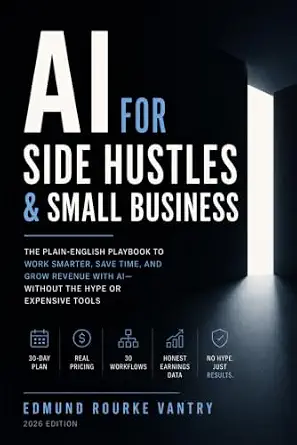
AI for Side Hustles & Small Business: The Complete Playbook to Start, Automate, and Grow
Most AI business books assume you already have a running company with staff and processes. This playbook takes the opposite approach, aiming squarely at first-time founders and side hustlers who need strategy before tooling. Compared with AI Automation for Small Business Success, which targets established operations, this one frames AI around starting and scaling from zero, which changes what gets covered: idea validation, lean automation, and growth on a shoestring.
The no-hype tone is refreshing for readers burned out on AI evangelism, and the budget-conscious framing means you won’t be pushed toward expensive subscriptions. The tradeoff is depth. There’s little technical instruction and no named tool recommendations, so readers wanting copy-paste workflows should look at the more hands-on titles in this lineup instead.
Pros:- Strategy-first approach suited to businesses that don’t exist yet
- Deliberately avoids hype and pushes no expensive tool subscriptions
- Covers the full arc from starting to automating to growing
- Accessible language for readers with no prior AI background
Cons:- Lacks detailed technical instructions for building anything
- No specific tools or software recommendations to act on
- Implementation steps are thin compared with hands-on guides
Best for: Aspiring entrepreneurs and side hustlers who want a strategic, low-cost introduction to AI before investing in specific tools
Not ideal for: Readers who need step-by-step implementation guides or named software recommendations to actually build automations
- Format:Digital book (Kindle)
- Audience Level:Beginner
- Primary Focus:Starting, automating, and growing side businesses
- Tool Recommendations:Not included — deliberately tool-agnostic
- Approach:Strategy playbook, not technical manual
- Language:English
Our verdict“A solid strategic starting point for side hustlers, but not the book to buy if you want build-it-today instructions.”
Automating Small Businesses Using AI Tools: Use AI automation to save time, reduce costs, and grow your business efficiently (Portuguese Edition)
Language access is the entire story here, and it’s a legitimate differentiator. The Portuguese-language edition covers the same time-saving, cost-cutting automation ground as English titles like AI for Small Business Mastery, but for an audience largely ignored by mainstream AI publishing. For Brazilian and Portuguese entrepreneurs, reading about ROI-driven automation in a native language beats struggling through English jargon, and the content is tuned to smaller-market realities rather than Silicon Valley assumptions.
That focus is also its ceiling. Non-Portuguese speakers obviously get nothing from it, and even for the target audience it shares the common weakness of this genre: strategy without implementation detail. Compared with the English playbook titles in this roundup, there’s less depth overall. Buyers wanting actual workflows and tool tutorials will finish this book informed but not equipped.
Pros:- Rare native-language AI automation content for Portuguese speakers
- Frames automation around measurable time and cost savings
- Content adapted to small-business realities, not enterprise scale
- Approachable for owners with no technical background
Cons:- Portuguese-only edition excludes the broader market
- No detailed technical or implementation guidance
- Thinner overall depth than comparable English-language titles
Best for: Portuguese-speaking small business owners in Brazil or Portugal who want AI automation concepts explained in their native language
Not ideal for: Non-Portuguese speakers, and anyone who needs hands-on technical walkthroughs regardless of language
- Format:Digital book (Kindle)
- Language:Portuguese
- Audience Level:Beginner to intermediate
- Primary Focus:Time savings, cost reduction, and business growth via AI
- Tool Recommendations:Concepts only, minimal tool-specific detail
- Regional Relevance:Brazilian and Portuguese small businesses
Our verdict“The clear pick for Portuguese-speaking owners, but only as a conceptual primer rather than a working manual.”
AI for Small Business Mastery: Automating Marketing and Finance with ChatGPT and the 3M System
Where most entries in this roundup survey AI broadly, this book bets everything on two functions — marketing and finance — and on a single tool: ChatGPT. That narrowness is its strength. A small business owner drowning in invoice chasing and content calendars gets a repeatable framework (the 3M System) rather than a checklist of vague possibilities. Compared with AI for Side Hustles & Small Business, which stays conceptual, this title at least anchors advice to one platform, so prompts and workflows are easier to replicate.
The tradeoffs are real, though. Everything outside marketing and finance — operations, HR, customer service — is out of scope, and prior familiarity with ChatGPT is assumed. It also lacks detailed technical instruction and has no customer reviews yet to validate the framework, so early buyers carry some risk that the 3M System won’t click for their business.
Pros:- Deep focus on the two highest-impact functions for most small businesses
- Proprietary 3M System gives a repeatable framework, not just tips
- Anchors advice to ChatGPT so examples are easy to replicate
- Practical orientation toward efficiency and growth
Cons:- Narrow scope ignores operations, HR, and customer service
- Assumes prior familiarity with AI tools
- No customer reviews yet, so the framework is unproven at scale
Best for: Owner-operators whose biggest time sinks are marketing content and financial admin and who already use ChatGPT
Not ideal for: Readers needing coverage of operations or customer service, or complete beginners who have never opened ChatGPT
- Format:Digital book (Kindle)
- Audience Level:Intermediate
- Primary Tool Covered:ChatGPT
- Framework:3M System (proprietary methodology)
- Functional Scope:Marketing and finance automation
- Language:English
Our verdict“The most targeted pick here if marketing and finance automation are your priority — just come in already comfortable with ChatGPT.”
AI Tools for Business and Productivity: A Practical Guide to Artificial Intelligence Tools and Strategies for Working Faster, Smarter, and More Efficiently
This is the broadest title in the batch — and that’s a deliberate choice worth understanding. Instead of small-business operations like AI Automation for Small Business Success, it aims at individual professionals working faster and smarter, whether they run a business or not. For a freelancer or consultant who wants AI woven into daily productivity — writing, research, decision-making — that framing fits better than a business-process book would.
The tradeoff is generality. Because it spans many AI applications rather than automating a specific function, nothing gets covered in much depth, and advanced users will find little technical detail to sink their teeth into. It also sits at the back of the pack on market validation, with scant review data to judge quality by. Compared with the 3M System book, which trades breadth for a repeatable framework, this one bets that a wide survey is what productivity seekers actually want.
Pros:- Broad survey across many AI applications and use cases
- Framed around personal productivity outcomes like speed and smarter decisions
- Useful for professionals outside traditional small-business contexts
- Accessible for readers new to AI
Cons:- Wide scope means shallow coverage of any single tool or workflow
- Limited technical detail for advanced readers
- Little market feedback or review data to gauge quality
Best for: Busy professionals and solo consultants who want a broad overview of AI tools to speed up everyday work
Not ideal for: Advanced users or owners wanting deep, function-specific automation playbooks with hands-on detail
- Format:Digital book (Kindle)
- Audience Level:Beginner to intermediate
- Primary Focus:General business productivity with AI
- Scope:Broad — multiple AI applications surveyed
- Business Angle:Professional productivity over company process
- Language:English
Our verdict“A wide-angle primer for productivity-minded professionals — skip it if you want depth on any one automation area.”
AI Automation for Small Business Success: Harnessing Technology to Enhance Efficiency and Growth
This title lands closest to the classic business-process automation position in the lineup: how a going concern wires AI into daily operations to boost efficiency. Compared with AI Tools for Business and Productivity, which follows the individual professional, this one stays on company-level processes and growth, making it the better fit for an owner managing workflows rather than personal output. Its framing of efficiency and growth as the twin goals of automation gives the content a clear throughline.
But it faces stiff competition. Next to AI for Small Business Mastery, which commits to specific functions and a named system, this book’s guidance reads as general and directional rather than actionable — fine for building conviction, weak for execution. It also arrives with no reviews or ratings yet, and advanced readers will find the treatment too surface-level to change how they work.
Pros:- Focuses on company-wide operations rather than individual productivity
- Clearly frames automation around efficiency and growth outcomes
- Suitable for owners with no technical background
- Good orientation read before committing to tool-specific books
Cons:- Content is too general for advanced readers
- No named tools, specs, or technical detail to act on
- Lacks customer reviews or ratings to verify quality
Best for: Established small business owners early in their AI journey who want a conceptual case for process automation
Not ideal for: Advanced users or readers who want named tools, workflows, and technical steps they can implement immediately
- Format:Digital book (Kindle)
- Audience Level:Beginner
- Primary Focus:Operational efficiency and business growth via AI automation
- Perspective:Company-level processes, not individual workflows
- Tool Recommendations:None — conceptual treatment
- Language:English
Our verdict“A decent entry point for owners new to operational AI, but its high-level view limits what you can actually build from it.”
AI for Small Business: From Marketing and Sales to HR and Operations
Among all the titles in this roundup, this one takes the widest-angle view of what AI can do for a small company. Rather than drilling into a single workflow like Agentic AI for Small Business does with automation, it walks through marketing, sales, HR, and operations so an owner can see the whole map before picking where to start. That breadth is genuinely useful during the planning stage — knowing that AI applies to hiring screens and inventory forecasting, not just content, changes how a business prioritizes. The tradeoff is depth. Compared with the step-by-step AI for Small Business Owners guide, this stays at the strategy level, and readers who already know what they want to automate may find it too broad to act on directly.
Pros:- Covers four major business functions in one place
- Strong on strategy and prioritization rather than tool hype
- Useful for building an internal business case for AI spending
- Accessible to readers without any technical background
Cons:- No specific tools, vendors, or technical walkthroughs
- Too broad for owners with a single specialized problem to solve
Best for: Owners and managers in the early planning stage who want a company-wide AI roadmap before committing budget to any single tool or workflow
Not ideal for: Anyone who already knows which task they want to automate and needs hands-on, tool-by-tool instructions
- Format:Paperback / eBook
- Topic Focus:Company-wide AI strategy
- Functions Covered:Marketing, Sales, HR, Operations
- Skill Level Required:Beginner, non-technical
- Approach:Strategic overview and frameworks
- Best Use Case:AI planning and prioritization
Our verdict“This is the pick for owners who need the full landscape of AI across their business before deciding where to invest time and money.”
AI Automation for Small Business: Cut Costs, Increase Profit, and Scale Faster
Where AI for Small Business spreads itself across every department, this book narrows the lens to one question: where does automation actually pay for itself? The framing around cost reduction and margin makes it a better fit for owners under financial pressure who need automation to justify itself quickly. Each strategy is tied to a business outcome — lower overhead, faster scaling — rather than to the novelty of the technology. That said, it sits in an awkward middle ground. It assumes more comfort with implementation than the beginner-friendly AI for Small Business Owners guide, yet it names no specific tools, so readers may finish motivated but unsure which software to open on Monday morning.
Pros:- Every strategy is framed around cost savings or profit growth
- Practical emphasis on scaling without proportional headcount growth
- Better prioritization guidance than broader AI overview titles
- Action-oriented tone suited to time-pressed owners
Cons:- No specific tools or products named, leaving a gap between strategy and execution
- Assumes some technical knowledge to actually implement the ideas
Best for: Cost-conscious owners and operators who want every automation decision tied to profit and scaling outcomes
Not ideal for: Complete beginners who need named tools and click-by-click guidance, since the book assumes some technical confidence
- Format:Kindle eBook / Paperback
- Topic Focus:Cost reduction, profit, and scaling
- Skill Level Required:Intermediate
- Approach:Outcome-driven automation strategies
- Tools Covered:Concepts only, no named products
- Best Use Case:ROI-focused automation planning
Our verdict“Choose this if the bottom line drives your automation decisions and you can handle the implementation details yourself or with a team.”
AI for Small Business Owners: A Practical Step-by-Step Guide to Using AI to Save Time, Create Better Content, Automate Tasks, and Improve Business
This is the most beginner-friendly entry point in the entire lineup. While AI Automation for Small Business assumes you can figure out implementation, this guide holds your hand through each step and explicitly requires no technical experience. The content creation angle is its real strength — compared with Make Money with AI, which leans toward freelancing and side income, this one targets the owner who wants better marketing copy, faster emails, and fewer repetitive admin tasks inside an existing business. The price of that accessibility is ceiling. Readers who master the basics will outgrow it quickly, and the advanced automation territory covered by Agentic AI for Small Business — multi-step no-code systems — is largely out of reach here.
Pros:- Genuinely assumes zero prior technical knowledge
- Step-by-step structure that can be followed one task at a time
- Strong coverage of content creation and everyday task automation
- Directly applicable to running an existing small business
Cons:- Limited depth on advanced or multi-step AI tools
- Small-business scope only — consultants and agency builders will want more
Best for: Non-technical small business owners trying AI for the first time, especially those focused on content and routine task automation
Not ideal for: Owners already comfortable with AI who want advanced agent workflows or multi-tool automation builds
- Format:Kindle eBook / Paperback
- Topic Focus:Time saving, content, task automation
- Skill Level Required:Absolute beginner
- Approach:Practical step-by-step guide
- Technical Prerequisites:None
- Best Use Case:First exposure to AI for an existing business
Our verdict“If the words ‘prompt’ and ‘workflow’ still feel foreign, this is the gentlest on-ramp in the roundup.”
Make Money with AI: The Complete Beginner’s Guide to ChatGPT, Generative AI, AI Tools, Automation, Freelancing, and Online Income
Every other book in this roundup is written for someone running a business; this one is written for someone building an income stream. That distinction matters. Where AI for Small Business Owners helps you automate tasks inside a company you already operate, this guide uses ChatGPT and generative AI as engines for freelancing, online products, and new revenue. The breadth is impressive — it spans tool landscape, automation basics, and multiple monetization paths — which makes it a solid orientation for someone choosing a direction. The flip side of that breadth is vagueness. Compared with the weekend-by-weekend structure of Agentic AI for Small Business, the guidance here stays conceptual, and readers expecting a literal click-by-click path to income will need to fill in gaps themselves.
Pros:- Broad survey of ChatGPT, generative AI, and automation income paths
- Accessible to complete beginners with no business or tech background
- Covers freelancing and online income, a niche no other title in this roundup addresses
- Good for comparing multiple monetization options side by side
Cons:- Concept-heavy rather than step-by-step, which can leave beginners stuck at execution
- Focus on making money with AI rather than improving an existing business’s operations
Best for: Aspiring freelancers and side hustlers who want to understand the full menu of ways to monetize AI before committing to one
Not ideal for: Established business owners who need operational automation — the income-stream focus doesn’t map to running an existing company
- Format:Kindle eBook / Paperback
- Topic Focus:Monetizing AI, freelancing, online income
- Primary Tools Covered:ChatGPT and generative AI
- Skill Level Required:Beginner
- Approach:Concepts and strategy overview
- Best Use Case:Choosing an AI-based income path
Our verdict“Pick this if you want AI to create a new income stream rather than optimize a business you already run — just expect to research specific tactics elsewhere.”
Agentic AI for Small Business: The No-Code Weekend Playbook to Automate Your Business in 5 Hours and Reclaim 15+ Hours Every Week
This is the most execution-driven book in the batch, and its promise is unusually specific: a weekend plan, five hours of setup, 15+ hours saved weekly. Against broader strategy titles like AI for Small Business, the difference is structure — instead of explaining why automation matters, it hands you a schedule for actually doing it with no-code tools. Compared with the beginner-oriented AI for Small Business Owners guide, it also goes further technically, introducing agentic workflows rather than stopping at simple task swaps. That ambition cuts both ways. The no-code framing lowers the barrier, but the book assumes some comfort with automation concepts, so true first-timers may find the weekend pace aggressive and the technical hand-holding thinner than they expect.
Pros:- Highly specific time-saving target (15+ hours per week) that makes results measurable
- No-code approach removes programming as a barrier
- Concrete weekend schedule rather than open-ended advice
- Goes deeper into agentic workflows than beginner-level guides in this lineup
Cons:- Assumes prior familiarity with automation tools despite the no-code label
- Lacks detailed technical instructions for troubleshooting when builds break
Best for: Busy owners who already have basic AI familiarity and want a concrete, time-boxed plan to build automations fast
Not ideal for: Complete beginners with no exposure to automation tools — the compressed weekend format leaves little room for foundational explanation
- Format:Kindle eBook / Paperback
- Topic Focus:No-code agentic AI automation
- Time Commitment:One weekend, ~5 hours of setup
- Claimed Benefit:15+ hours saved per week
- Skill Level Required:Some automation familiarity
- Approach:Time-boxed weekend playbook
- Coding Required:None (no-code tools)
Our verdict“If you want a deadline-driven automation sprint rather than another book about AI strategy, this playbook delivers the most direct path to reclaimed hours.”

How We Picked
I evaluated each option against the criteria that matter most to a small business owner investing time and money in AI automation: actionability (does it give concrete workflows, prompts, or templates rather than vague advice), time-to-value (how quickly a reader can implement something that saves real hours), breadth of business coverage (marketing, finance, operations, HR), and accessibility for non-technical readers. I also weighed the credibility of each methodology — structured systems like the 3M framework or 30-day starter programs scored higher than loosely organized tip collections because they give readers a path to follow rather than a pile of ideas.
The ranking logic favors options that solve a specific, urgent problem first. Guides that promise everything to everyone ranked lower than those with a clear promise, such as automating in a weekend or monitoring financial performance. I also penalized titles that repeat free internet content without added structure, and gave credit to options that remain useful as reference material after the first read. Finally, currency mattered: material reflecting 2025-2026 AI capabilities, including agentic AI and modern no-code platforms, placed above content built around older tool landscapes.
| AI automation tools for small business | Format |
|---|---|
| AI Tools for Small Business Ow | Kindle guide / paperback |
| Agentic AI for Solopreneurs: B | Kindle guide |
| How to Use AI Agents for Your | Kindle guide / paperback |
| AI in Finance and Controlling | Kindle guide |
| The AI Advantage: How Small Bu | Kindle book / paperback |
| AI for Side Hustles & Small Bu | Digital book (Kindle) |
| Automating Small Businesses Us | Digital book (Kindle) |
| AI for Small Business Mastery: | Digital book (Kindle) |
| AI Tools for Business and Prod | Digital book (Kindle) |
| AI Automation for Small Busine | Digital book (Kindle) |
| AI for Small Business: From Ma | Paperback / eBook |
| AI Automation for Small Busine | Kindle eBook / Paperback |
| AI for Small Business Owners: | Kindle eBook / Paperback |
| Make Money with AI: The Comple | Kindle eBook / Paperback |
| Agentic AI for Small Business: | Kindle eBook / Paperback |
Factors to Consider When Choosing AI Automation Tools For Small Business
Choosing the right AI automation resource depends less on which book is “best” and more on where your business stands today. Before picking from the list above, think through these factors — they explain most of the mistakes small business owners make when adopting AI.Match the Resource to Your Starting Point
The single most common mistake is buying an advanced agentic AI playbook when you have never written a prompt or connected two apps together. If AI is brand new to you, a 30-day starter guide or beginner’s roadmap will produce better results than a technical manual you abandon by chapter two. Conversely, owners who already use ChatGPT daily often find beginner books repetitive and get more value from agent-building or finance-focused titles. Be honest about your current skill level — overestimating it leads to shelf-ware, while underestimating it wastes money on content you already know. The right resource meets you where you are and stretches you one level further, not five.
Decide Between Breadth and Depth
Generalist guides covering marketing, sales, HR, and operations give you a map of what’s possible, but each topic gets shallow treatment. Specialist titles — finance monitoring, marketing automation, AI agents — go deeper but leave gaps elsewhere. A useful rule of thumb: if your biggest pain is one specific function like cash flow visibility or content production, buy the specialist resource first. If you’re automating from scratch and don’t know where the biggest savings hide, start broad, then invest in a targeted follow-up once you’ve identified your heaviest time drains. Many owners end up buying two resources six months apart and regret only the ones bought in the wrong order.
Watch for the Tool-Landscape Problem
AI tools change faster than any book can track, so a guide naming specific apps can age badly within months. The resources that hold value longest teach durable frameworks and workflows — how to think about automating a process, how to structure prompts, how to sequence a build — with tools as illustrations rather than the substance. Before buying, check the publication date and whether the content centers on evergreen methodology or on step-by-step screenshots of particular platforms. A 2024 guide built around one tool’s interface may be useless after a redesign, while a systems-thinking approach survives platform churn. This is why methodology-driven titles ranked higher in the comparison above.
Calculate Real Time-to-Value
A resource’s price is trivial compared to the hours you’ll invest implementing it, so judge options by how fast they produce measurable savings, not by cover price. A weekend playbook that gets one automation live within five hours beats a cheaper book whose first actionable exercise appears in chapter six. Look for clear promises you can verify: hours saved per week, specific tasks automated, a defined timeline. Then hold yourself accountable to that timeline — the failure mode with AI books isn’t the content, it’s reading without implementing. Owners who commit to one automation per week consistently report better returns than those who binge-read and never build.
Beware Income-Promise Packaging
Several titles in this space are marketed with promises of replacing a salary or generating online income through freelancing and side hustles. For an established small business, these are usually the wrong fit — they optimize for personal income streams rather than reducing your operating costs and freeing your team’s time. Read the table of contents carefully: if the chapters center on client acquisition, freelance platforms, or monetizing AI output, the book serves a different reader. Business owners get better ROI from resources focused on internal efficiency — automating repetitive tasks, improving margins, and scaling operations without hiring. Save the income-focused titles for a separate purchase decision.
Budget for the Tools, Not Just the Guide
Every book in this roundup teaches you to use software that carries its own subscription costs. AI automation platforms, ChatGPT Plus tiers, and no-code connectors can easily run $50-200 per month once you build real workflows. Factor this into your decision: a guide requiring expensive enterprise-grade tools is a poor match for a lean operation, while no-code approaches built on free or low-cost tiers stretch further. Before committing, list the categories of tools the resource depends on and price them at your expected usage. The best outcomes come from resources that offer tiered implementations — a free version to start, paid upgrades only when an automation proves its worth.
Frequently Asked Questions
Do I need technical skills to benefit from these AI automation guides?
Most current resources are written specifically for non-technical readers, and the no-code movement has made agent-building accessible without programming. That said, technical comfort still affects which title suits you: a solopreneur comfortable with spreadsheets and Zapier-style connectors can jump straight into agentic AI playbooks, while a first-time user should start with a step-by-step starter guide that covers prompt basics first. The real skill requirement isn’t coding — it’s process thinking, meaning the ability to describe your workflow clearly enough that a tool can replicate it. If you can write out how you answer a customer email step by step, you can automate it with the right guide. Owners who struggle with that decomposition benefit from books with fill-in worksheets and templates.
Is one generalist guide enough, or should I buy multiple specialized titles?
For most owners, one well-chosen generalist resource plus one specialist title for their most painful function is the sweet spot. A broad guide helps you discover automations you didn’t know existed — many owners automate the wrong things because they never mapped their full workflow. Once you know where your hours actually go, a specialist finance, marketing, or agent-building title pays for itself quickly. Buying three or four books upfront tends to backfire: implementation stalls, and unfinished resources compound into guilt rather than savings. The exception is the pairing of a beginner guide with a weekend playbook, since the second assumes vocabulary the first teaches. Sequence your purchases around implementation, not curiosity.
How quickly can I realistically expect time savings from AI automation?
Simple automations — email drafting, content repurposing, meeting summaries — can be live within a weekend and save two to five hours per week almost immediately. Multi-step workflows connecting your CRM, invoicing, and communication tools typically take two to four weeks to build and stabilize, because the hard part is diagnosing your process, not configuring the software. The weekend-playbook format in this roundup promises five hours to a first working automation and 15+ reclaimed hours weekly, which is achievable for owners with clearly repetitive tasks like scheduling, follow-ups, and reporting. Anything promising savings without naming the tasks it automates deserves skepticism. Track your hours for one week before starting so you can measure the actual return rather than trusting the book’s claims.
Are these guides still useful if I already use ChatGPT daily?
Partially — and this is where many buyers waste money. If you already write effective prompts and use ChatGPT for content, roughly the first third of most beginner guides will feel redundant. Your better investments are the agentic AI titles, which move from conversational AI to autonomous multi-step systems, and the finance-focused guide, which covers monitoring and risk analysis most generalist content skips entirely. The advanced value in this space now lies in orchestrating multiple tools into workflows rather than using any single AI better. Before buying, check the table of contents for chapters on agents, integrations, or system design — if the book spends most of its pages on prompt basics, skip it. One caveat: even experienced users often underestimate the structured methodology books offer, so a systems-based title can still reframe how you work.
What’s the biggest mistake small business owners make with AI automation?
Automating a broken process. Owners frequently take a messy manual workflow — inconsistent follow-ups, duplicated data entry, ad hoc invoicing — and ask AI to do it faster, which just produces errors at higher volume. The guides that ranked highest in this comparison force you to document and simplify a process before automating it, and that discipline matters more than any tool choice. The second common mistake is automating everything at once instead of starting with one high-frequency, low-judgment task and proving the return. Customer-facing automations also need human review periods before going fully hands-off, since early errors damage trust disproportionately. Treat your first automation as a pilot with a defined success metric, and expand only after it holds up for a month.
Conclusion
After comparing all 15 options, the right choice comes down to who you are as a buyer. For the best overall pick, AI for Small Business Owners: A Practical Step-by-Step Guide covers automation, content, and operations with the broadest practical value for a typical owner. The best value option is AI Automation for Small Business: Cut Costs, Increase Profit, and Scale Faster, which delivers actionable cost-reduction strategies without a premium price. For beginners, the 30-Day Starter Guide offers the gentlest on-ramp with a structured daily path that prevents overwhelm. The closest thing to a premium pick is Agentic AI for Solopreneurs, which teaches the most advanced capability in the lineup — building autonomous no-code systems — for owners ready to invest serious learning time. For specific needs, choose AI in Finance and Controlling for cash flow and risk monitoring, or AI for Small Business Mastery if marketing and finance automation with a proven framework is your priority. And for maximum speed, the No-Code Weekend Playbook remains the fastest route from purchase to a working automation. Whatever you choose, commit to implementing one automation within the first week — that single decision separates owners who save 15 hours a week from those with another unread book on the shelf.
Fall Picks
fall essentials
As an affiliate, we earn on qualifying purchases.