📊 Full opportunity report: Following The Signals In U.S.–Belgium Trade Operations on IdeaNavigator AI — validation score, market gap, and execution plan.

Get business pricing on tech for your team
- Business-only prices and quantity discounts
- Tax-exempt purchasing
- Multiple users, one account, clear invoices
TL;DR

IdeaNavigator AI has outlined a proposed signal-monitoring service for supply-chain and trade operations staff tracking U.S.–Belgium developments. The concept cites a Google Trends score of 88/100, but provides no measurement window, baseline, underlying trend data or evidence that the idea has been tested with customers.
IdeaNavigator AI has proposed a monitoring service that would track U.S.–Belgium trade and geopolitical signals and summarize relevant developments for supply-chain operations leads. The concept points to a Google Trends signal rated 88/100, but the available description does not establish what that score measures or show that the proposed service has been built or tested.
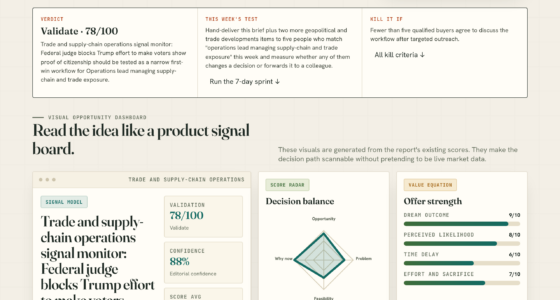
According to IdeaNavigator AI’s product concept, the proposed tool would watch Google Trends and similar feeds for developments related to trade and geopolitics, then filter them for an operations lead responsible for supply-chain and trade exposure. For each item judged relevant, it would produce a short brief organized around what changed, why it matters and what to do. The example topic is described as “estados unidos – belgica,” referring to the United States and Belgium.
IdeaNavigator AI frames the problem as one of finding and acting on information scattered across news, forums and filings. Its proposal is that a role-specific, same-day summary could help a reader identify developments relevant to operational decisions sooner than a general weekly roundup. That is the product rationale presented by the company, not evidence that a particular trade disruption or policy change has occurred.
The concept’s suggested first step is a small customer test: deliver this brief and two other geopolitical or trade-development items to five people matching the intended operations role during the same week. IdeaNavigator AI says the test should track whether recipients change a decision or forward a brief to a colleague. The proposal also suggests a subscription model, but provides no price, customer commitments, test results or revenue data.
Testing Demand for Faster Trade Signals
For supply-chain teams, the concept addresses a practical information problem: a policy announcement, trade restriction or geopolitical development can affect sourcing, routing, compliance or supplier risk, while the relevant information may appear across several channels. A concise alert tailored to a specific role could reduce the time spent sorting general news from developments with operational relevance.
However, IdeaNavigator AI’s proposal does not identify a confirmed U.S.–Belgium trade event, nor does it document a change in tariffs, regulations, shipping conditions or business operations. Its significance at this stage is as a product hypothesis: whether a focused signal service can surface actionable items reliably, and whether operations staff would pay for it, remain questions for testing.
The five-person exercise recommended in the proposal offers a way to gather early feedback, but it would be a limited test rather than proof of broad market demand. A forwarded brief or changed decision could indicate usefulness to those participants; it would not by itself establish the service’s accuracy, coverage or commercial viability.
As an affiliate, we earn on qualifying purchases.
From Trend Signal to Workflow
IdeaNavigator AI’s proposal is aimed at trade and supply-chain operations, not at general news consumers. It describes a workflow in which a monitoring system identifies developments, applies a role-based filter and converts selected items into short decision briefs. The stated purpose is to help operations leads manage trade and supply-chain exposure.
IdeaNavigator AI says Google Trends surfaced the opportunity with an 88/100 signal. The description does not specify the search term, geography settings, scoring method, measurement period or comparison baseline. The number should therefore be treated as a reported signal in the proposal, not as evidence of a measured increase in interest or a forecast of demand.
The validation plan proposed by IdeaNavigator AI is to hand-deliver three briefs to five people who fit the intended user profile and observe whether they act on or share them. The company does not report that this test has taken place. No product launch, customer interview findings or operational outcomes are described.
supply chain geopolitics alert tool
As an affiliate, we earn on qualifying purchases.
As an affiliate, we earn on qualifying purchases.
Key Evidence Still Missing
IdeaNavigator AI’s proposal leaves several questions unresolved. It does not identify a specific new U.S.–Belgium trade development behind the example phrase, provide links to the trend data, or explain what the 88/100 score represents. It is also unclear whether the score reflects search interest, a proprietary ranking or another measure, and what time window or baseline applies.
The proposal provides no information about how the monitor would assess whether an item actually affects a company’s operations, handle conflicting reports, or update briefs when facts change. It also does not establish whether the service exists as a working product. Customer demand, willingness to pay, accuracy and the reliability of any recommended actions remain unverified.
U.S.-Belgium trade news brief subscription
As an affiliate, we earn on qualifying purchases.
As an affiliate, we earn on qualifying purchases.
The Proposed Five-Person Test
IdeaNavigator AI’s concept recommends delivering three briefs to five potential users in one week: the U.S.–Belgium example and two other geopolitical or trade developments. The proposed test would record whether recipients change a decision or forward a brief to a colleague. The company provides no results or start date.
That feedback could help determine whether the format is useful enough to warrant further development. Before the proposal can be assessed as a functioning service, additional information would be needed about its data sources, filtering criteria, alert timing, factual checks and commercial terms. For now, based on the information published by IdeaNavigator AI, it remains a proposed workflow and validation plan, not a reported launch or confirmed change in trade operations.
Source: IdeaNavigator AI
As an affiliate, we earn on qualifying purchases.
Key Questions
Has a new U.S.–Belgium trade measure been announced?
IdeaNavigator AI’s proposal does not report a specific new trade measure or operational disruption. “Estados unidos – belgica” is presented as an example topic for the proposed monitor.
What would the proposed monitor do?
According to IdeaNavigator AI, it would watch Google Trends and similar feeds, filter geopolitical and trade developments for supply-chain operations leads, and create briefings on what changed, why it matters and what to do.
What does the 88/100 Google Trends signal mean?
IdeaNavigator AI’s description does not explain the score’s method, search term, time window or comparison baseline. It cannot be interpreted from the available information as a quantified increase in interest.
Has the idea been tested with operations teams?
IdeaNavigator AI reports no test results. Its proposal recommends delivering three briefs to five people in the intended role and measuring whether they change a decision or share a brief.
Source: IdeaNavigator AI
Halloween Picks
halloween
As an affiliate, we earn on qualifying purchases.