🔍 Read the full analysis: The Promise And Limits Of AI For 3D Printing on ThorstenMeyerAI.com

Get business pricing on tech for your team
- Business-only prices and quantity discounts
- Tax-exempt purchasing
- Multiple users, one account, clear invoices
TL;DR
AI is already used to optimize part designs and monitor certain 3D-printing errors, according to a November 29 report from ThorstenMeyerAI.com. Those applications can save time or catch problems, but the source says AI-generated designs still need human review and physical testing; text-to-CAD is not yet a dependable route from a prompt to a trusted part.
AI can help optimize 3D-printed part designs and monitor some printers while they work, but it cannot yet reliably turn a text prompt into a part people can trust, according to a report published November 29 by ThorstenMeyerAI.com. The report describes current uses in design and print monitoring while stressing that people still need to check and test parts, especially when they carry loads or affect safety.
The report follows a part through design, simulation, slicing and printing. Its best-documented example is generative design work by NASA Goddard Space Flight Center research engineer Ryan McClelland. Engineers specify where a component must connect, where bolts go and which areas must remain clear. Software then proposes a shape based on those constraints and the loads the part must carry. The technique, known as topology optimization, removes material the model calculates is underused.
For a bracket designed for NASA’s EXCITE balloon telescope, McClelland’s paper compares a conventional design by two engineers with a software-assisted approach. The paper says the conventional design took two days of effort by two engineers; the generative-design version took about 30 minutes for one engineer to encode requirements and about one hour of computing. The report says NASA found lighter, stiffer designs, but the provided account does not give the bracket’s measured weight or stiffness figures.
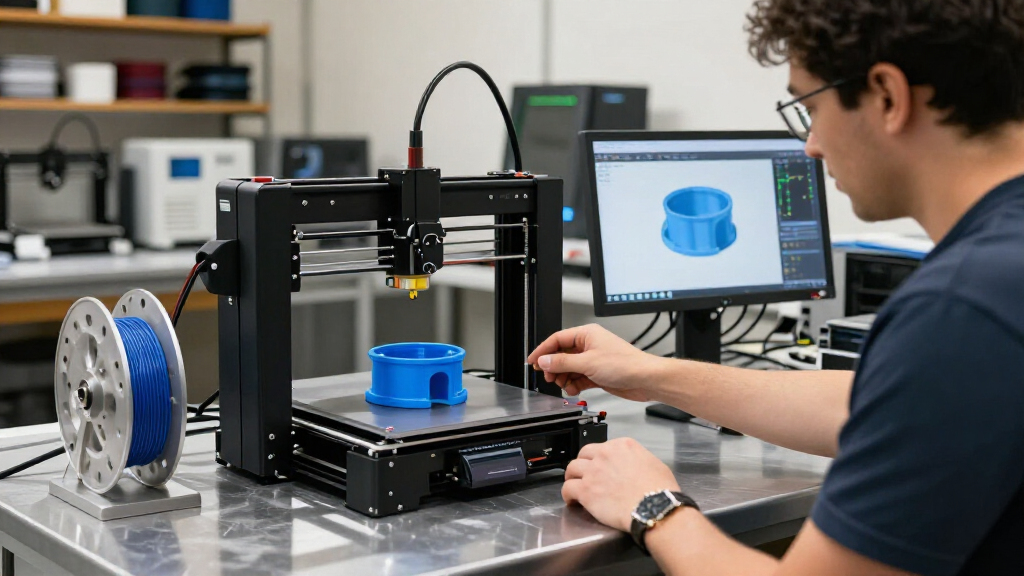
AI can also monitor printing. The report cites a University of Cambridge research system that used a camera to identify and correct common nozzle-related errors as a material-extrusion printer ran. The report describes material extrusion as the most widespread additive-manufacturing method, but does not provide the system’s error rates, operating conditions or evidence that it works across different printers and materials.
From idea to printed part: where AI looks over your shoulder
The orange marker shows where AI helps today. The last word still belongs to a real test.
Design: you set the loads, bolts and keep-out zones. The software proposes the shape.
Check: simulation predicts how the part bends. Only a real test shows how strong it is.
Print: a camera next to the nozzle spots common errors and corrects them during the print.
Every step: AI guesses from patterns. For parts that carry weight, people still test.
Where AI Can Save Design Time
Generative design may reduce the time engineers spend drawing and refining complex parts, while printer monitoring could help identify problems before a failed print is complete. These uses matter to both professional manufacturing and consumer printers, though they serve different needs: design software proposes a geometry, while a camera-based system watches a particular printing process.
Neither application removes the need to define the problem correctly. The software works from the constraints people enter. If a designer omits a load, fastener or required clearance, an optimized-looking result may still be unsuitable. And a camera that spots common errors is a monitoring aid, not a guarantee that the finished component is sound.
That distinction matters most for parts that carry weight, protect people or are used in flight. The report says NASA’s AI-assisted parts undergo conventional stress analysis and testing. It also cites a NASA standard for printed flight hardware, underscoring that software-generated geometry does not replace engineering review or physical validation.
Products Worth Considering

Logitech MX Master 4 Ergonomic Wireless Mouse with Haptic Feedback, Graphite

Apple iPad mini (A17 Pro) 128GB Wi-Fi 6E – Starlight

Samsung Galaxy Tab A11+ 11-Inch Tablet, 6GB RAM, 128GB Storage, Expandable Storage, Gray
As an affiliate, we earn on qualifying purchases.
From CAD Model to Printed Part
Most 3D-printed parts pass through a sequence of steps. An engineer first creates a dimensioned model in computer-aided design (CAD), then checks how it may respond to forces. A slicer divides the model into layers and produces instructions for the printer, which builds the object layer by layer. The report notes that unexpected failures are common enough in additive manufacturing for teams to repeat fabrication.
The source discusses several printer types, including nozzle-based material extrusion, resin printing and powder-based processes. The Cambridge monitoring example concerns material extrusion, not every 3D-printing method. It also distinguishes practical design and monitoring applications from text-to-CAD research: code that runs or a model that looks plausible does not establish that a part has the right dimensions, material properties or performance.
The report also points to legal limits in the United States: it says purely AI-generated output is not eligible for copyright and that only humans can be named as inventors. Those points concern legal recognition, not whether a particular printed part is safe or technically useful.
What the Examples Do Not Establish
The source report does not supply detailed performance data for the Cambridge monitoring system, such as its accuracy, false alarms, range of printer types or performance with different materials. It also does not establish that the system is commercially available or suitable for unsupervised operation. The NASA example is a specific bracket workflow, not evidence that generative design will improve every part.
It remains unclear how broadly these tools have been adopted in routine production and how much time or cost they save across projects. The report says text-to-CAD remains research rather than a dependable tool, but does not identify a particular benchmark or measure of reliability. No AI application described here removes the need to test the finished part under relevant conditions.
Human Review Remains the Next Step
For now, the practical next step is continued engineering review and testing. Designers need to check whether their requirements capture every load, connection and clearance; teams must assess the proposed geometry and verify the manufactured part. Home users may encounter AI through printer cameras, but the report advises treating those systems as a second pair of eyes and checking early print layers themselves.
The source does not announce a product launch, deployment date or upcoming test. Wider adoption will depend on evidence about how well these systems perform across machines, materials and real production conditions. Until that evidence and the required part-specific testing are available, AI can assist the workflow, but it cannot certify the finished object.
Key Questions
What can AI currently do in 3D printing?
According to the report, AI can help generate part shapes from engineering constraints and monitor some material-extrusion prints for common nozzle errors. These are separate applications and do not cover every printer or use case.
Can AI design a part that is ready to use without testing?
No. The report says AI-designed parts still need human checks and physical tests. NASA’s AI-assisted designs undergo stress analysis and testing, and the source notes that algorithms can sometimes propose structures that are too thin.
Does the NASA example prove generative design is always faster?
No. It reports time figures for one EXCITE telescope bracket: two days of effort by two engineers for the conventional design, compared with about 30 minutes of engineering effort and about one hour of computing for the software-assisted approach. That single case does not establish results for other parts.
Can a text prompt reliably create a printable part?
The report characterizes text-to-CAD as research, not a dependable tool. A model or code that runs does not prove that the resulting part has correct dimensions, strength or performance.
Should home users trust an AI printer camera to catch every failure?
No. The report presents camera monitoring as a helpful second check, not a guarantee. It advises users to inspect the first layers themselves, and the source does not give data showing that the Cambridge system catches every error.
Source: ThorstenMeyerAI.com