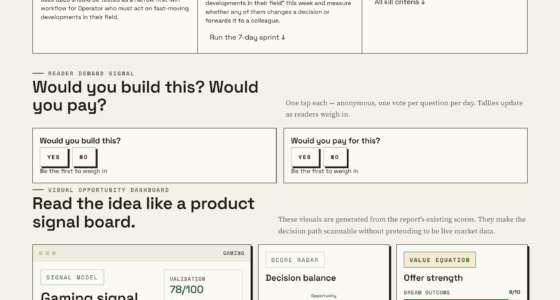
📊 Full opportunity report: AI Detection Gets A Boost With Anthropic’s New Watermarking Approach on ThorstenMeyerAI.com — validation score, market gap, and execution plan.

Get business pricing on tech for your team
- Business-only prices and quantity discounts
- Tax-exempt purchasing
- Multiple users, one account, clear invoices
TL;DR
Anthropic is reportedly developing a watermarking method to embed detectable signals directly into AI-generated text. This could shift AI detection from post-hoc classifiers to generation-level signals, but details remain unconfirmed.
Anthropic has been linked to a new approach for detecting AI-generated text through a method called watermarking, which involves embedding signals during the content creation process. This development, reported by Axios, represents a potential shift in AI detection techniques, moving from external classifiers to generation-level signals. The specifics of the technology, including its deployment and reliability, remain unconfirmed. For a detailed analysis, see the original analysis.
According to Axios, Anthropic is exploring a watermarking technique that influences the model’s word choices to create a statistical pattern, which can be detected by specialized systems. This approach differs from traditional detection methods that analyze finished text without access to the generation process. No technical paper, benchmark, or official product announcement has been released, and it is unclear whether any Anthropic models currently use this method or if it is still in experimental stages.
There is no public information about the scope of the watermarking, such as whether it will be enabled by default or available to users. The approach could provide a new tool for publishers, educators, and investigators to verify the provenance of suspicious texts, especially in cases involving impersonation or disinformation campaigns. However, the effectiveness of the watermark against paraphrasing, editing, or text passed through multiple systems remains untested and unconfirmed.
Potential Impact on AI Content Verification
This development could significantly enhance the ability to verify whether content was generated by AI, especially in sensitive contexts such as academic, journalistic, or legal settings. By embedding signals during generation, it shifts some responsibility for detection from external classifiers to the AI systems themselves. However, without independent testing and official disclosures, the reliability and robustness of Anthropic’s watermarking remain uncertain. If successful, this approach could influence industry standards and policies on AI transparency and accountability.
As an affiliate, we earn on qualifying purchases.
Advances and Challenges in AI Text Detection
Current AI detection methods primarily rely on analyzing linguistic patterns and probability scores, which can be unreliable and prone to false positives, especially with short or heavily edited text. Watermarking has been proposed in academic research as a way to improve detection accuracy by creating a generation-time signal that is harder to remove. Anthropic’s reported work aligns with a broader industry effort to develop more dependable provenance tools amidst increasing concerns over synthetic content and misinformation. However, no public technical details or validation results have been shared, leaving the practical viability of the approach uncertain.
“The reported watermarking technique could represent a significant step forward if it proves robust against common manipulation methods, but we need transparency and independent testing.”
— Thorsten Meyer, AI researcher
AI watermarking detection software
As an affiliate, we earn on qualifying purchases.
As an affiliate, we earn on qualifying purchases.
Unverified Aspects of Anthropic’s Watermarking System
It is not yet clear whether Anthropic has deployed this watermarking in any of its models, such as Claude, or if it remains in experimental phases. No performance metrics, error rates, or independent evaluations have been published. The system’s robustness against paraphrasing, translation, or manual editing is also unknown. Additionally, it is unclear whether the watermark will be publicly disclosed or kept proprietary, which impacts transparency and verification efforts.
AI-generated text verification tools
As an affiliate, we earn on qualifying purchases.
As an affiliate, we earn on qualifying purchases.
Expected Steps Toward Validation and Deployment
The next key development will be an official technical disclosure from Anthropic detailing the design, scope, and limitations of their watermarking approach. Independent researchers will need to evaluate its effectiveness across various scenarios, including manipulated or paraphrased text. Further, industry adoption depends on whether the company chooses to enable the feature in its models and whether detection tools will be made available publicly or through partnerships. Observers will watch for any pilot programs, academic papers, or product updates that clarify the system’s readiness and reliability.
As an affiliate, we earn on qualifying purchases.
Key Questions
How does Anthropic’s watermarking differ from existing AI detection methods?
Watermarking involves embedding signals during the text generation process, creating a detectable pattern that can be identified by specialized detectors. This contrasts with traditional methods that analyze finished text without access to the generation process, which can be less reliable.
Is Anthropic’s watermarking system currently in use?
No, there is no public confirmation that the system has been deployed in any Anthropic models or products. Details about its current status remain undisclosed.
Could watermarking be removed or bypassed?
While watermarking aims to be robust, it may be vulnerable to sophisticated paraphrasing, translation, or manual editing. Its effectiveness against such manipulations is still untested and unknown.
Will the watermark be disclosed to users or remain proprietary?
It is not yet clear whether Anthropic will publicly disclose the watermarking method or keep it as a proprietary feature. This decision will impact transparency and independent verification efforts.
What does this mean for AI-generated content regulation?
If proven effective, watermarking could become a key tool for verifying AI authorship, aiding regulators, educators, and platforms in managing synthetic content. However, until validated, its impact remains speculative.
Source: ThorstenMeyerAI.com
Fall Picks
fall essentials
As an affiliate, we earn on qualifying purchases.