
🔍 Read the full analysis: The 9 Best Mini PCs For AI Processing At Home In 2027 on ThorstenMeyerAI.com

Get business pricing on tech for your team
- Business-only prices and quantity discounts
- Tax-exempt purchasing
- Multiple users, one account, clear invoices
TL;DR
This roundup ranks nine mini PCs by their published configurations, with the MINISFORUM MS-S1 MAX its top overall pick for its Ryzen AI Max+ 395, 128GB of memory and workstation connectivity. The rankings are not based on hands-on testing or benchmark results, and buyers should match memory, storage and software support to their intended workloads.
A 2027 buyer’s guide ranks nine mini PCs for home AI processing, putting the MINISFORUM MS-S1 MAX first because the original analysis lists a Ryzen AI Max+ 395 processor, 128GB of memory, a 2TB SSD and workstation-focused ports. The ranking compares configurations as presented in the guide, not measured AI performance: the supplied source material provides no benchmark results, sustained-cooling tests or software-compatibility findings.
The guide places three systems with a Ryzen AI Max+ 395 and listed 128GB memory configurations among its candidates for memory-intensive local workloads: the MINISFORUM MS-S1 MAX, GMKtec EVO-X3 and BOSGAME M5, alongside other mini PCs for local AI projects. It describes the MS-S1 MAX as the most rounded of those options, citing dual 10GbE, USB4 V2 and dual M.2 PCIe 4.0 slots. These are specifications reported by the guide; they indicate potential capacity and connectivity, not how quickly a particular AI model will run.
For other recommendations, the guide lists the GEEKOM A9 Max with a Ryzen AI 9 HX 470, 32GB of RAM and a 2TB SSD, and presents the GMKtec K15 as a simpler option for lighter work, similar to systems considered for developers and home labs. It also identifies the GEEKOM IT13 MAX and Glorlin as lower-capacity choices, citing a smaller SSD for the former and 16GB of RAM for the latter. The supplied material does not provide a complete, comparable specification sheet for every model.
According to the guide, its ranking considers processor tier, memory capacity and type, graphics information, storage and connectivity. It cautions that an AI-branded processor alone does not determine suitability: software support, memory bandwidth, workload and thermal behavior also affect results. The supplied material provides no prices, so the rankings describe capability matched to likely needs rather than verified value for money.
The 9 picks
- 1
 MINISFORUM MS-S1 MAX Mini AI Workstation PC, AMD Ryzen AI Max+ 395, 128GB RAM…View on Amazon →
- 2
 GMKtec EVO-X3 Mini PC with AMD Ryzen AI Max+ 395, 128GB LPDDR5X, and 2TB PCIe…View on Amazon →
- 3
 BOSGAME M5 AI Mini PC with AMD Ryzen AI Max+ 395, 128GB LPDDR5X, 2TB SSDView on Amazon →
- 4
 GMKtec EVO-X2 AI Mini PC with AMD Ryzen AI Max+ 395View on Amazon →
- 5
 GEEKOM A9 Max Top AI Mini PC, AMD Ryzen AI9 HX470, 32GB DDR5, 2TB SSDView on Amazon →
- 6
 MINISFORUM AI X1 Pro-370 Mini PC with AMD Ryzen AI 9 HX 370, 32GB DDR5, 1TB P…View on Amazon →
- 7
 GEEKOM IT13 MAX AI Mini PC 2026, Intel Ultra 9 185H, 24GB LPDDR5, 500GB SSDView on Amazon →
- 8
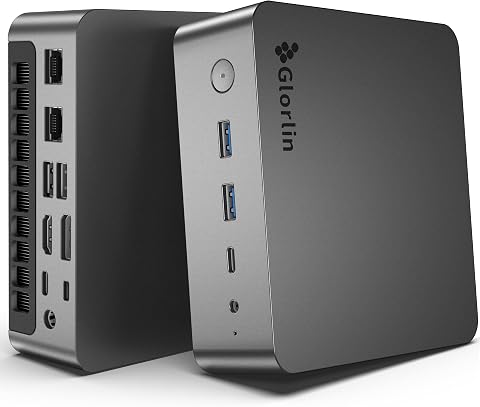 Glorlin AI Mini PC AMD Ryzen 7 Pro 8845HS, 16GB DDR5, 1TB SSD, Gaming & Offic…View on Amazon →
- 9
 GMKtec K15 AI Mini PC Oculink Intel Ultra 5 125U 32GB DDR5 512GB SSD, Desktop…View on Amazon →
Memory Sets the Local AI Ceiling
For people running models on a home desktop, memory capacity can determine which workloads fit before processor labels become decisive. The configurations cited in the guide illustrate the difference: 128GB offers more capacity for models, datasets and other applications than the listed 16GB or 32GB setups, particularly on systems using integrated graphics and shared system memory. That does not guarantee faster inference, broad software compatibility or support for every model.
The guide frames mini-PC selection as a tradeoff between workstation headroom and everyday practicality. A buyer who mainly develops software or runs smaller experiments may not need a high-capacity system. Someone handling larger local models may value memory and storage more than a newer processor paired with less RAM. Independent, workload-specific tests would be needed to establish real-world performance.
Products Worth Considering

EcoFlow Delta 3 Max Portable Power Station with 220W Solar Panel, 2048Wh

Samsung Galaxy Tab S7 11-inch Android Tablet 128GB Wi‑Fi with S Pen Mystic Black

Samsung Galaxy Tab A11+ 8GB RAM, 256GB Storage, Gray
As an affiliate, we earn on qualifying purchases.
How the Nine Picks Were Ranked
The guide describes its list as a configuration-based assessment, weighing published hardware details against likely tasks such as local model use, development, creative work and general desktop computing. It says systems with more memory, storage and useful connectivity rank higher for demanding work, while lower-memory machines are treated as options for lighter workloads.
That stated method makes the list a buying guide, not a lab test. The supplied material does not establish measured performance, cooling under sustained load, upgradeability for every model or compatibility with particular AI frameworks. It also does not provide prices or a complete specification table for all nine entries. Buyers should check the exact configuration offered by a retailer, since specifications can vary by model and version.
Performance Evidence Is Missing
The main limitation is the lack of independent benchmarks and hands-on testing in the supplied source material. It reports no model-specific inference speeds, power use, noise, sustained thermals or results across AI software. Without those details, the guide’s rankings cannot establish that the top-listed PC outperforms the others on a particular task.
Some specifications and expansion details are also incomplete in the material provided. It does not confirm upgradeability for every system or identify exact configurations, prices or availability for all nine picks. The guide describes the GMKtec K15 as suitable for lighter workloads, but the supplied information does not give enough comparable detail to quantify that recommendation. A processor’s listed AI features also do not, by themselves, confirm that a buyer’s preferred software can use them.
Check Configurations Before Buying
Before choosing, buyers should confirm the exact RAM and SSD configuration, whether memory can be upgraded, the number and type of storage slots, and the ports needed for displays, fast drives and wired networking. They should also verify that their intended operating system, AI framework and model support the processor’s available acceleration features.
The next useful evidence would be independent tests using named models and workloads, alongside thermal and power measurements. The supplied guide does not include those results, so its ranking is best used to shortlist machines by their published specifications, not as a guarantee of speed or compatibility.
Key Questions
Which mini PC is ranked first?
The guide ranks the MINISFORUM MS-S1 MAX first, citing its listed Ryzen AI Max+ 395 processor, 128GB of memory, 2TB SSD, dual 10GbE and USB4 V2. The ranking is based on specifications reported in the guide, not independent benchmark results.
Which listed models have 128GB of memory?
The guide identifies the MINISFORUM MS-S1 MAX, GMKtec EVO-X3 and BOSGAME M5 as models with 128GB memory configurations. Buyers should verify the exact version and configuration before purchasing.
Does a 128GB mini PC guarantee better AI performance?
No. More memory can provide room for larger models and datasets, but performance also depends on the workload, memory bandwidth, software support, graphics resources and cooling. The guide provides no measured comparisons.
Is the GEEKOM A9 Max a workstation-class alternative?
The guide describes it as a newer-platform everyday option, listing a Ryzen AI 9 HX 470, 32GB RAM and 2TB SSD. Whether it fits a particular AI workload depends on the software and model size; the supplied material includes no comparative benchmark results.
What should buyers verify before choosing?
Check the exact memory and storage configuration, upgrade options, ports, cooling information and compatibility with the AI tools you plan to use. For demanding or sustained workloads, seek independent tests using comparable models and applications; the guide does not provide such testing.
Source: ThorstenMeyerAI.com