

📊 Full opportunity report: Enhancing Data Center Efficiency With Rack-by-Rack Deployment Analytics on IdeaNavigator AI — validation score, market gap, and execution plan.

Get business pricing on tech for your team
- Business-only prices and quantity discounts
- Tax-exempt purchasing
- Multiple users, one account, clear invoices
TL;DR
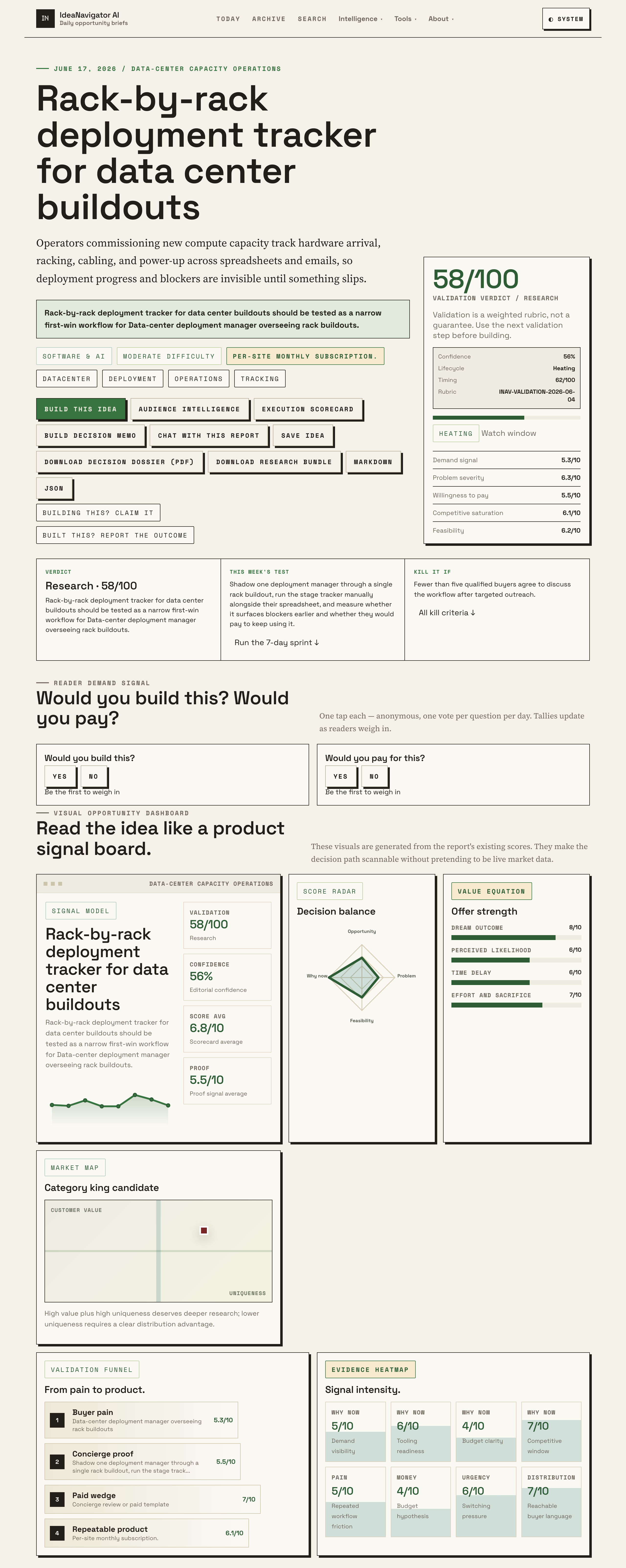
A new rack-by-rack deployment tracker is being tested for data centers, allowing managers to monitor progress in real time. This tool aims to improve efficiency during rapid buildouts driven by AI demand. Its effectiveness and adoption remain under evaluation.
A new rack-by-rack deployment tracker designed for data center operators is being developed to provide real-time visibility into hardware installation stages. This tool aims to address the challenge of tracking complex buildouts during record-breaking data-center expansions driven by AI demand, offering a potential efficiency boost for deployment managers.
The tracker is a simple, stage-based dashboard where a deployment manager logs each rack through fixed phases: delivered, racked, cabled, powered, and validated. It displays a live percentage of completion for each site and highlights stalled racks, offering a clear overview that currently relies on manual updates via spreadsheets and emails. The initiative is in the testing phase, with plans to shadow a deployment manager to compare its effectiveness against existing workflows.
According to sources familiar with the project, the goal is to validate whether this tool can surface blockers earlier, thus reducing delays and improving overall deployment efficiency. The subscription-based model targets data center capacity operators managing large-scale buildouts, especially those handling thousands of GPUs per site, where current tracking methods are inefficient and prone to oversight.
Potential Impact on Data Center Deployment Efficiency
This development could significantly improve how data center operators manage large-scale hardware deployments, especially under tight timelines driven by AI infrastructure demands. Early detection of delays or issues could reduce costly overruns and improve project planning. If successful, this tracker could become a standard tool, enabling more predictable and streamlined buildouts, which are critical in today’s fast-paced data-center expansion landscape.
data center rack deployment tracker
As an affiliate, we earn on qualifying purchases.
As an affiliate, we earn on qualifying purchases.
Rapid Data Center Expansion Driven by AI Demand
Recent years have seen a surge in data center capacity expansion, largely fueled by the rapid growth of AI applications requiring massive compute resources. Operators are deploying thousands of GPUs per site on compressed timelines, often relying on manual tracking methods that lack real-time visibility. Existing workflows involve multiple spreadsheets and email updates, which can delay the identification of deployment issues. The development of dedicated tools like this rack-by-rack tracker aims to address these inefficiencies, aligning with industry trends toward automation and digital management solutions.
“This deployment tracker could provide the real-time insights needed to prevent delays during rapid buildouts.”
— an anonymous researcher
rack-by-rack deployment analytics software
As an affiliate, we earn on qualifying purchases.
As an affiliate, we earn on qualifying purchases.
Unconfirmed Effectiveness and Adoption Rate
It is not yet clear how effectively the tracker will surface blockers earlier in practice or whether deployment managers will adopt it widely. The validation process is ongoing, and results are pending. Additionally, the precise cost-benefit impact for operators remains to be demonstrated through real-world testing.
real-time data center monitoring tools
As an affiliate, we earn on qualifying purchases.
As an affiliate, we earn on qualifying purchases.
Next Steps in Validation and Market Rollout
The project team plans to shadow a deployment manager during a single rack buildout, comparing manual tracking with the new stage tracker. Results from this trial will determine whether the tool can reduce delays and improve efficiency. If successful, a pilot program could expand to multiple sites, followed by commercial deployment and subscription offerings targeted at large data center operators.
data center hardware installation tracking
As an affiliate, we earn on qualifying purchases.
As an affiliate, we earn on qualifying purchases.
Key Questions
How does the rack-by-rack deployment tracker work?
The tracker logs each rack through fixed stages—delivered, racked, cabled, powered, and validated—and displays real-time progress and stalled racks on a dashboard.
What benefits does this tool offer over current methods?
It provides real-time visibility, early detection of blockers, and reduces reliance on manual spreadsheet updates, potentially saving time and avoiding delays.
Is this deployment tracker available for commercial use?
No, it is currently in the testing phase. Validation results will determine its future availability and adoption potential.
Who is the target market for this tool?
The primary target is data center capacity operators managing large-scale buildouts, especially those deploying thousands of GPUs per site.
What challenges remain before wider adoption?
Proving its effectiveness in real-world scenarios and ensuring integration with existing workflows are key hurdles before broader rollout.
Source: IdeaNavigator AI
Halloween Picks
halloween
As an affiliate, we earn on qualifying purchases.