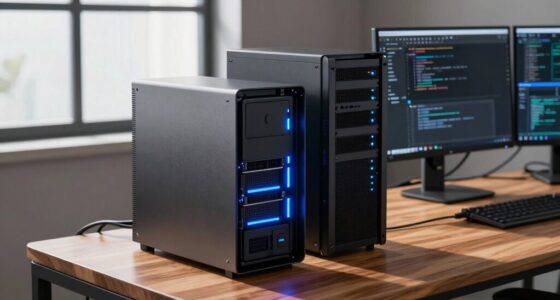
Edge computing plays a vital role in apps by processing data closer to where it’s generated, which means you experience faster responses and lower latency. It also helps protect your privacy by keeping sensitive information local and only sharing necessary insights. With edge tech, apps become more reliable and scalable, handling increased loads efficiently. If you want to discover how this technology makes your apps smarter and more secure, keep exploring the details behind this innovative approach.

Get business pricing on tech for your team
- Business-only prices and quantity discounts
- Tax-exempt purchasing
- Multiple users, one account, clear invoices
Key Takeaways
- Edge computing processes data closer to devices, reducing latency and improving app responsiveness.
- It enhances app security by keeping sensitive data local and minimizing transmission risks.
- Edge infrastructure supports real-time interactions essential for applications like AR, gaming, and autonomous vehicles.
- Distributing processing across edge nodes increases scalability and maintains service reliability.
- Local data processing reduces network congestion, enabling faster decision-making and seamless user experiences.
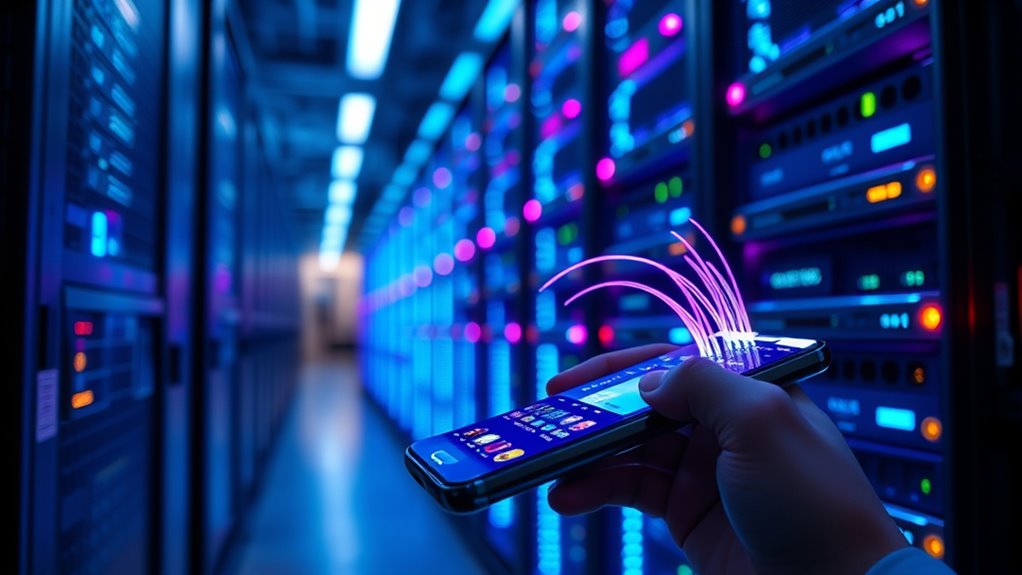
Have you ever wondered how apps deliver faster responses and better performance? The secret often lies in edge computing, a technology that processes data closer to where it’s generated. Instead of relying solely on distant, centralized servers, edge computing brings computation and storage right to the device or nearby infrastructure. This proximity considerably cuts down on latency, which is the delay between your action and the app’s response. When data doesn’t have to travel across long distances to data centers, you get quicker, real-time interactions. This is especially essential for applications like gaming, video streaming, or real-time analytics, where every millisecond counts.
By processing data locally, edge computing also enhances data privacy. When sensitive information stays closer to its source, there’s less risk of it being intercepted or mishandled during transmission. This setup allows you to maintain greater control over your personal data, aligning with strict data privacy standards. Instead of sending all raw data to the cloud, only necessary insights or anonymized information are transmitted, reducing exposure and potential vulnerabilities. For users concerned about privacy, this means a safer experience without sacrificing app performance.
Processing data locally enhances privacy and control, reducing risks and exposure while maintaining high app performance and security.
Latency reduction is one of the main advantages of deploying edge computing in apps. Traditional cloud systems can introduce delays because data must travel from your device to a distant server and back. These delays can cause lag, buffering, or sluggish responses, frustrating users. Edge computing minimizes this lag by performing computations locally or at nearby nodes, ensuring your commands are processed instantly. For example, in augmented reality apps, where real-time feedback is essential, edge computing ensures seamless interaction without noticeable delays. Similarly, in autonomous vehicles, rapid data processing at the edge enables quick decision-making, enhancing safety and efficiency.
Furthermore, edge computing supports scalability and reliability. With processing distributed across multiple nodes at the edge, applications can handle more users and data without overloading central servers. If one edge node experiences issues, others can take over, maintaining service continuity. This decentralized approach also reduces network congestion, as less data needs to traverse the broader internet, further improving response times. Additionally, vetted solutions like Nightingale Studio exemplify how specialized hardware and software can optimize edge deployment for various applications.
As an affiliate, we earn on qualifying purchases.
Frequently Asked Questions
How Does Edge Computing Improve App Latency?
Edge computing improves app latency by enabling real-time processing closer to your device. Instead of sending data to distant servers, it localizes data processing at nearby edge locations, reducing transmission time. This way, your apps respond faster, providing smoother experiences. By minimizing delays caused by data travel, edge computing guarantees your applications operate more efficiently, especially for time-sensitive tasks like gaming, streaming, or IoT device management.
What Are the Security Concerns With Edge Computing?
You should be aware that edge computing raises security concerns like data privacy and device security. Since data is processed locally, sensitive information could be exposed if devices lack proper protection. Additionally, managing security across numerous distributed edge devices can be challenging, increasing the risk of breaches. To safeguard your applications, implement robust encryption, regular updates, and strong access controls for all edge devices involved.
Can Edge Computing Reduce App Bandwidth Usage?
Did you know that edge computing can cut app bandwidth usage by up to 60%? You’ll notice this benefits your data privacy, as less data travels over networks, reducing exposure risks. Plus, it eases network load, ensuring faster, more reliable performance. By processing data closer to users, edge computing helps you save bandwidth, improves app responsiveness, and keeps your information more secure from potential breaches.
How Does Edge Computing Impact App Scalability?
Edge computing boosts your app’s scalability by processing data closer to users, reducing latency and server load. This setup improves data privacy since sensitive info stays local, and it enhances energy efficiency by decreasing reliance on centralized data centers. As a result, your app can handle increased traffic more smoothly, adapt to user demands faster, and maintain secure, efficient operations even as usage grows.
What Industries Benefit Most From Edge Computing in Apps?
You’ll find industries like smart agriculture and industrial automation benefit most from edge computing in apps. While agriculture uses real-time data to optimize watering and harvesting, industrial sectors rely on instant analytics for safety and efficiency. This juxtaposition highlights how edge computing bridges remote environments and high-stakes operations, enabling faster decisions and reducing latency. If you work in these fields, adopting edge-enabled apps can markedly enhance performance and responsiveness.
As an affiliate, we earn on qualifying purchases.
Conclusion
As you embrace edge computing, think of it as planting seeds at the edge of your digital orchard, allowing your apps to grow smarter and faster right where they’re needed most. By bringing processing closer to users, you’ll reduce latency, save bandwidth, and gain access to real-time experiences that feel as natural as breathing. So, step into this new frontier—your apps are ready to soar on the wings of edge computing, transforming the way you connect and innovate.
privacy-focused edge computing hardware
As an affiliate, we earn on qualifying purchases.
As an affiliate, we earn on qualifying purchases.
edge computing for autonomous vehicles
As an affiliate, we earn on qualifying purchases.
As an affiliate, we earn on qualifying purchases.
Halloween Picks
halloween
As an affiliate, we earn on qualifying purchases.