TL;DR

Get business pricing on tech for your team
- Business-only prices and quantity discounts
- Tax-exempt purchasing
- Multiple users, one account, clear invoices
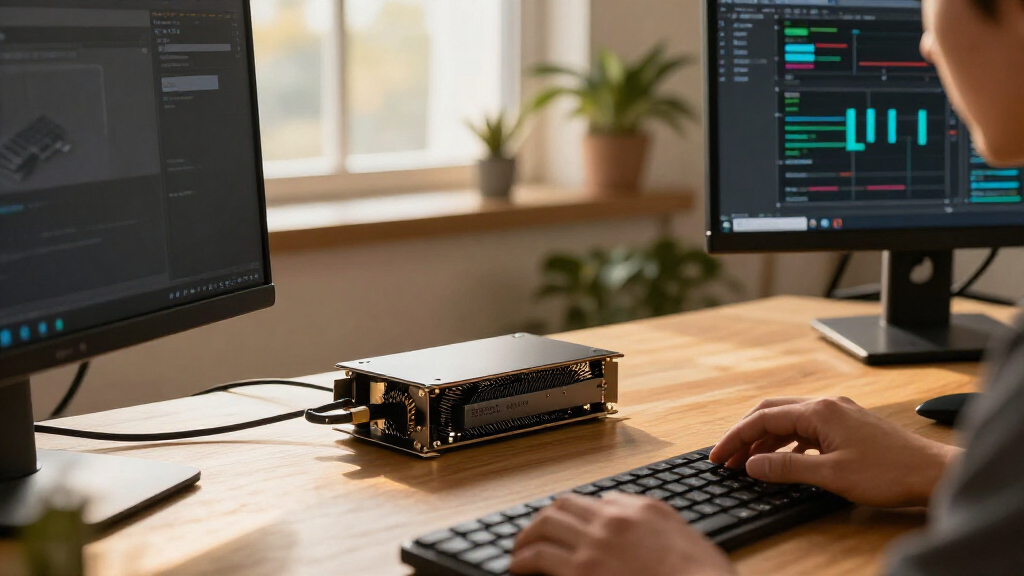
Intel’s product information describes the D270 as an inference-focused data-center GPU with up to 480 GB of LPDDR5X memory, 350-watt air cooling and a PCIe 5.0 interface. The company is positioning it for long-context and high-concurrency AI serving, but has not provided pricing, availability, independent benchmarks or detailed configuration information in the supplied material.
Intel is positioning its D270 as an inference-focused data-center GPU with up to 480 GB of LPDDR5X memory, a 350-watt power rating and standard PCIe 5.0 connectivity. The company says the design is aimed at long-context and high-concurrency AI applications, including agentic systems, but the product information provided does not state when the accelerator will ship or what it will cost.
Intel lists the D270 with 32 Xe3P cores and 256 XMX matrix engines, and says the card is air-cooled at 350 watts. Its product page describes the memory capacity as “up to” 480 GB of LPDDR5X, which indicates a maximum configuration rather than a guarantee that every D270 card will carry that amount. The supplied information does not detail other memory configurations, memory bandwidth, or the specific system requirements.
The company frames the accelerator around inference rather than large-scale model training. Intel says the D270 is intended for workloads where processing lengthy prompts, keeping model and context data resident, and serving multiple sessions can affect throughput and operating costs. Named use cases include retrieval-augmented generation, enterprise and coding assistants, document understanding, multimodal AI, diffusion models and high-concurrency model serving.
Intel also points to a standard PCIe 5.0 form factor and air-cooled deployment, saying these features could let operators evaluate the GPU in existing data-center environments without a liquid-cooling retrofit or proprietary networking. The company describes its software approach as supporting leading open models and familiar serving tools. The supplied product material refers to vLLM and the open PyTorch ecosystem; it does not provide a detailed compatibility matrix or independently verified deployment results.
Memory Capacity for Long-Context Serving
The D270’s headline specification addresses a real infrastructure constraint for inference: long prompts and concurrent conversations can consume substantial memory, including space used to retain intermediate attention data during generation. More memory per accelerator may allow operators to keep larger models, longer contexts or more sessions resident, potentially reducing the need to distribute a workload across as many GPUs. The actual effect depends on model size, software, memory bandwidth and workload configuration, none of which are quantified in the supplied announcement.
For data-center teams, the 350-watt air-cooled design and PCIe 5.0 interface are relevant because they may fit more readily into conventional server and rack plans than systems requiring specialized cooling or interconnects. That could simplify evaluation, but it does not by itself establish lower total costs or higher throughput. Buyers will need measured results for their own workloads, as well as pricing and power-efficiency comparisons, before drawing conclusions about deployment economics.
The announcement also signals Intel’s attempt to compete for production inference workloads as companies move beyond one-off prompts toward multi-step AI services. In those applications, a system may repeatedly retrieve information, call tools and generate responses. Serving efficiency and memory capacity can matter as much as peak compute, but Intel’s material presents product positioning rather than independent proof of performance advantages.
As an affiliate, we earn on qualifying purchases.
Intel’s Inference-Focused Positioning
Intel describes the D-series as designed for agentic AI, a category of applications that can make repeated model calls and handle lengthy context over a sequence of steps. The company argues that these workloads increase demand for prompt processing, memory capacity and concurrent serving. The D270’s listed specifications and use cases reflect that argument; the source material does not provide customer deployments or third-party test results to show how the card performs in production.
Intel’s page also says the D270 reallocates die area from graphics and ray-tracing pipelines toward Xe3P compute and matrix engines. It presents the card as supporting precision options ranging from low-precision inference to FP64 scientific computing. These are Intel’s descriptions of the product; the supplied material does not include detailed performance tables across those precision modes or a full technical specification.
Some Intel materials mention performance projections against the RTX Pro 6000 based on publicly available information and Intel internal analysis as of February 2026, with a disclaimer that results vary by use and configuration. The supplied source gives no specific benchmark figure or test methodology. That comparison should not be read as an independently verified result or a direct measure of D270 performance.
““Memory up to 480 GB LPDDR5X per card.””
— Intel product page
As an affiliate, we earn on qualifying purchases.
Pricing, Availability and Benchmarks
The supplied Intel material does not specify price, ship date, customer availability or regional rollout. It also does not identify the exact memory configuration for a retail or production card, memory bandwidth, supported model sizes, server qualification list or detailed software versions. Those omissions prevent a full assessment of what customers can order and how the product would fit into particular systems.
Intel’s efficiency and throughput language is presented as product positioning, not as a set of independently verified outcomes. The source does not provide benchmark results, test conditions, comparison baselines or customer references for the D270. It is also unclear how its performance and total cost compare with competing accelerators across specific inference workloads. The company’s general disclaimer about projections does not supply those missing measurements.
As an affiliate, we earn on qualifying purchases.
Awaiting Deployment Details and Tests
Intel directs interested customers to contact the company for further information and says additional D-series news and AI resources will follow. The next useful disclosures would include availability, pricing, full specifications and supported server configurations, along with software documentation covering model serving and framework support.
Potential buyers and developers will also need reproducible benchmarks for representative long-context and concurrent-serving workloads. Until those details and independent or customer results are available, the D270’s advertised memory capacity and deployment profile can be reported, but claims about its relative speed, cost savings or practical throughput remain unverified.
As an affiliate, we earn on qualifying purchases.
Key Questions
What is the Intel D270?
Intel describes the D270 as an inference-focused data-center GPU for running deployed AI applications, including long-context and high-concurrency workloads.
How much memory does the D270 have?
Intel lists up to 480 GB of LPDDR5X memory per card. The supplied material does not say which configurations will be available or whether all cards will include the maximum capacity.
What are the D270’s power and interface specifications?
Intel lists a 350-watt air-cooled design and a standard PCIe 5.0 form factor. Detailed server qualification and system power requirements were not provided in the source material.
When will the Intel D270 be available, and what will it cost?
The supplied product information does not include a release date or price. Intel advises interested customers to contact the company for more information.
Has Intel published independent performance results?
The supplied material does not include independent benchmark results or detailed test conditions. Intel’s performance and efficiency descriptions should be treated as company positioning until comparable measurements are published.
Source: hn
Fall Picks
fall essentials
As an affiliate, we earn on qualifying purchases.