
📊 Full opportunity report: Keep Trust Funding Tasks In View With An Empty Tracker on IdeaNavigator AI — validation score, market gap, and execution plan.

Get business pricing on tech for your team
- Business-only prices and quantity discounts
- Tax-exempt purchasing
- Multiple users, one account, clear invoices
TL;DR
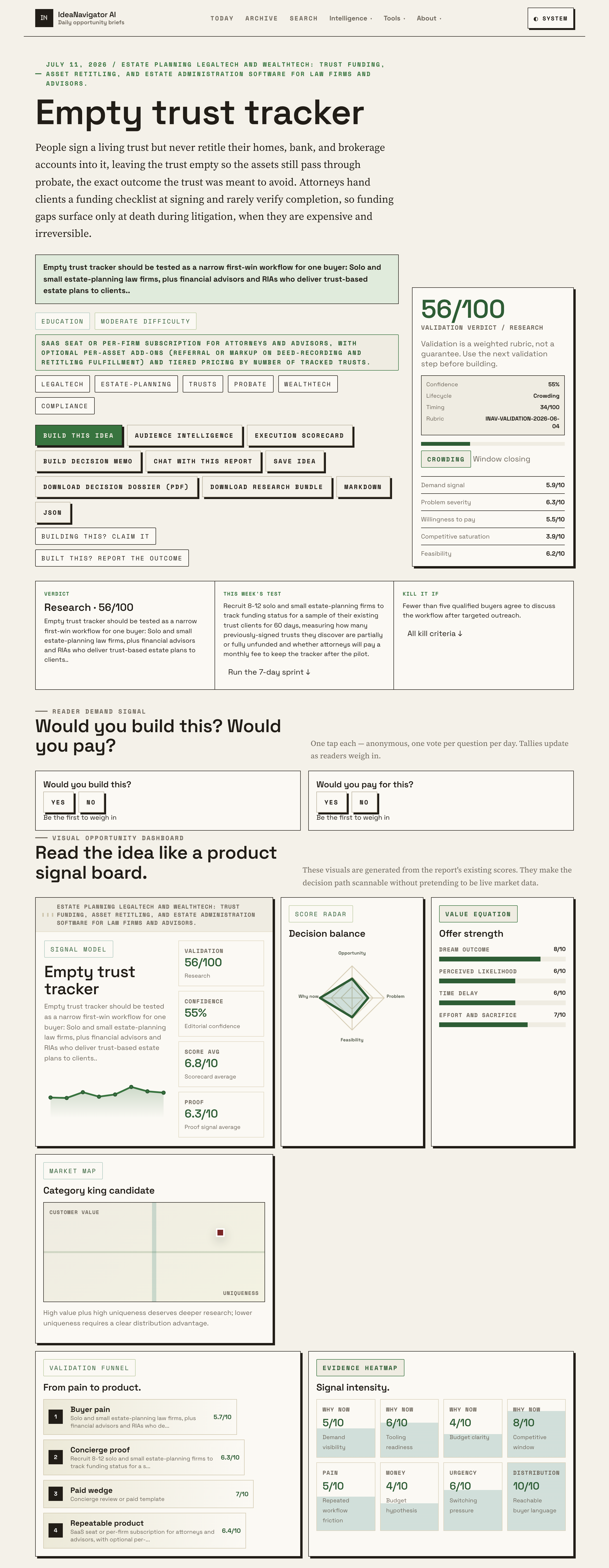
IdeaNavigator AI has outlined a software concept for tracking whether living trusts are actually funded, targeting solo estate-planning attorneys and financial advisors. The core problem is real: signed trusts often sit empty because assets are never retitled. The proposed tracker remains unvalidated pending a 60-day pilot.
A newly published product concept from IdeaNavigator AI proposes a simple tracking tool to solve one of estate planning’s quietest failures: clients who sign a living trust but never move their assets into it, leaving what the proposal calls “empty trusts” that still pass through probate. The concept, aimed at solo and small estate-planning law firms and financial advisors, calls for a client-by-client funding tracker with asset statuses, uploaded proof, and automated reminders — a narrow workflow the analysis argues could be a first win in the estate-planning legaltech market.
According to the IdeaNavigator AI analysis, the core problem is that attorneys typically hand clients a funding checklist at signing and rarely verify completion. Homes, bank accounts, and brokerage accounts that are never retitled into the trust remain outside it, so those assets pass through probate — the exact outcome the trust was meant to avoid. The analysis states these gaps tend to surface only at death, often during litigation, when they are described as expensive and irreversible to fix.
The proposed MVP is a funding tracker where attorneys or advisors create a checklist per trust covering real estate, bank, brokerage, retirement, business interests, and beneficiary designations. Each asset would carry a status of pending, in-progress, or confirmed funded, with proof attached — such as a recorded deed or a retitled account statement. Automated client reminders and a firm-wide dashboard showing each book of trusts by percent funded would let partners flag dangerously empty trusts before a client’s death.
The business model outlined is a SaaS seat or per-firm subscription, with optional per-asset add-ons such as referral fees or markups on deed-recording and retitling fulfillment, plus tiered pricing by the number of trusts tracked. The analysis positions this within the estate-planning legaltech and wealthtech market, noting that advisors and RIAs are racing to bundle funded estate plans into client offerings and that per-deed funding services priced from $250 have already created a paid market a verification layer could sit on top of.
Why Empty Trusts Drain Estate Value
The concept targets a gap with direct financial consequences for clients and liability exposure for professionals. An unfunded trust provides none of the probate-avoidance benefits clients paid for, and the analysis notes the problem is discovered too late to correct. For solo attorneys and advisors, a dashboard that surfaces unfunded trusts could convert a one-time document engagement into an ongoing verification relationship — and, according to the analysis, a recurring subscription revenue stream in a market where document-drafting software already exists but funding verification largely does not.
The timing argument is also part of the case: the analysis says estate planning adoption and digital tooling are surging in 2026, yet only about 11% of Americans hold a trust, leaving a large underserved base. It describes trust funding as a manual, fragmented step that existing drafting tools do not close.
The State of Estate-Planning Software
Estate-planning software has historically focused on document generation — drafting wills and trusts — rather than post-signature execution. Funding a trust requires separate actions across multiple institutions: recording new deeds with county offices, retitling bank and brokerage accounts, updating beneficiary designations, and transferring business interests. Because these steps happen outside the attorney’s office and over months, completion has been hard to track. The emergence of paid per-deed funding services, cited in the analysis at prices from $250, has created a fulfillment layer that a software tracker could orchestrate rather than replace.
What the Concept Has Not Yet Proven
No product exists yet, and the concept is unvalidated. The 11% trust-adoption figure and the claim that funding gaps routinely surface in litigation are presented in the analysis without cited external studies. Whether attorneys will pay a monthly subscription for a tracker — and whether advisors, rather than attorneys, are the better buyers — remains untested. The proposed per-asset revenue from deed-recording referrals also depends on partnerships that have not been announced.
The 60-Day Pilot That Would Test Demand
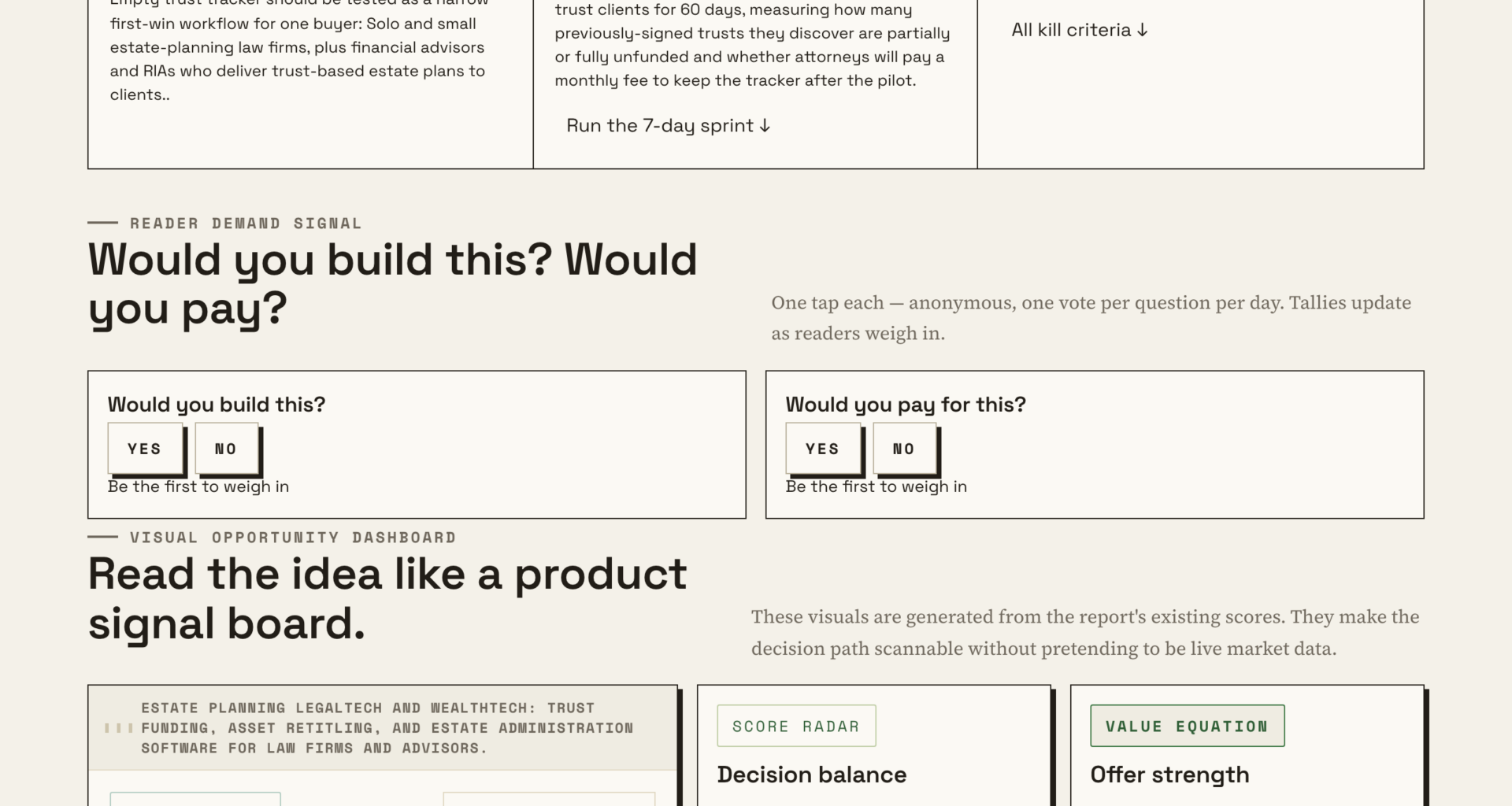
The validation plan calls for recruiting 8-12 solo and small estate-planning firms to track funding status for a sample of their existing trust clients over 60 days. Two metrics would decide whether the concept has legs: how many previously signed trusts the firms discover are partially or fully unfunded, and whether attorneys will pay a monthly fee to keep the tracker after the pilot ends. A builder taking on the concept would need to run that pilot before any broader launch.
Source: IdeaNavigator AI
Key Questions
What is an empty trust?
A living trust that was signed but never funded — the client’s home, bank, and brokerage accounts were never retitled into it. Those assets remain outside the trust and typically pass through probate, defeating the trust’s purpose.
Who is the proposed tracker for?
Solo and small estate-planning law firms, plus financial advisors and RIAs who deliver trust-based estate plans to clients.
Does this product exist yet?
No. It is a product concept published by IdeaNavigator AI. It has not been built or validated, and no pilot results have been reported.
How would the tracker make money?
Through a SaaS seat or per-firm subscription, with optional per-asset add-ons such as referral fees on deed-recording and retitling services, and tiered pricing by number of trusts tracked.
How would demand be tested?
By recruiting 8-12 firms to track funding status for existing trust clients over 60 days, measuring how many unfunded trusts are discovered and whether firms will pay to keep the tool afterward.
Source: IdeaNavigator AI
Evergreen bestsellers Picks
bestsellers
As an affiliate, we earn on qualifying purchases.