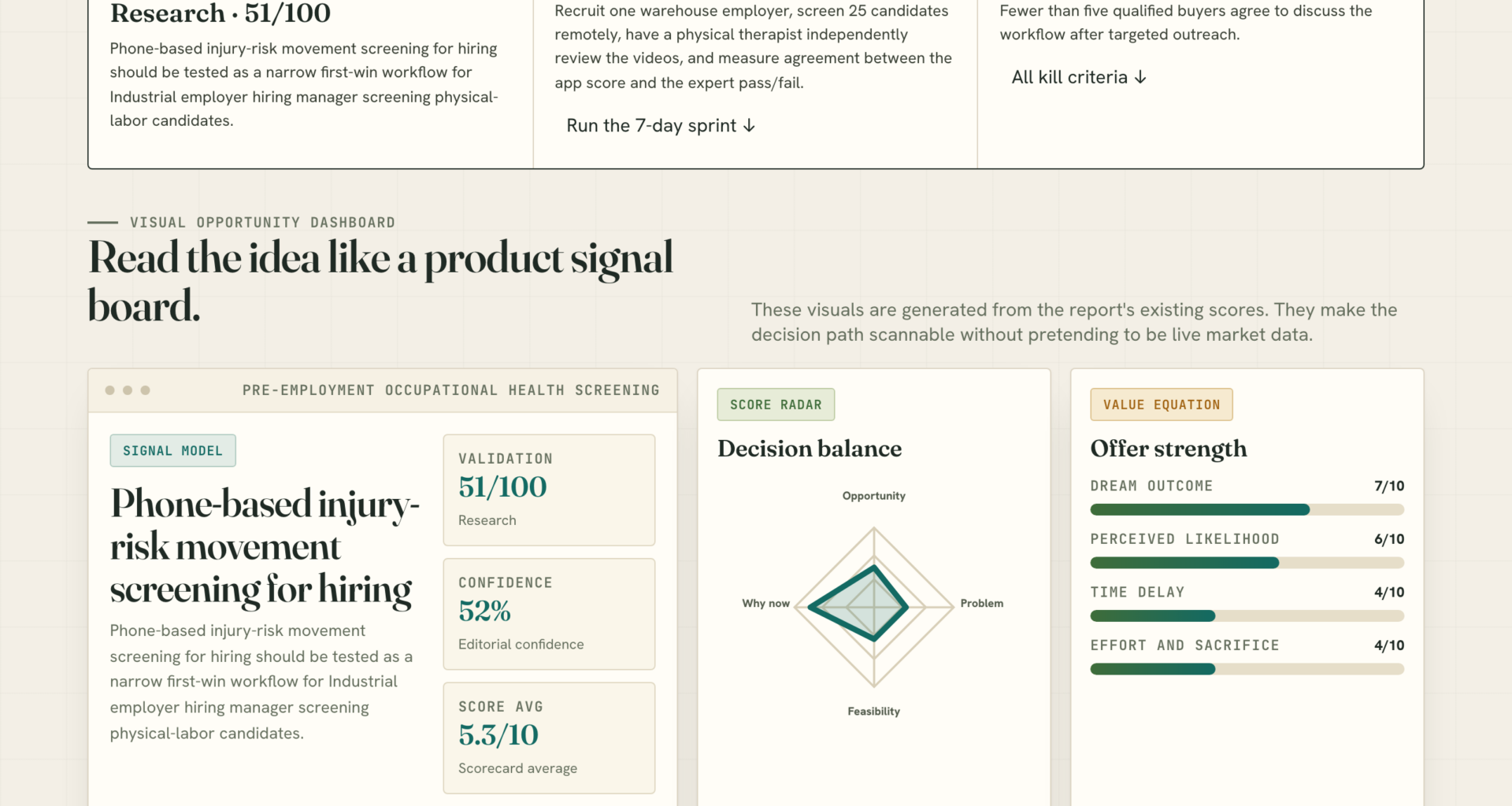
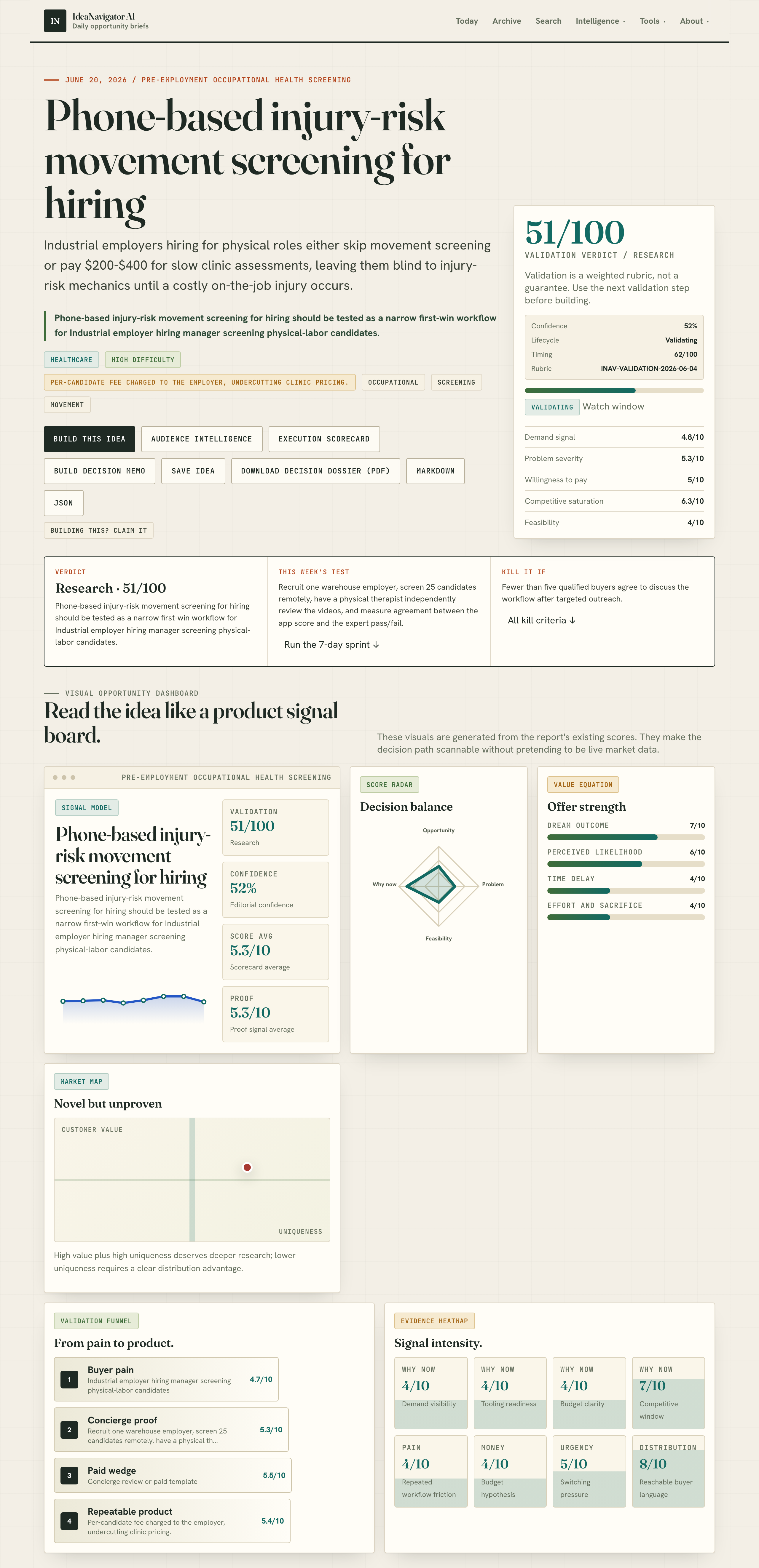
📊 Full opportunity report: Phone-based injury-risk movement screening for hiring on IdeaNavigator AI — validation score, market gap, and execution plan.

Get business pricing on tech for your team
- Business-only prices and quantity discounts
- Tax-exempt purchasing
- Multiple users, one account, clear invoices
TL;DR
A pilot program is testing a phone-based movement screening tool for hiring industrial workers. It aims to assess injury risk remotely, offering a faster, cheaper alternative to clinic assessments. The initiative could change pre-employment screening practices if validated.
A pilot program is testing a phone-based movement screening tool designed to evaluate injury risk in candidates for physical labor roles, offering a faster, more affordable alternative to traditional clinic assessments. This development could impact hiring practices in the industrial sector by enabling remote, pre-employment injury risk evaluation.
The proposed system involves candidates performing 5 to 7 guided movements—such as squats, reaching, lift simulations, and balance holds—while recording videos on their phones. These recordings are analyzed using pose estimation technology to generate a pass/fail score based on occupational injury risk benchmarks. The goal is to deliver results within 24 hours at a cost of approximately $30-$50 per candidate, significantly lower than current clinic assessments which can cost between $200 and $400.
This initiative is currently in the validation stage, with plans to recruit a warehouse employer to test the system by screening 25 candidates remotely. An independent physical therapist will review the videos to compare their assessments with the app-generated scores, measuring agreement and accuracy. The approach aims to provide a scalable, accessible screening method that could reduce injury-related costs and improve workforce safety.
Potential Impact on Industrial Hiring Practices
If validated, this remote screening approach could significantly alter how industrial employers assess injury risk during hiring. By providing a quick, low-cost, and accessible tool, companies may reduce reliance on expensive, slow clinic assessments and better identify candidates with high injury risk before they start work. This could lead to fewer on-the-job injuries, lower workers’ compensation costs, and safer workplaces overall.
Furthermore, the adoption of phone-based screening aligns with broader trends toward remote assessments and digital health tools, potentially expanding to other sectors and types of physical evaluations. However, the effectiveness and reliability of the technology in diverse real-world settings remain to be proven through ongoing validation studies.
As an affiliate, we earn on qualifying purchases.
Background of Remote Injury Screening Development
Traditional injury risk assessments for physically demanding jobs often require in-person clinic evaluations, which can be costly and time-consuming. Employers have limited options, frequently relying on manual screening or costly assessments that delay hiring. Recent advancements in smartphone cameras and pose estimation algorithms now make it feasible to analyze movement remotely. This technological shift opens possibilities for scalable, pre-employment injury screening, especially as rising workers’ compensation costs incentivize proactive risk management. The concept is still in early testing, with validation studies underway to determine accuracy and reliability.
“Using phone cameras and pose estimation, we can remotely assess movement mechanics that are critical for injury risk, potentially transforming pre-employment screening.”
— an anonymous researcher
As an affiliate, we earn on qualifying purchases.
Validation Results and Reliability of the System
It is not yet confirmed how accurately the phone-based system will match expert assessments across diverse candidate populations and job roles. Validation studies are ongoing, and results are expected in the coming months. The reliability of the technology in real-world, uncontrolled environments remains to be established, and questions about its ability to replace or supplement existing assessments are still open.
video analysis tool for injury risk
As an affiliate, we earn on qualifying purchases.
As an affiliate, we earn on qualifying purchases.
Next Steps in Pilot Testing and Validation
The next phase involves deploying the screening tool with a partner employer, screening at least 25 candidates, and comparing the app’s scores with independent physical therapist reviews. Results from this pilot will determine the system’s accuracy and scalability. Further development may include refining the movement protocols, improving pose estimation algorithms, and expanding validation to different job types and worker demographics. Successful validation could lead to broader adoption across the industry within the next year.
As an affiliate, we earn on qualifying purchases.
Key Questions
How accurate is the phone-based movement screening compared to traditional assessments?
Accuracy is currently being evaluated through validation studies comparing app scores with expert reviews. Results are pending, and reliability across diverse candidates remains to be confirmed.
What types of movements are assessed in the screening?
The system guides candidates through 5 to 7 movements, including squats, reaching, lift simulations, and balance holds, which are relevant to injury risk in physical labor roles.
Will this screening replace in-person assessments entirely?
It is too early to say. The goal is to supplement or replace existing assessments if validated, providing a faster and cheaper option, but further testing is needed to confirm its effectiveness.
How much does the screening cost per candidate?
The estimated cost is approximately $30-$50 per candidate, significantly lower than clinic assessments, which can cost between $200 and $400.
When will this technology be available for widespread use?
If validation proves successful, broader adoption could happen within the next 12 months, depending on industry acceptance and further development.
Source: IdeaNavigator AI
Halloween Picks
halloween
As an affiliate, we earn on qualifying purchases.