
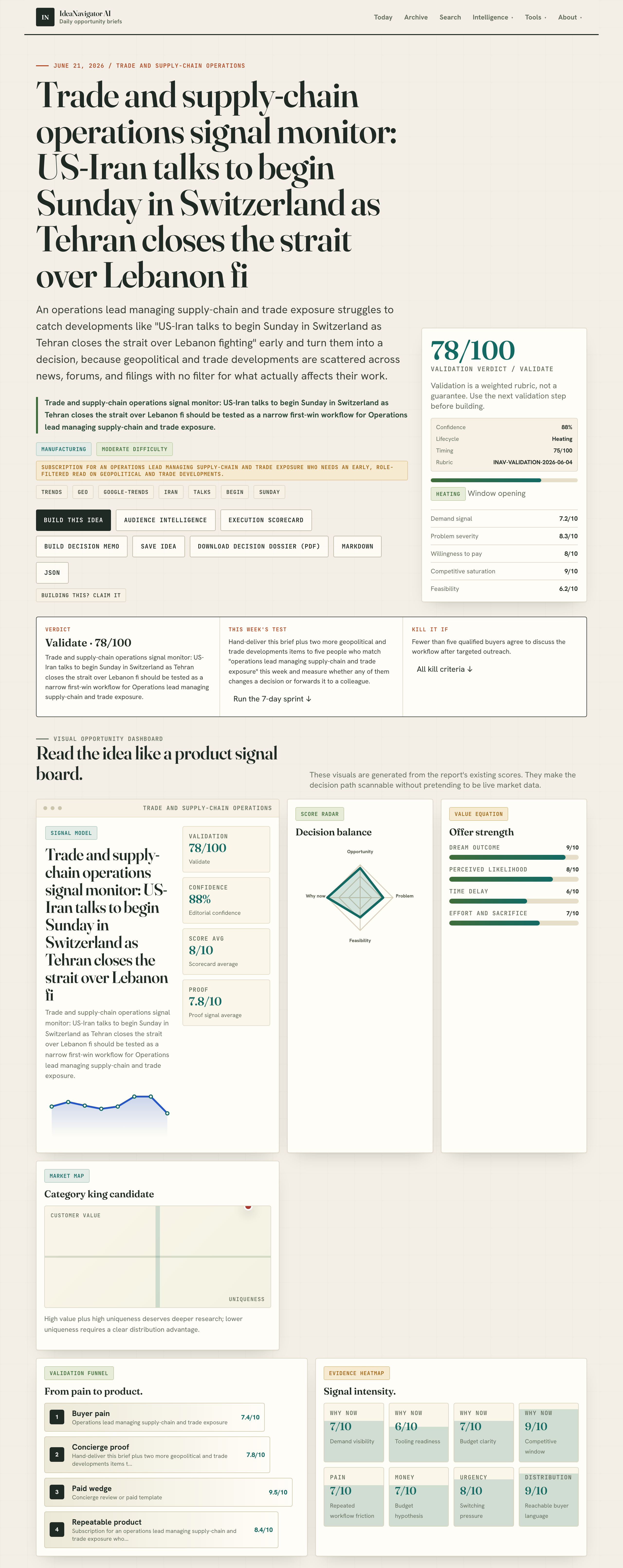
📊 Full opportunity report: Trade and supply-chain operations signal monitor: US-Iran talks to begin Sunday in Switzerland as Tehran closes the strait over Lebanon fi on IdeaNavigator AI — validation score, market gap, and execution plan.
Listen free for 30 days with Audible
Thousands of audiobooks and originals — cancel anytime.
Start your free trialAs an affiliate, we earn on qualifying purchases.
TL;DR
U.S. and Iran are scheduled to hold talks in Switzerland starting Sunday, amid Iran’s closure of the Strait of Hormuz. This development could significantly affect global supply chains and trade flows.
U.S. and Iranian officials are set to hold talks in Switzerland starting this Sunday, amid Iran’s recent decision to close the Strait of Hormuz over the conflict in Lebanon, a move that threatens to disrupt global shipping and trade routes.
The upcoming negotiations between the United States and Iran are confirmed to begin this Sunday in Switzerland, according to multiple diplomatic sources. Iran’s recent decision to close the Strait of Hormuz, a critical chokepoint for global oil and trade shipments, has heightened tensions and raised concerns among international trade operators.
Trade and supply-chain operations monitoring tools indicate that geopolitical developments like these can have immediate impacts on shipping schedules, insurance costs, and supply chain stability. The closure of the Strait over Lebanon fighting is a significant escalation, potentially affecting energy markets and global trade flows if the situation persists or worsens.
It is not yet clear whether the talks will lead to any immediate de-escalation or if Iran will maintain the closure of the Strait beyond the negotiation period. Diplomatic sources emphasize that the talks are a crucial opportunity to address escalating tensions but do not guarantee a resolution.
Implications for Global Trade and Supply Chains
This development matters because the Strait of Hormuz is a vital route for approximately 20% of the world’s oil trade. Any prolonged closure or escalation could lead to rising energy prices, increased shipping costs, and supply chain disruptions across multiple sectors. The negotiations could influence Iran’s future actions and the stability of regional trade routes, making this a key event for global markets and logistics operations.
As an affiliate, we earn on qualifying purchases.
Recent Escalations and Diplomatic Efforts
Iran’s decision to close the Strait of Hormuz was announced amid ongoing tensions related to Lebanon fighting, which has increased regional instability. Learn more about regional tensions and their impact on global trade. Historically, Iran has used the Strait as leverage during periods of diplomatic or military tension, with closures or threats impacting global oil prices and shipping. The upcoming talks in Switzerland follow a series of failed negotiations and increased sanctions pressures on Iran, with international stakeholders closely watching for signs of de-escalation.
Previous negotiations have seen limited success, and the current situation marks a potential turning point that could either ease tensions or escalate further, depending on the outcomes of Sunday’s discussions.
“The talks scheduled for Sunday are a critical opportunity to address the escalating tensions and seek a de-escalation of the situation.”
— a diplomatic source
supply chain risk management software
As an affiliate, we earn on qualifying purchases.
As an affiliate, we earn on qualifying purchases.
Unresolved Questions About Negotiation Outcomes
It remains unclear whether the talks will lead to a resolution or if Iran will maintain the Strait closure beyond the negotiation period. The duration and effectiveness of any agreement are also uncertain at this stage, as are Iran’s future actions regarding regional tensions and trade routes.
maritime trade route tracking device
As an affiliate, we earn on qualifying purchases.
As an affiliate, we earn on qualifying purchases.
Next Steps and Monitoring Developments
Following the start of negotiations on Sunday, international observers and trade operators will closely monitor for signs of de-escalation or escalation. The immediate focus will be on whether Iran reopens the Strait and if the talks produce tangible commitments. Market responses and shipping schedules are expected to adjust based on the negotiation outcomes and regional developments in the coming days.
As an affiliate, we earn on qualifying purchases.
Key Questions
What is the significance of the Strait of Hormuz?
The Strait of Hormuz is a vital maritime chokepoint through which about 20% of the world’s oil trade passes. Its closure or disruption can significantly impact global energy prices and supply chains.
Why are U.S.-Iran talks happening now?
The talks are part of ongoing diplomatic efforts to de-escalate tensions in the region, especially amid Iran’s recent actions such as closing the Strait over Lebanon fighting, which threaten regional stability and global trade.
Could the Strait closure lead to a wider conflict?
The closure increases regional tensions and could escalate if Iran refuses to reopen the Strait or if other actors respond aggressively. However, the current negotiations aim to prevent such escalation.
What are the potential impacts on supply chains?
Disruptions to the Strait could delay shipments, increase shipping costs, and affect industries reliant on timely energy and raw material supplies, especially in sectors sensitive to price fluctuations.
When will we know the outcome of the talks?
Details about the negotiations’ progress are expected in the coming days, with any significant breakthroughs or setbacks likely to be announced shortly after the talks conclude or if tensions escalate further.
Source: IdeaNavigator AI
Flea & tick season Picks
flea and tick prevention
As an affiliate, we earn on qualifying purchases.