📊 Full opportunity report: Bringing Vacant Storefronts And Business Owners To The Same Platform on IdeaNavigator AI — validation score, market gap, and execution plan.

Get tech for your team delivered free — and shop member deals
- Fast, free delivery on millions of items
- Access to Prime Big Deal Days deals on October 6–7
- Prime Video, Amazon Music and more included
TL;DR
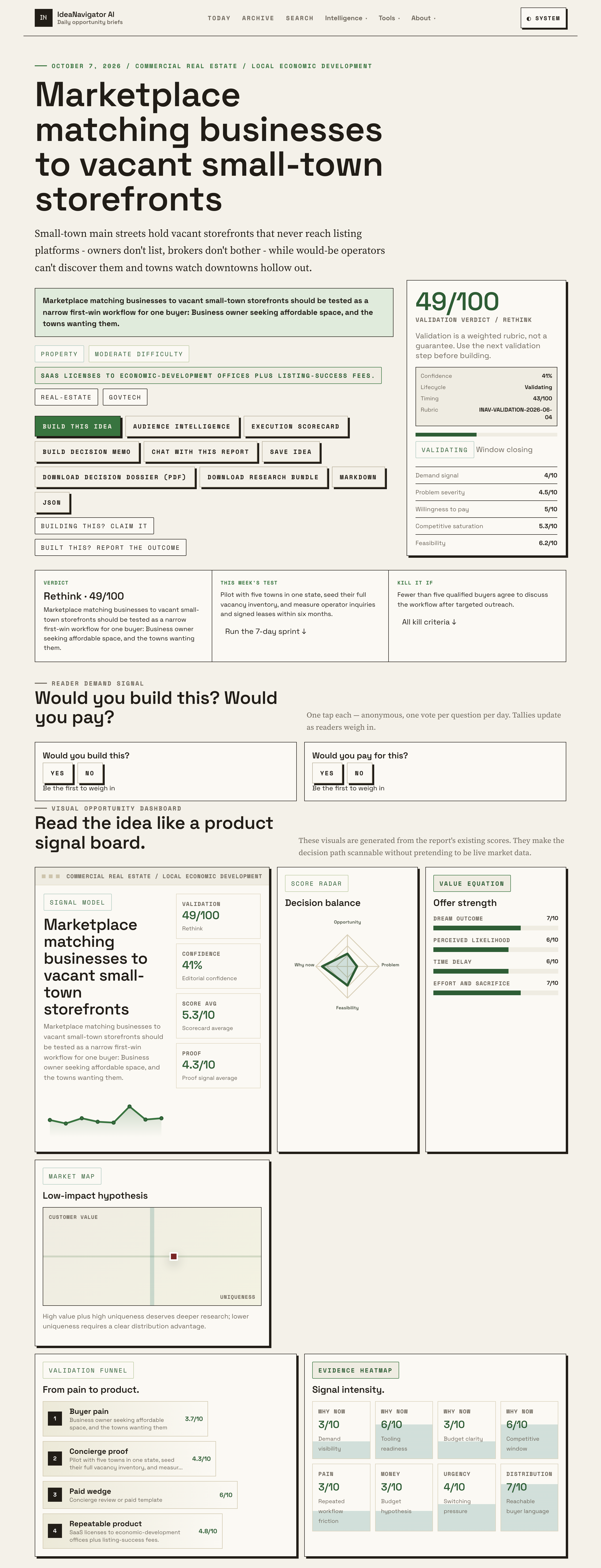
IdeaNavigator AI has outlined a proposed marketplace to connect business owners with vacant storefronts in small towns and route potential matches to local economic-development offices. The proposal calls for a five-town pilot, with inquiries and signed leases tracked over six months; no pilot launch or results are reported.
IdeaNavigator AI has proposed a marketplace to connect business owners seeking affordable space with towns seeking tenants for vacant small-town storefronts. In its proposal, the company suggests a first test in five towns in one state, measuring operator inquiries and signed leases over six months; the proposal does not say that a pilot has begun or identify participating towns.
According to IdeaNavigator AI’s proposal, the marketplace would let towns and property owners post storefront listings with photos, size, rent and available incentive programs. Prospective operators would browse by town profile and foot-traffic data, then send potential matches to the local economic-development office. The proposal calls for attaching relevant grants to those referrals, although it does not specify how eligibility would be checked or grants awarded.
IdeaNavigator AI frames the marketplace as a focused tool for two groups: business owners looking for affordable commercial space and towns trying to attract businesses. Its proposal argues that some vacancies are difficult to find because owners do not list them on commercial platforms and brokers may not pursue them. It provides no survey or inventory figures showing how many storefronts are affected.
For an initial test, IdeaNavigator AI recommends selecting five towns in one state, gathering each town’s full vacancy inventory and tracking operator inquiries and leases signed within six months. The proposal suggests revenue from software licenses sold to economic-development offices and fees tied to successful listings. It gives no pricing, operating budget, participating offices or lease targets.
A Test for Main Street Leasing
If the problem described in IdeaNavigator AI’s proposal is widespread, a shared inventory could make hard-to-find commercial space easier to discover for entrepreneurs who do not have a broker or existing local contacts. A referral to an economic-development office could also connect a prospective tenant with information about local grants or other incentives, rather than leaving the operator to identify each program independently.
For towns, the practical question is whether improved discovery leads to qualified inquiries and completed leases, not simply more listings or website visits. The six-month pilot proposed by IdeaNavigator AI could offer an early measure of interest, but signed leases may depend on factors the platform does not control, including rent, property condition, financing and the time required to negotiate.
IdeaNavigator AI also proposes a possible funding model for local development offices, which might pay recurring software fees while the operator charges for successful listings. Whether towns would buy such a service—and whether success fees can support the marketplace—remains untested. The proposal’s pilot would be more informative with transparent measures and participation from property owners, not just the number of towns enrolled.
commercial storefront listing software
As an affiliate, we earn on qualifying purchases.
As an affiliate, we earn on qualifying purchases.
How the Proposed Matching Works
IdeaNavigator AI presents the marketplace as an early-stage concept, rather than a report of a launched service or completed local-government program. Its proposal focuses on compiling vacant storefronts in small towns, making them searchable to business operators, and sending potential matches to local development staff.
IdeaNavigator AI cites remote-work migration as a reason small-town commercial interest may have returned and says economic-development offices have grant funding aimed at this kind of matching. The proposal supplies no dates, named programs or supporting data, so these points are the rationale it offers for testing the concept, not independently established findings.
The proposed listing fields—photos, size, rent and incentives—would give operators basic information to compare spaces. Town profiles and foot-traffic data are also part of the suggested browsing experience, but IdeaNavigator AI does not identify data providers, explain how traffic would be measured, or describe who would keep listings current.
As an affiliate, we earn on qualifying purchases.
Pilot Details Still Missing
IdeaNavigator AI reports no launch, town partners or pilot results. Its proposal does not name a state, participating municipalities, property owners, development offices or a start date. It also provides no evidence that towns have committed to listing their vacancies or that operators would use a dedicated marketplace.
Several operational and financial questions remain open: how listings would be verified and updated; what counts as a successful match; which grants could be attached and how eligibility would be determined; and what the software licenses or success fees would cost. The proposal does not define its six-month measurement method beyond tracking inquiries and signed leases, or provide a comparison baseline against existing leasing activity.
IdeaNavigator AI’s claims about unlisted storefronts, renewed interest and available grant money are not accompanied by statistics or named programs. Until a pilot supplies local data, the scale of the problem and the likelihood that the proposed service can turn listings into leases remain uncertain.
As an affiliate, we earn on qualifying purchases.
Evidence Needed From a Pilot
IdeaNavigator AI identifies recruiting five towns in one state and assembling a complete inventory of their vacant storefronts as the next steps. A meaningful test would also need to establish who is responsible for verifying rents, space details and incentive information, and how often those records will be refreshed.
Over the proposed six-month period, the pilot would track operator inquiries and signed leases. IdeaNavigator AI sets no numerical targets and gives no start date. Results would need to clarify whether inquiries came from qualified operators, whether referrals led to leases, and how those outcomes compare with each town’s usual leasing activity before towns or investors can judge the model’s usefulness.
IdeaNavigator AI has not announced a rollout beyond the suggested test. The immediate development remains a proposal; whether towns adopt it, secure funding and report results is still to be determined.
Source: IdeaNavigator AI proposal
As an affiliate, we earn on qualifying purchases.
Key Questions
Has the storefront marketplace launched?
No launch is reported. IdeaNavigator AI describes a proposed marketplace and recommends testing it with five towns; it does not name a live service or confirm that a pilot has started.
Who would use the proposed platform?
The concept is intended for business owners seeking affordable space and small towns or property owners with vacant storefronts. Local economic-development offices would receive referrals from potential matches.
What would storefront listings include?
IdeaNavigator AI’s proposal suggests photos, space size, rent and incentive programs. Operators would also browse using town profiles and foot-traffic data, though the proposal does not explain where that data would come from.
How would the proposed pilot be evaluated?
IdeaNavigator AI recommends a six-month test across five towns in one state, measuring operator inquiries and signed leases. The proposal does not specify targets, participating towns, a start date or a baseline for comparison.
How might the marketplace earn revenue?
IdeaNavigator AI suggests combining software licenses for economic-development offices with fees tied to successful listings. Pricing and whether towns would pay for the service have not been established.
Source: IdeaNavigator AI
Fall Picks
fall essentials
As an affiliate, we earn on qualifying purchases.