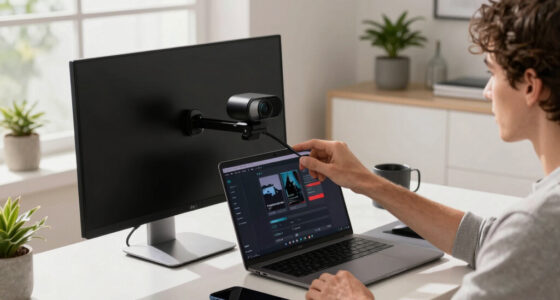

📊 Full opportunity report: Power Up Your AI Projects With These 9 Mobile Workstations In 2026 on ThorstenMeyerAI.com — validation score, market gap, and execution plan.

Get business pricing on tech for your team
- Business-only prices and quantity discounts
- Tax-exempt purchasing
- Multiple users, one account, clear invoices
TL;DR
In 2026, nine leading mobile workstations are highlighted for AI development, offering a range of high-performance options. These devices balance power and portability, catering to diverse professional needs, with some sacrificing portability for raw power.
Nine high-performance mobile workstations have been identified as ideal tools for AI professionals in 2026. These devices offer the power, portability, and reliability needed for demanding AI workloads, making them essential for developers, data scientists, and creative AI teams. The selection highlights models that balance processing capabilities with mobility, reflecting ongoing trends in AI hardware needs.
The list includes models such as the Lenovo ThinkPad P14s Gen 6 Copilot+ and Dell Precision 7780, among others, each tailored to different professional priorities. The Lenovo ThinkPad P14s Gen 6 is praised for its balanced specs and durable design, suitable for general AI development on the move. The Dell Precision 7780 offers exceptional raw power with high-end CPUs and large RAM options, ideal for intensive AI training and data processing but less portable. Other models focus on a mix of display quality, battery life, and build durability, catering to varied workflows.
Industry sources like Thorsten Meyer AI emphasize that choosing a mobile workstation depends on balancing CPU, GPU, RAM, display quality, and portability. These models are selected based on performance benchmarks, build quality, and value, ensuring professionals can find suitable options for their specific AI projects. The market continues to evolve, with hardware improvements driven by AI’s increasing computational demands.
The 9 picks
- 1
 Dell Precision 7780 Mobile Workstation 17.3" FHD Laptop with Intel Core i9-13…View on Amazon →
 - 2
 HP ZBook X G1i AI Laptop, 16" FHD+, Intel Ultra 7 265H, 64GB DDR5, 1TB SSD |…View on Amazon →
 - 3
 Lenovo ThinkPad P1 Gen 7 Mobile Workstation with NVIDIA RTX 3000 and 16-Inch…View on Amazon →
 - 4
 Dell Precision 7680 Mobile Workstation Laptop with NVIDIA RTX 2000 Ada 8GB, I…View on Amazon →
 - 5
 Dell Precision 7680 Laptop with NVIDIA RTX 2000 Ada 8GB, Intel i7-13850HX, 32…View on Amazon →
 - 6
 Lenovo ThinkPad P16s Gen 4 with OLED 4K Touchscreen, 32GB DDR5, AMD Ryzen 7 P…View on Amazon →
 - 7
 Lenovo ThinkPad P14s Gen 6 Mobile Workstation with AMD Ryzen AI 7 PRO 350, 32…View on Amazon →
 - 8
 Lenovo ThinkPad P14s Gen 6 Copilot+ Mobile Workstation 14.0" IPS WUXGA, AMD R…View on Amazon →
 - 9
 HP ZBook Firefly 14 G8 14" FHD Mobile Workstation Laptop, 11th Gen Quad-Core…View on Amazon →
Impact of High-Performance Workstations on AI Development
These mobile workstations are critical for AI professionals who require powerful hardware on the go. By enabling complex model training, data analysis, and creative AI tasks outside traditional labs, they facilitate greater flexibility and productivity. As AI workloads grow more demanding, having access to portable yet high-capacity hardware ensures that innovation can continue without being limited by hardware constraints. This shift also influences hardware manufacturers to prioritize mobility alongside raw processing power, shaping the future of AI development tools.
2026 Hardware Trends for AI Professionals
Over the past few years, the demand for portable AI hardware has increased significantly. Early models prioritized portability but lacked sufficient processing power for advanced AI tasks. Recent developments, including models like the Lenovo ThinkPad P14s Gen 6 and Dell Precision 7780, reflect a trend toward integrating high-end CPUs, GPUs, and large RAM capacities into portable form factors. Industry experts note that hardware advancements are driven by the need for real-time data processing, edge computing, and flexible remote work environments for AI teams.
Historically, the market has seen a gradual shift from bulky workstations to lightweight, high-performance laptops capable of handling intensive workloads. This evolution aligns with the broader AI industry trend of decentralizing compute resources, making portable solutions more viable for professional AI development.
“The ThinkPad P14s Gen 6 Copilot+ is designed for durability and performance, making it ideal for AI developers on the move.”
— Lenovo spokesperson
Remaining Questions About 2026 Mobile Workstations
While these models are highly regarded, specific details about long-term durability, real-world battery performance under AI workloads, and future firmware updates remain unclear. Additionally, the actual performance of these devices in extreme AI training scenarios has yet to be independently verified through extensive testing. The rapidly evolving hardware landscape means newer models may soon surpass current options, and compatibility with upcoming AI frameworks is still uncertain.
Upcoming Developments in AI-Optimized Mobile Hardware
Manufacturers are expected to release updated models later in 2026, featuring even more powerful CPUs, GPUs, and energy-efficient designs. AI software developers are also working to optimize frameworks for these hardware platforms, ensuring better integration and performance. Industry analysts predict that future devices will further blur the line between portability and raw processing power, possibly incorporating integrated AI accelerators. Users should anticipate new releases that address current limitations and enhance AI development capabilities on the go.
Key Questions
What are the most important features to consider in a mobile workstation for AI projects?
Key features include a high-end CPU (such as Intel i9 or AMD Ryzen PRO), professional-grade GPU (like NVIDIA RTX series), ample RAM (at least 32GB, with 64GB or more preferred for large datasets), a high-quality display for visual work, and a durable, lightweight design for portability.
Are these mobile workstations suitable for deep learning and large-scale AI training?
Yes, models like the Dell Precision 7780 with high-end CPUs and GPUs are suitable for intensive AI training. However, their portability may be limited, and longer training runs might require external power sources or dedicated servers for large-scale tasks.
How do I balance performance and portability when choosing a mobile workstation?
Prioritize your primary use case. If mobility is essential, opt for lighter models with slightly lower specs. For demanding AI workloads that require maximum processing power, a heavier, more powerful device may be necessary, accepting reduced portability.
Will future hardware updates improve AI performance on mobile workstations?
Yes, upcoming hardware releases are expected to include more powerful processors, GPUs, and AI accelerators, which will enhance AI performance and efficiency on portable devices.
What is the typical price range for these high-performance mobile workstations?
Prices vary widely based on configuration, from around $2,000 for mid-range models to over $5,000 for top-tier configurations with the latest hardware.
Source: ThorstenMeyerAI.com
Halloween Picks
halloween
As an affiliate, we earn on qualifying purchases.